
Makassar, Indonesia, August 21, 2026/NUTRIFEED/— In rural communities, crops and livestock are closely connected. Yet in practice, they are often managed as separate sectors. Crop residues may be discarded or underused, while livestock farmers depend on external feed and fertilizer. This separation can increase costs and waste resources.
What if agricultural “waste” could become the starting point for a sustainable rural economy?
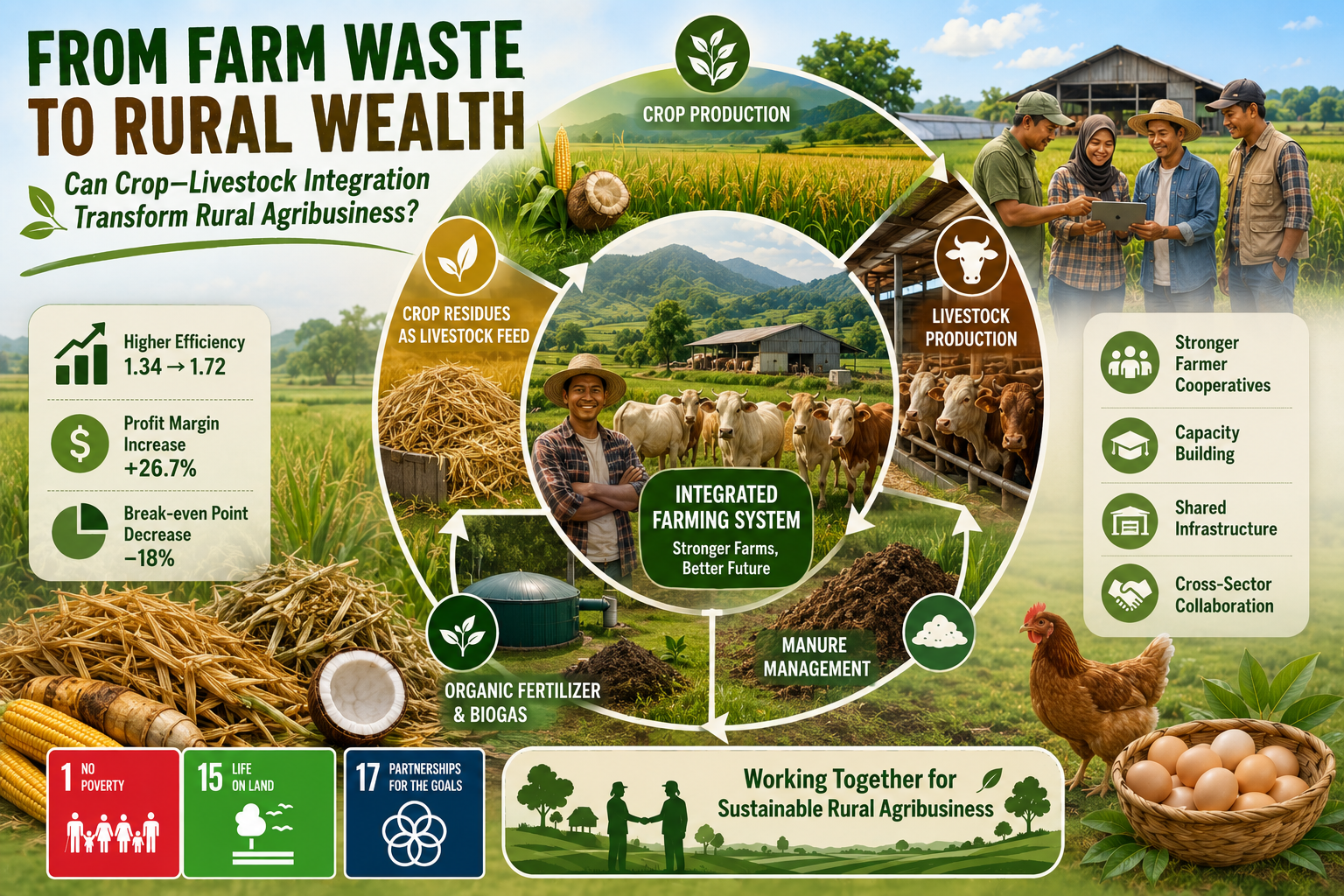
In a circular farming system, materials treated as waste can remain useful. Rice straw, corn residues, and coconut by-products can be used as livestock feed, while cattle manure can return to agricultural land as organic fertilizer or be processed into compost and biogas.
This idea is explored in “Planning Model of Integrated Livestock Area Based on Crop-Livestock Integration for Sustainable Rural Agribusiness Development in North Bolaang Mongondow District.” Published in the Indonesian Journal of Animal Science by the Faculty of Animal Science, Universitas Brawijaya, on August 31, 2026, the study developed a regional planning model for sustainable rural agribusiness.
The research focused on North Bolaang Mongondow, a region with substantial agricultural and livestock resources. The study estimated 41,000 tonnes of crop residues per year from rice, corn, and coconut, together with 10,800 tonnes of beef cattle manure per year. Rather than treating these materials as separate waste streams, the model links them within a farming system.
The researchers also showed that integration can provide economic benefits. The farming efficiency ratio increased from 1.34 to 1.72, profit margins increased by 26.7%, and the break-even point decreased by 18%. These findings suggest that crop–livestock integration can improve farming systems.
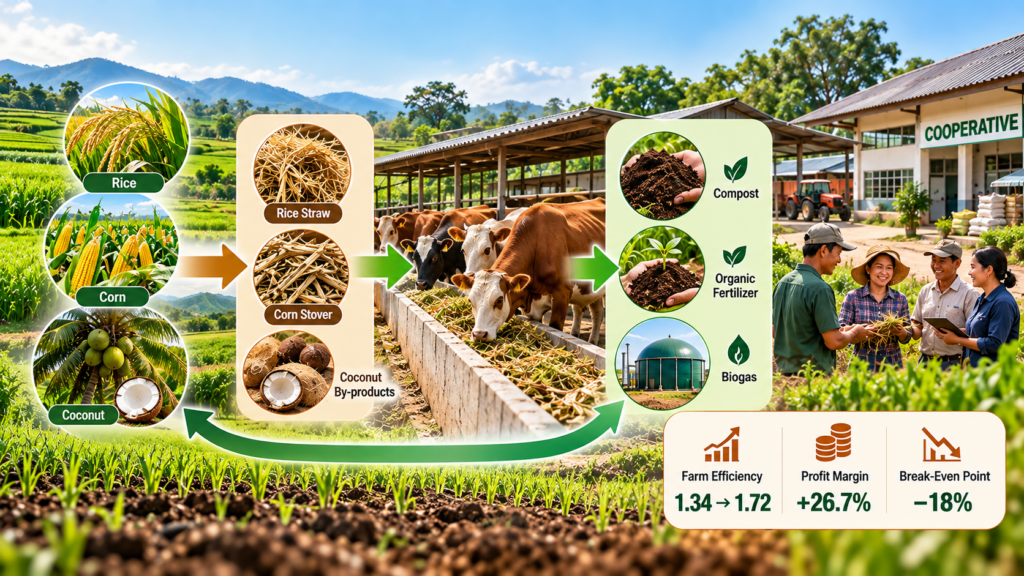
It divides the region into zones for crop production, livestock development, processing, and waste management. The model also emphasizes farmer cooperatives, capacity building, shared infrastructure, and coordination.
For rural communities, integration should not be seen simply as feeding crop residues to animals or using manure as fertilizer. Its success depends on planning, knowledge, infrastructure, and strong institutions. Farmers need training, while governments, universities, cooperatives, and agricultural stakeholders need to work together.
This research supports SDG 1: No Poverty by creating opportunities to improve farming efficiency, reduce dependence on external inputs, and strengthen rural incomes. It also supports SDG 15: Life on Land through the responsible use of biomass and organic resources. In addition, it connects with SDG 17: Partnerships for the Goals, because sustainable rural agribusiness requires cooperation among farmers, government, researchers, universities, and local institutions.
The message is simple: rural resources become valuable when they are connected. By turning crop residues into useful inputs and linking livestock, crops, institutions, and local planning, rural communities can move toward a more productive, resilient, and sustainable future.
References
DOI: https://doi.org/10.21776/ub.jiip.2025.035.02.15
Contact:
Prof. Sri Purwanti
+62 811-4103-775
sripurwanti@unhas.ac.id