
Makassar, Indonesia, August 22, 2026/NUTRIFEED/— For poultry farmers and feed producers, safe and reliable feed begins with good-quality ingredients. Maize is one of the most important ingredients in poultry feed because it provides a major source of dietary energy. However, behind its familiar yellow kernels lies a potential concern: aflatoxin contamination.
Could the physical condition of maize provide early clues about this hidden feed-safety risk?
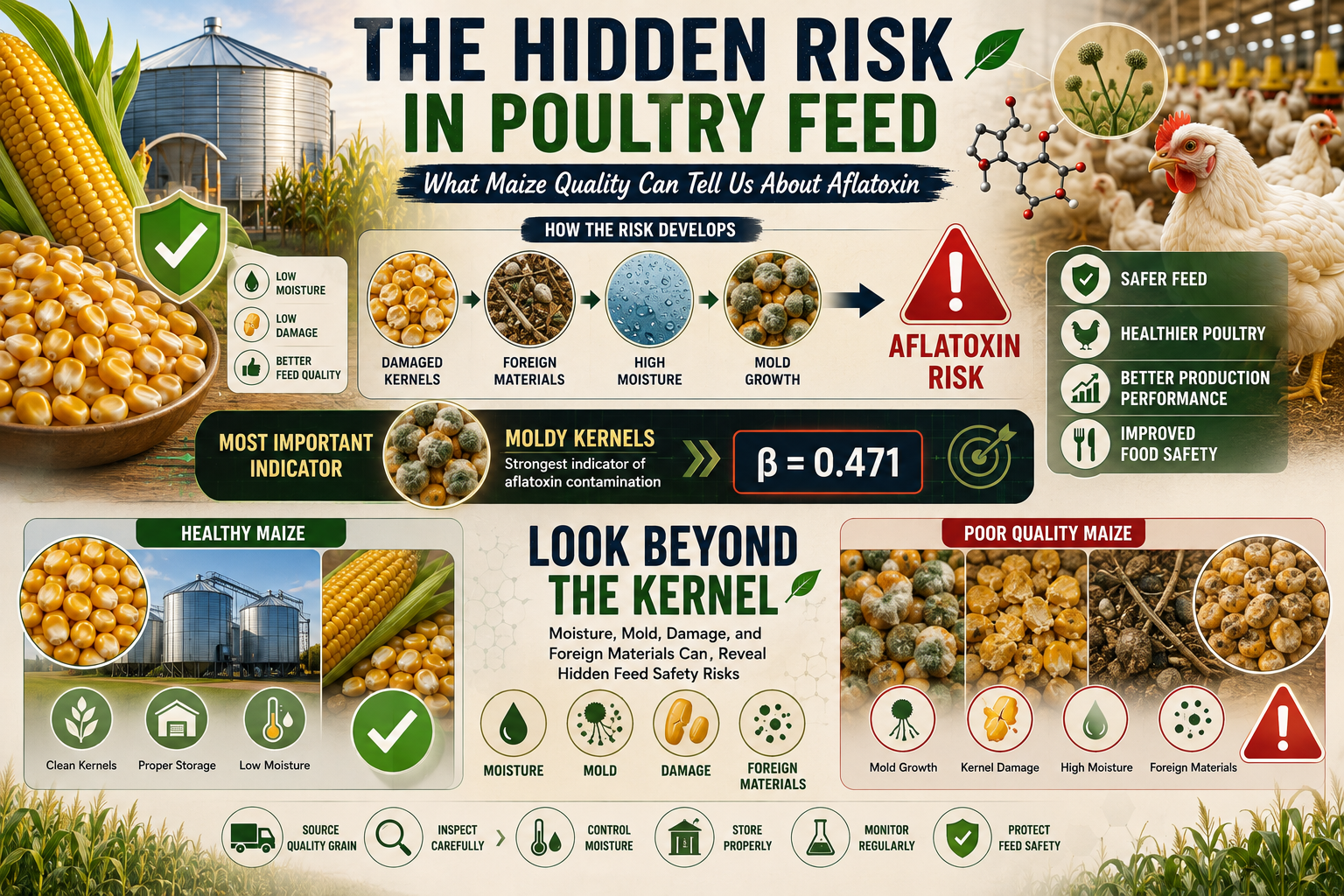
Maize quality can vary considerably between batches. Kernels may be broken, damaged, moldy, or mixed with foreign materials such as dust, soil, and plant residues. Moisture levels and storage conditions can also influence grain quality. These characteristics may seem like simple quality indicators, but they can reveal conditions that support fungal growth and aflatoxin development.
This issue is examined in the article “Relationships between Physical Characteristics and Aflatoxin Contamination in Maize as a Poultry Feed Ingredient.” Published in the International Journal of Veterinary Science by Unique Scientific Publishers on June 11, 2026, the study analyzed 300 composite maize samples collected from incoming feed mill lots. Researchers evaluated moisture content, foreign materials, damaged kernels, broken kernels, moldy kernels, batch temperature, and estimated aflatoxin concentration using Near Infrared Spectroscopy (NIRS).
The findings revealed that aflatoxin contamination is connected to several physical characteristics rather than one factor alone. Moldy kernels showed the strongest positive direct association with aflatoxin contamination, with a standardized coefficient of β = 0.471 (P < 0.001). This indicates that higher levels of moldy kernels were strongly associated with higher aflatoxin levels. Foreign materials also played a role. They were positively associated with moisture content and moldy kernels. In the statistical model, foreign materials were associated with moisture at β = 0.385 and with moldy kernels at β = 0.187. These findings suggest that visible contamination may reflect broader conditions affecting maize quality.
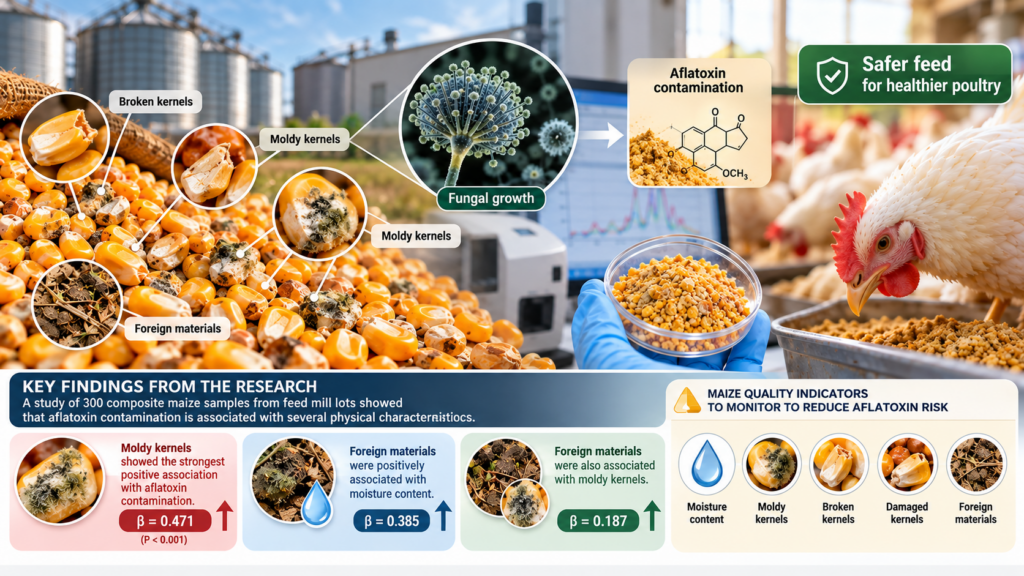
For farmers and feed producers, moldy kernels should not be treated as merely a visual quality problem. They may indicate fungal development and potential aflatoxin risk. Broken and damaged kernels can expose the inner grain, creating conditions that favor fungal colonization during storage. Nevertheless, the researchers emphasize careful interpretation. The study was observational, and moisture was measured when maize arrived at the feed mill. Therefore, the relationships identified should not automatically be interpreted as direct cause-and-effect relationships. Instead, they highlight the importance of monitoring several quality indicators together.
This research supports SDG 3: Good Health and Well-Being, because safer feed contributes to healthier poultry and food safety. It also supports SDG 4: Quality Education by transforming scientific evidence into practical knowledge for farmers, producers, students, and communities. In addition, it connects with SDG 17: Partnerships for the Goals, emphasizing cooperation among researchers, universities, laboratories, farmers, and the feed industry.
The message is simple: a maize kernel can reveal more than its appearance. By monitoring moisture, mold, damage, and foreign materials, the feed industry can take an important step toward safer and more reliable poultry feed.
References
DOI:https://doi.org/10.47278/journal.ijvs/2026.093
Contact:
Prof. Sri Purwanti
+62 811-4103-775
sripurwanti@unhas.ac.id