
Makassar, Indonesia, August 21, 2026/NUTRIFEED/— For poultry farmers and feed producers, sustainable poultry farming begins with safe, effective, and responsibly sourced feed. In South Sulawesi, Indonesia, plant-based feed additives known as phytobiotics are attracting growing attention. These ingredients include herbs, spices, essential oils, and other botanical compounds that may support poultry health and productivity.
Phytobiotics have become especially relevant since Indonesia officially banned antibiotic growth promoters (AGPs) in livestock feed in 2018. The policy was important for public health because excessive or inappropriate antibiotic use can contribute to antimicrobial resistance, making infections more difficult to treat. Plant-based alternatives may help poultry producers maintain performance while reducing dependence on conventional antibiotics.
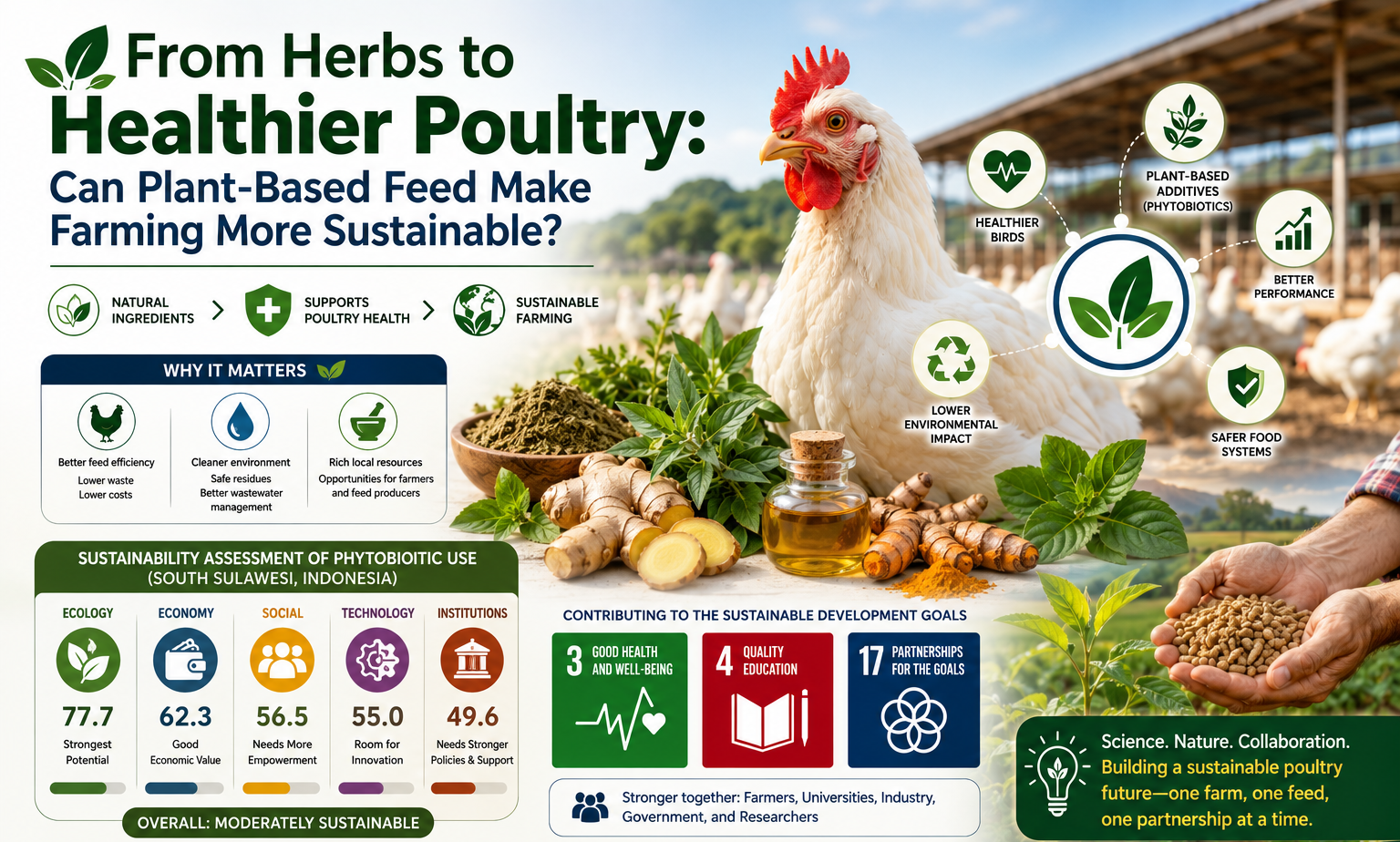
This issue is examined in the article “Sustainability Assessment Of Phytobiotic Feed Additives In Poultry Farming: A Case From South Sulawesi, Indonesia.” The article was published in Mesopotamia Journal of Agriculture by the College of Agriculture and Forestry, University of Mosul, on December 31, 2025. Rather than focusing only on chicken growth, the researchers assessed phytobiotic use through five sustainability dimensions: ecology, economy, social factors, technology, and institutions.
The findings offer both encouragement and a warning. Overall, phytobiotic use in poultry farming was classified as “moderately sustainable.” The ecological dimension received the strongest score, 77.7, indicating considerable environmental potential. The economic dimension followed with a score of 62.3, while the social and technological dimensions scored 56.5 and 55.0, respectively. The institutional dimension was the weakest, with a score of 49.6.
Why do these results matter?
Better feed conversion can help chickens use feed more efficiently, potentially reducing waste and production costs. The study also identified wastewater quality, residue safety, and the availability of local raw materials as important factors. In a country rich in medicinal and aromatic plants, locally sourced phytobiotics could create new opportunities for farmers and feed producers while supporting more responsible poultry production.
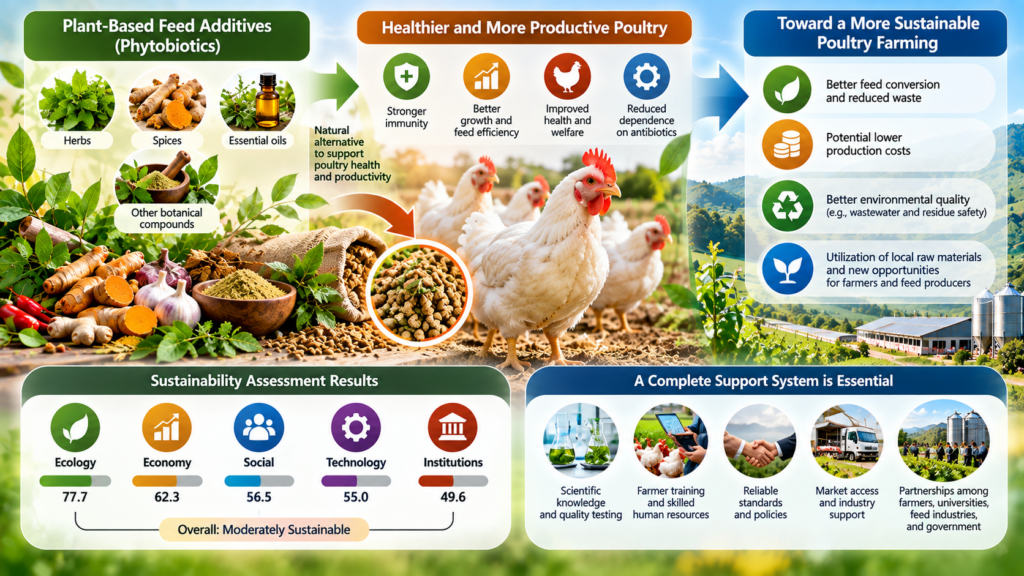
This research supports SDG 3: Good Health and Well-Being because reducing reliance on antibiotic growth promoters can contribute to responsible antimicrobial use and safer food systems. It also supports SDG 4: Quality Education, as farmer training and skilled workers are essential for applying phytobiotics correctly. In addition, it connects with SDG 17: Partnerships for the Goals, emphasizing cooperation among farmers, universities, feed industries, government agencies, and researchers.
The message is simple: replacing antibiotics with plant-based additives is not a magic solution. Phytobiotics work best when supported by scientific knowledge, quality testing, reliable standards, market access, and strong policies. South Sulawesi may already possess a promising ecological foundation, but its future success depends on strengthening human and institutional capacity.
A sustainable poultry future will not come from one ingredient alone. It will come from people working together to transform scientific evidence into practical action—one farm, one feed formulation, and one partnership at a time.
References
DOI: https://doi.org/10.33899/mja.2025.162191.1643
Contact:
Prof. Sri Purwanti
+62 811-4103-775
sripurwanti@unhas.ac.id