
Makassar, Indonesia, August 21, 2026/NUTRIFEED/— What if producing better chicken feed did not always require adding more expensive ingredients? Sometimes, the answer may lie in something as simple as the way corn is ground.
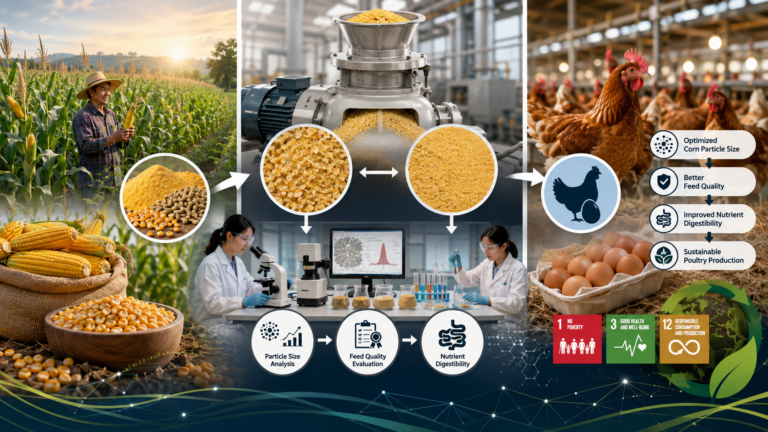
Corn is one of the most important ingredients in poultry feed. In Indonesia, it commonly makes up 40–55% of a poultry diet and provides a major share of the energy needed for growth and production. But before corn becomes part of a complete feed, it must be processed—and one small decision can make a big difference: how fine should the corn be ground?
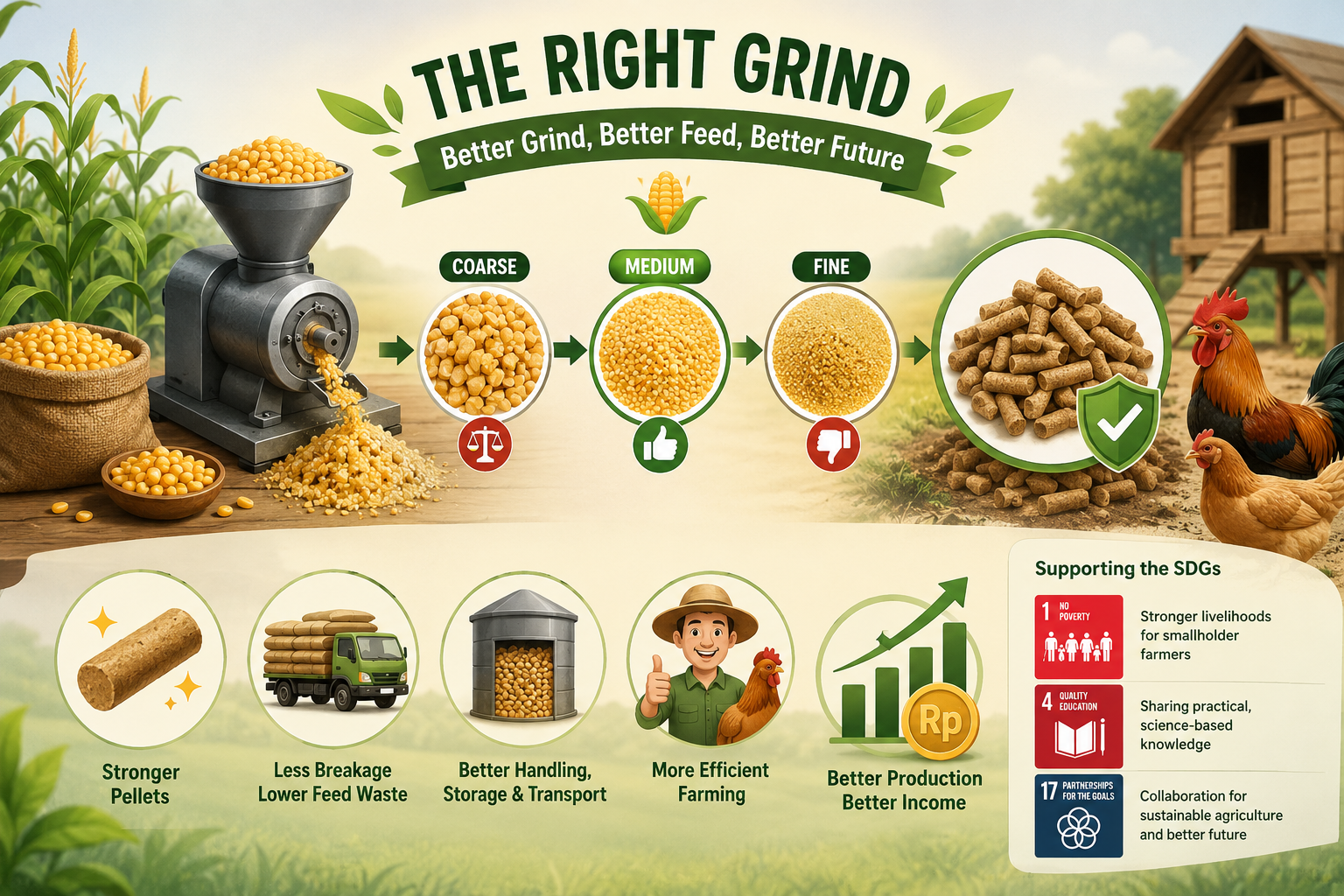
This question was explored in the article “Optimization of Ground Corn Particle Size in the Diet to Improve Physical Pellet Quality in Native Chicken Feed Production,” published in the International Journal of Agriculture and Biosciences by Unique Scientific Publishers on October 10, 2025. The study compared three corn particle sizes: coarse, medium, and fine, to determine which one could produce the best physical quality of feed pellets for native chickens.
The results offer an important lesson: finer is not always better.
When corn was ground into very fine particles, the resulting mash feed became less efficient to handle. Fine particles had poorer flowability and lower bulk density, meaning the feed could be more difficult to transport, store, and manage. However, when the feed was processed into pellets, the story became even more interesting.
Medium-sized corn particles—between approximately 500 and 1,000 micrometers—produced the most balanced pellet quality. These pellets achieved the highest Pellet Durability Index (97.45%), meaning they were strong enough to resist breaking during handling and transportation. They also produced a low percentage of fines, or broken pellet particles.
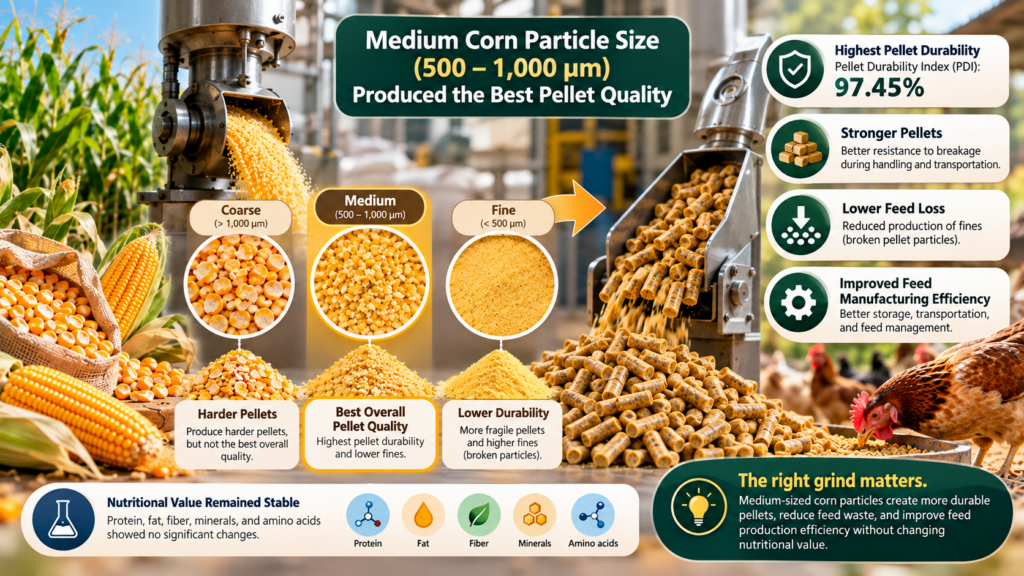
Coarse particles created harder pellets, while excessively fine particles produced more fragile pellets and a lower durability score. Importantly, changing the corn particle size did not significantly alter the nutritional composition of the feed. Protein, fat, fiber, minerals, and key amino acids remained relatively stable. This means that the main advantage of selecting the right particle size is improving the physical quality and efficiency of feed production.
The findings show that feed technology can play a practical role in supporting more efficient poultry farming. Stronger pellets can reduce feed waste, improve storage and transportation, and help farmers use their feed more effectively. For native chicken farmers, these improvements may contribute to better production management and potentially lower avoidable losses.
This research is closely connected with SDG 1: No Poverty, because improving production efficiency can help strengthen the economic resilience of smallholder farmers. It also supports SDG 4: Quality Education by providing practical, science-based knowledge that can be shared with farmers, feed producers, students, and agricultural communities. In addition, the study contributes to SDG 17: Partnerships for the Goals, as collaboration among researchers, universities, feed industries, and farming communities is essential for turning scientific findings into real-world benefits.
The message is simple but powerful: in animal feed production, the smallest details can have a major impact. By choosing the right corn particle size, feed producers can create stronger, more durable pellets without sacrificing nutritional value. Sometimes, better farming begins with getting the grind just right.
References
DOI: https://doi.org/10.47278/journal.ijab/2025.166
Contact:
Prof. Sri Purwanti
+62 811-4103-775
sripurwanti@unhas.ac.id