
Makassar, Indonesia, August 22, 2026/NUTRIFEED/— For poultry farmers and feed producers, producing good-quality animal feed involves more than choosing nutritious ingredients. The physical condition of feed ingredients can also influence processing efficiency, feed consistency, and production performance. Corn is particularly important because it can contribute more than 60–70% of the metabolizable energy in poultry feed formulations. But one factor is often easy to overlook: moisture content.
Could the amount of water inside a corn kernel determine how well it performs during feed processing?
Shelled corn may look similar from the outside, but kernels with different moisture levels can behave differently during storage, grinding, and handling. High moisture may influence physical quality, while differences in moisture can also affect milling performance, particle size, and how easily ground corn flows through processing equipment.
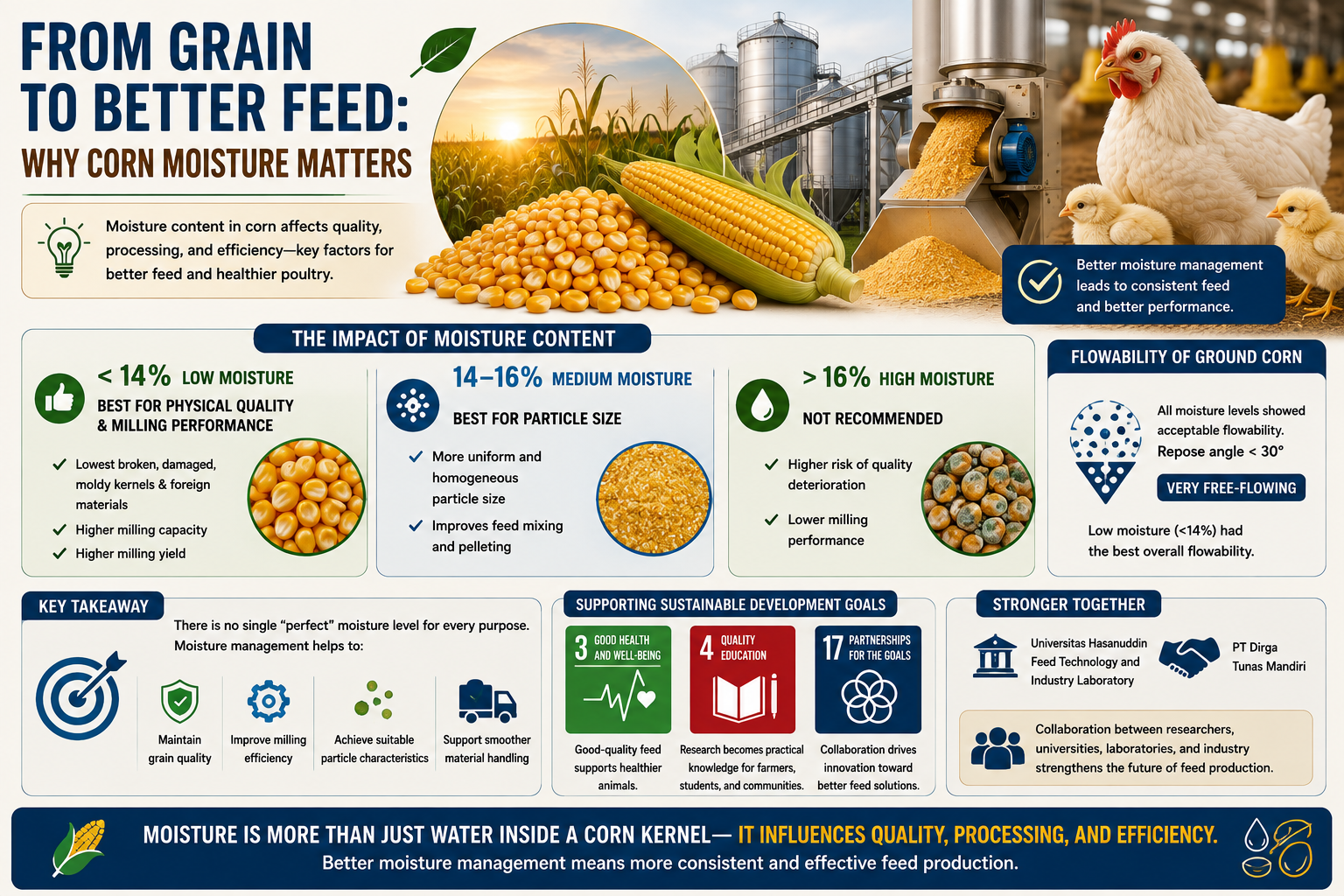
This issue was investigated in the article “Evaluation of Physical Quality, Milling Performance, Particle Size Characteristics, and Flowability of Shelled Corn at Different Moisture Contents as an Animal Feed Ingredient.” The article was published in the International Journal of Agriculture and Biosciences by Unique Scientific Publishers on May 4, 2026. Researchers compared three moisture conditions: low moisture below 14%, medium moisture between 14–16%, and high moisture above 16%. They evaluated physical quality, milling performance, particle size characteristics, and flowability.
The findings revealed an important pattern: moisture content affects different aspects of corn quality in different ways. For physical quality and milling performance, corn with less than 14% moisture performed best. This condition produced the lowest levels of broken, damaged, and moldy kernels, as well as foreign materials. It also provided better milling capacity and milling yield. However, the result was different when researchers looked at particle size. Corn with 14–16% moisture produced more uniform and homogeneous particle sizes after milling. This matters because particle size can influence feed mixing and subsequent processing, including pelleting.
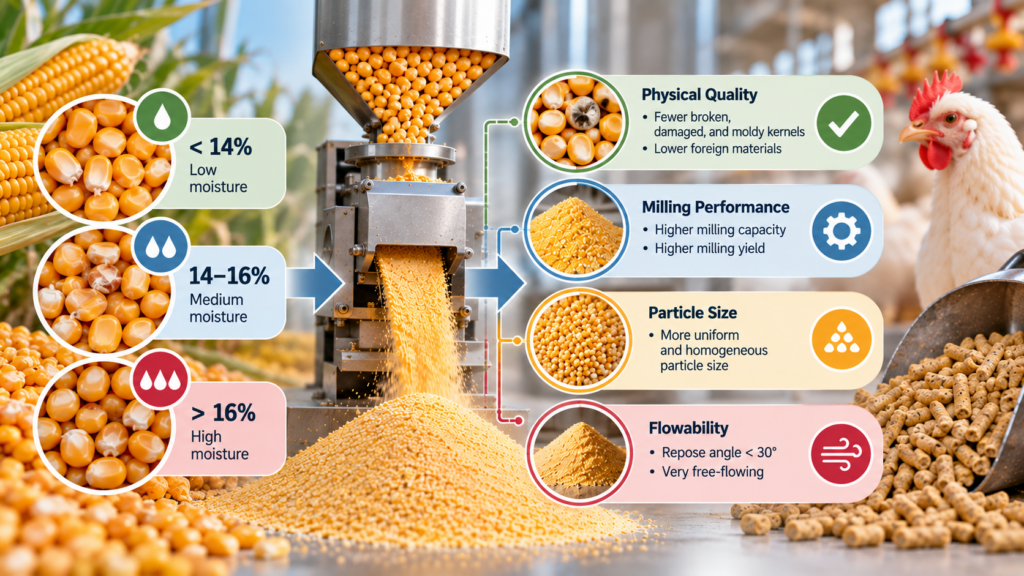
What about the ability of ground corn to flow? The study found that all moisture treatments remained within acceptable flowability ranges. The measured repose angles were below 30°, placing the ground corn in the “very free-flowing” category. Nevertheless, the low-moisture treatment showed the best overall flowability characteristics. These findings should not be viewed as simply identifying one “perfect” moisture level for every purpose. Instead, they show that moisture management is an important part of feed processing. Choosing an appropriate moisture condition can help maintain grain quality, improve milling efficiency, achieve suitable particle characteristics, and support smoother material handling.
This research supports SDG 3: Good Health and Well-Being, because good-quality feed contributes to healthier food-producing animals. It also supports SDG 4: Quality Education by transforming technical research into practical knowledge that can benefit farmers, feed producers, students, and communities. Furthermore, it connects with SDG 17: Partnerships for the Goals, highlighting the importance of cooperation among researchers, universities, laboratories, and industry partners. The study involved support from the Feed Technology and Industry Laboratory at Universitas Hasanuddin and collaboration with PT Dirga Tunas Mandiri.
For animal feed production, the message is clear: moisture is more than just water inside a corn kernel—it can influence quality, processing, and efficiency. Better moisture management could therefore be an important step toward more consistent and effective feed production.
References
DOI: https://doi.org/10.47278/journal.ijab/2026.115
Contact:
Prof. Sri Purwanti
+62 811-4103-775
sripurwanti@unhas.ac.id