
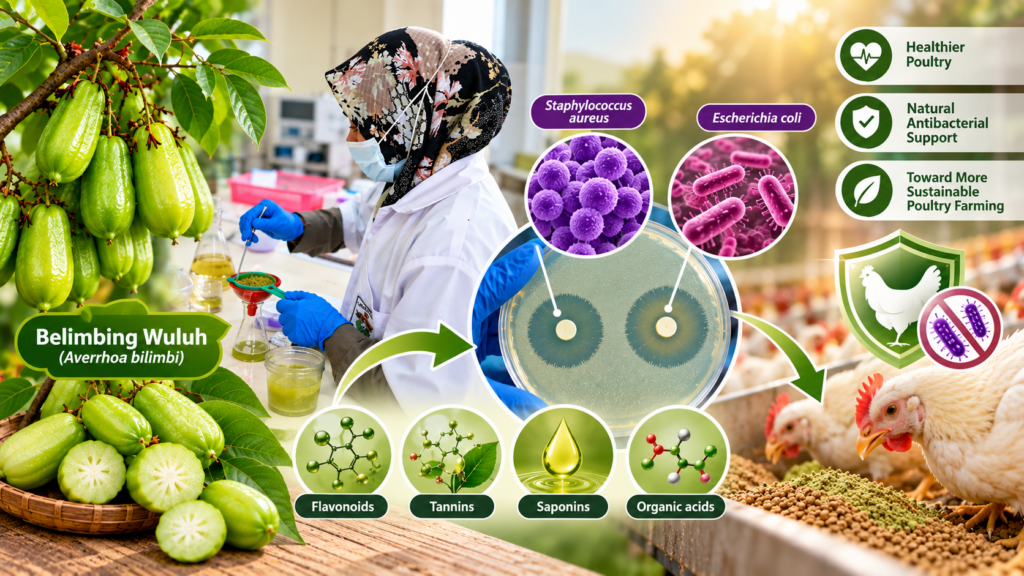
Makassar, Indonesia, August 22, 2026/NUTRIFEED/—What if a small, sour fruit commonly found in Indonesian households could help poultry farmers manage harmful bacteria? Belimbing wuluh (Averrhoa bilimbi), also known as bilimbi or starfruit, may have a bigger role in poultry farming than simply adding a sour taste to food. Recent research shows that its juice has promising antibacterial activity and could potentially be developed as a natural feed additive.
Bacterial infections are an important challenge in poultry production. Two bacteria of concern are Staphylococcus aureus and Escherichia coli. They can cause infections and contribute to health problems in poultry. Meanwhile, excessive or inappropriate antibiotic use can contribute to antimicrobial resistance, creating a growing challenge for animal and public health. This situation encourages researchers to explore natural alternatives from locally available plants.
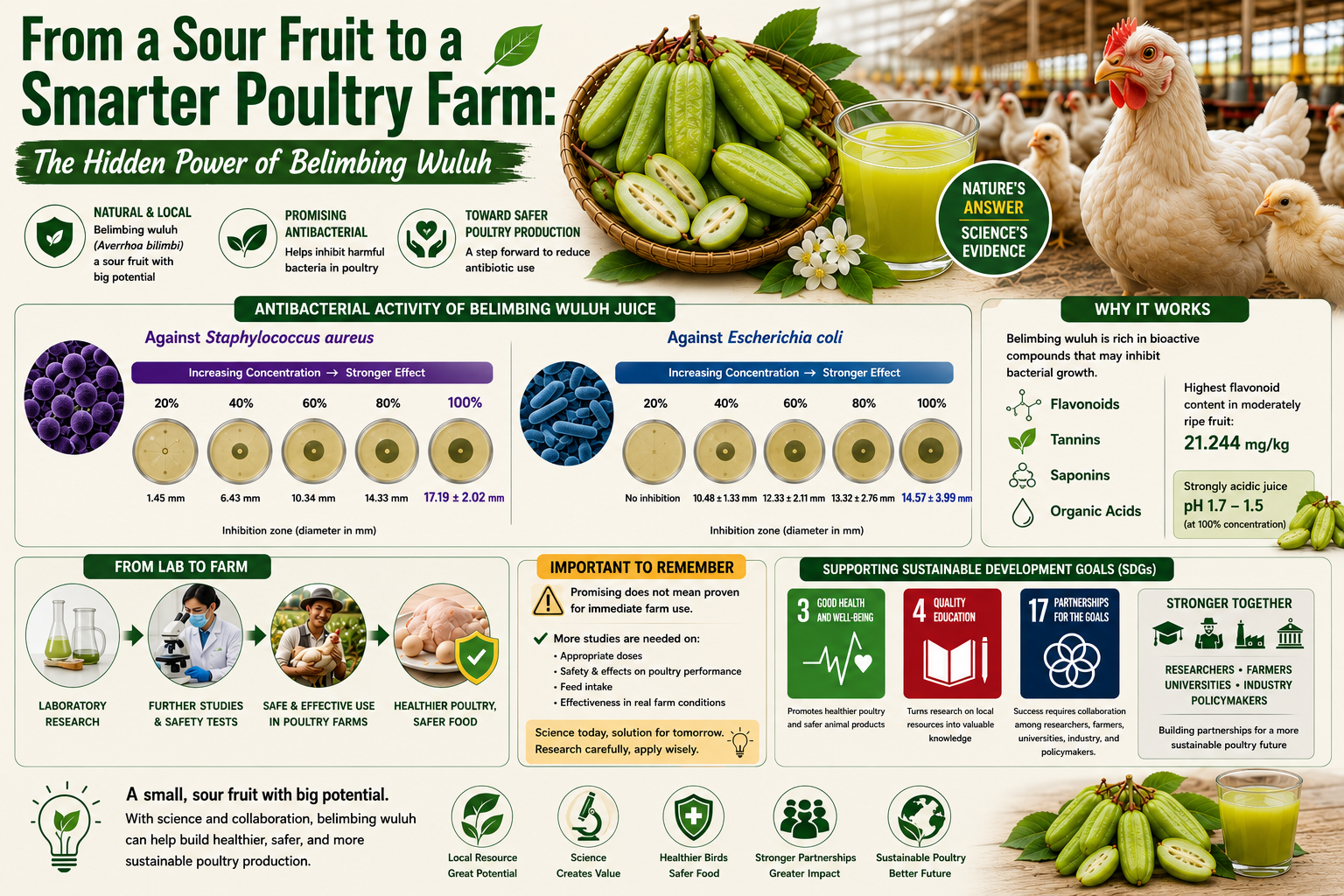
The study behind this story tested belimbing wuluh juice at concentrations of 20%, 40%, 60%, 80%, and 100%. The results revealed a simple but important pattern: higher concentrations generally produced stronger antibacterial activity. Against Staphylococcus aureus, the inhibition zone increased from 1.45 mm at 20% to 17.19 ± 2.02 mm at 100%. Against Escherichia coli, antibacterial activity was not detected at 20%, but appeared at 40% with an inhibition zone of 10.48 ± 1.33 mm and reached 14.57 ± 3.99 mm at 100%. These findings indicate that concentrated belimbing wuluh juice has potential to inhibit both bacteria under laboratory conditions.
Why might this fruit work?
Belimbing wuluh contains several bioactive compounds, including flavonoids, tannins, saponins, and organic acids. The study found the highest flavonoid content in moderately ripe fruit, reaching 21.244 mg/kg. The juice was also strongly acidic. Its pH ranged from approximately 1.7 at lower concentrations to 1.5 at 100% concentration. Such acidity, together with bioactive compounds, may create conditions that interfere with bacterial growth. However, there is an important message for the public: promising does not mean proven for immediate farm use. The research was conducted under controlled laboratory conditions. More studies are needed to determine appropriate doses, safety, effects on poultry performance, feed intake, and effectiveness in real farming environments.
This research supports SDG 3: Good Health and Well-Being by encouraging safer approaches to controlling harmful bacteria. It also supports SDG 4: Quality Education, because research on local resources can become valuable knowledge for students, farmers, and communities. Finally, it connects with SDG 17: Partnerships for the Goals, as transforming a laboratory finding into a practical feed additive requires collaboration among researchers, universities, farmers, industry, and policymakers.
These findings are reported in “The Use of Starfruit (Averrhoa bilimbi) Juice as an Alternative Feed Additive Based on Its Antibacterial Activity Against Staphylococcus aureus and Escherichia coli,” published in the Halu Oleo Animal Husbandry Scientific Journal by the Department of Animal Science, Faculty of Animal Science, Universitas Halu Oleo, on January 30, 2026. A familiar local fruit may therefore offer an exciting scientific possibility: turning biodiversity into knowledge, and knowledge into more sustainable poultry production.
References
DOI: https://doi.org/10.56625/jipho.v8i1.484
Contact:
Prof. Sri Purwanti
+62 811-4103-775
sripurwanti@unhas.ac.id