Makassar, Indonesia August 22 2026/NUTRIFEED/-For many smallholder poultry farmers, maintaining flock health while producing safe and affordable food is a constant challenge. Farmers must manage rising feed costs, disease risks, limited access to modern technology, and changing consumer expectations. One promising approach is the use of phytobiotics—natural, plant-based substances added to animal feed to support poultry health and production.
What if healthier poultry could begin with something as simple as a plant?
Phytobiotics can be derived from herbs, spices, leaves, roots, and other plants containing beneficial natural compounds. They have attracted growing interest because they may help support animal health and contribute to safer poultry production. However, transforming scientific potential into a practical farming solution is not always straightforward.
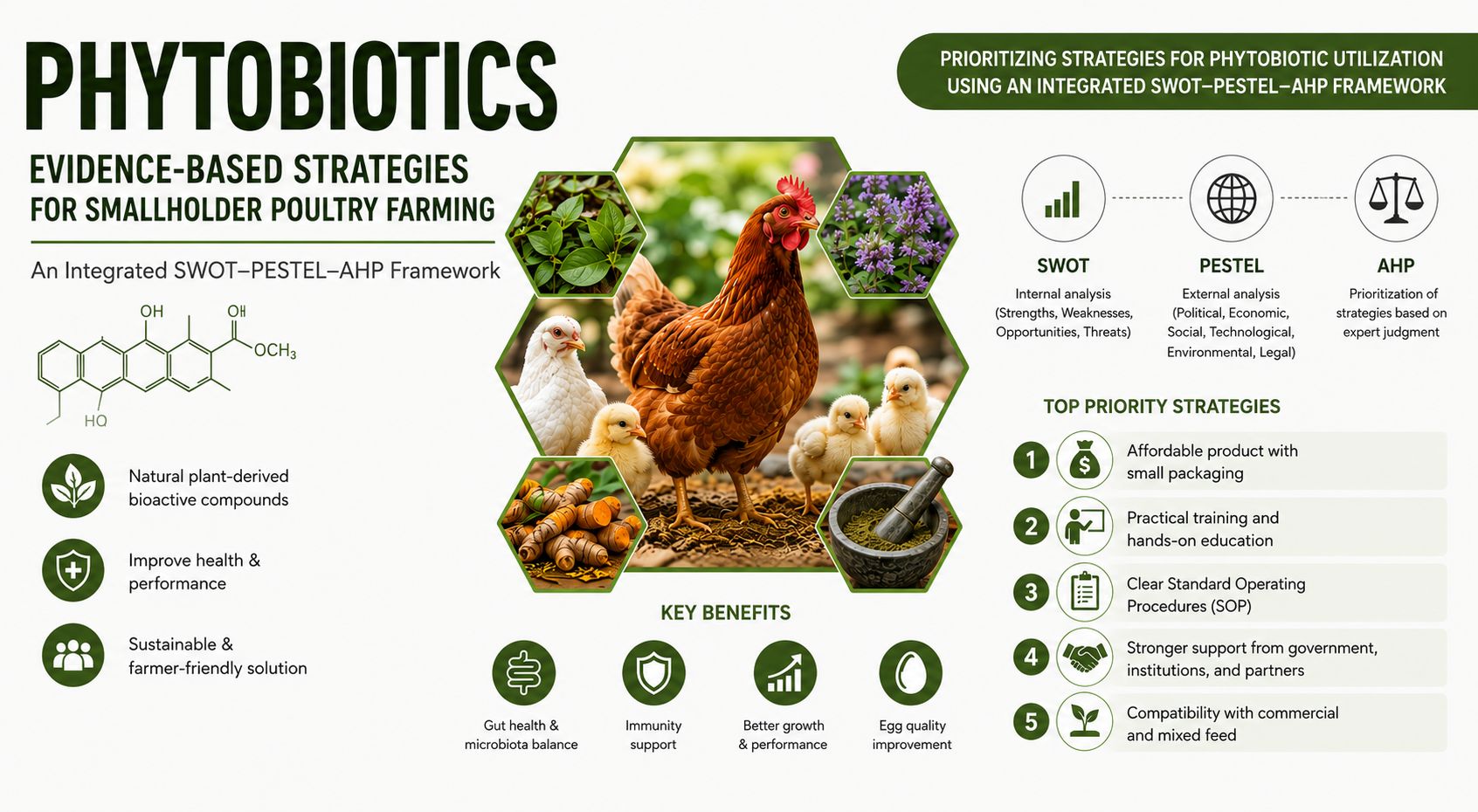
This issue is examined in the article “Prioritizing Strategies for Phytobiotic Utilization in Smallholder Poultry Farming Using an Integrated SWOT–PESTEL–AHP Framework,” published in Agrobiological Records by Unique Scientific Publishers on July 29, 2026. The study investigated how phytobiotics could be introduced and adopted more effectively by smallholder poultry farmers.
The research involved poultry farmers, stakeholders, and experts. Instead of focusing solely on the potential benefits of phytobiotics, the researchers also examined the practical challenges faced by farmers. Economic conditions emerged as the most important consideration, followed by social and technological factors. In simple terms, even the most promising innovation may fail if farmers cannot afford it, do not understand how to use it, or cannot access it easily.
The study identified five key strategies. First, phytobiotic products should be offered in small, affordable packages. Second, farmers need practical, hands-on training rather than information alone. Third, clear standard operating procedures are necessary to guide proper use. Fourth, stronger support from governments, institutions, and development partners can improve education and mentoring. Finally, locally developed phytobiotic products should be compatible with the commercial and mixed feeds already used by farmers.
These findings demonstrate that innovation is not simply about creating a new product. It is also about making that product practical, affordable, understandable, and accessible. The topic is closely connected to SDG 3: Good Health and Well-Being. Healthier poultry can contribute to the production of safer and higher-quality animal-source foods. At the same time, improving farmers’ knowledge of responsible feed additives can encourage more informed decisions throughout the food production chain.
For smallholder farmers, phytobiotics represent more than a scientific trend. They offer an opportunity to combine local natural resources, scientific knowledge, and practical farming experience. With appropriate training, affordable products, technical guidance, and strong partnerships, plant-based feed innovations could help create a healthier and more sustainable future for poultry farming. The message is clear: science becomes most valuable when it leaves the laboratory and makes a meaningful difference on the farm.
References
DOI: https://doi.org/10.47278/journal.abr/2026.053
Contact:
Prof. Sri Purwanti
+62 811-4103-775
sripurwanti@unhas.ac.id