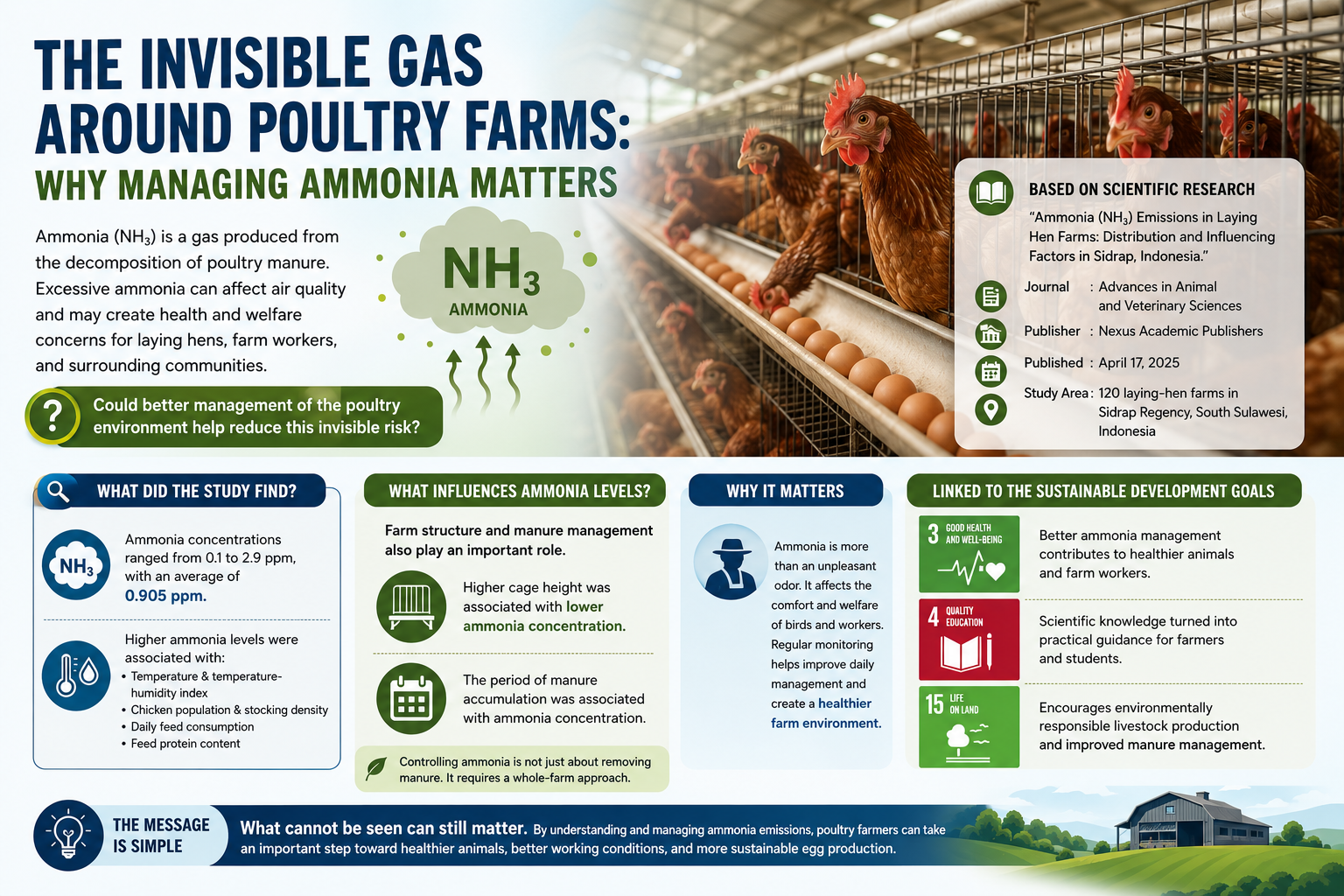

Makassar, Indonesia, August 21, 2026/NUTRIFEED/—For poultry farmers, a healthy production environment is just as important as good feed and proper farm management. However, one potential challenge cannot be seen with the naked eye: ammonia (NH₃). Ammonia is a gas produced through the decomposition of poultry manure. Although it is a natural part of livestock production, excessive ammonia accumulation can affect air quality and may create health and welfare concerns for laying hens, farm workers, and surrounding communities.
Could better management of the poultry environment help reduce this invisible risk?
Ammonia levels inside poultry farms are influenced by several factors. Temperature and humidity can affect the breakdown of manure and the release of ammonia into the air. Farm conditions, including the number of birds, stocking density, feed consumption, feed protein content, cage design, and manure management practices, may also influence ammonia concentrations. These factors may appear to be separate aspects of farm management, but together they can shape the quality of the production environment.
This issue is examined in the article “Ammonia (NH₃) Emissions in Laying Hen Farms: Distribution and Influencing Factors in Sidrap, Indonesia.” Published in the journal Advances in Animal and Veterinary Sciences by Nexus Academic Publishers on April 17, 2025, the study investigated ammonia emissions across 120 laying-hen farms in Sidrap Regency, South Sulawesi, Indonesia.
Using an ammonia gas sensor, the researchers found ammonia concentrations ranging from 0.1 to 2.9 ppm, with an average concentration of 0.905 ppm. The study also examined environmental and management factors associated with ammonia emissions. Temperature, the temperature-humidity index, chicken population, stocking density, daily feed consumption, and feed protein content were associated with higher ammonia concentrations.
The findings also highlighted the importance of farm structure and manure management. Cage height and the period of manure accumulation were associated with ammonia concentrations. These results show that controlling ammonia is not simply a matter of removing manure. It requires attention to the entire production system, including housing design, flock management, feeding practices, and environmental conditions.
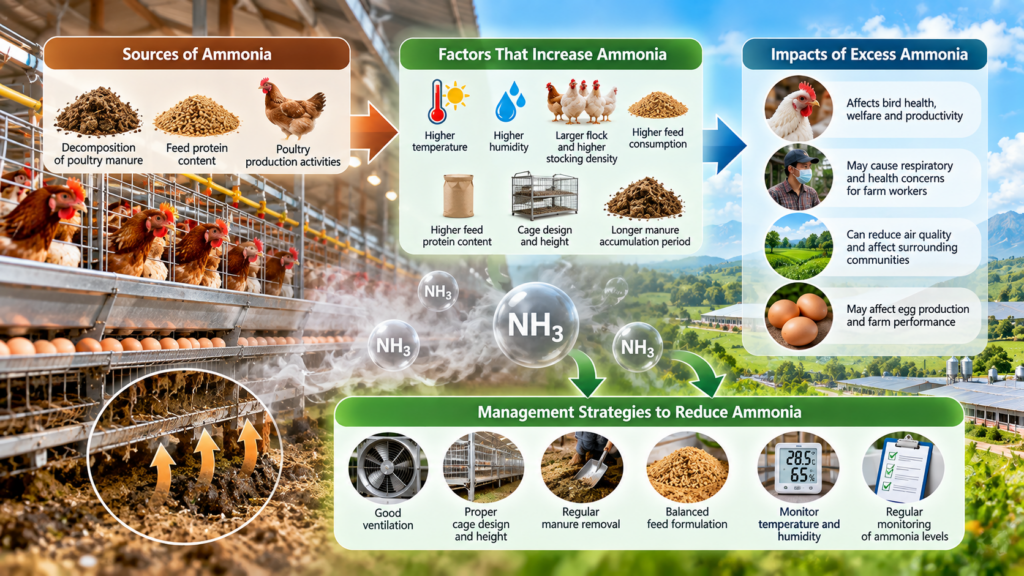
For poultry farmers, ammonia should not be viewed simply as an unpleasant farm odor. It is an important indicator of the conditions inside a poultry house. Poor air quality may affect the comfort and welfare of birds and workers. Regular monitoring can therefore help farmers better understand the relationship between daily management practices and the farm environment.
Nevertheless, the researchers emphasize that the relationships identified in the study should be interpreted carefully. The research examined ammonia distribution and associated influencing factors under actual farm conditions. Therefore, the observed relationships should not automatically be interpreted as direct cause-and-effect relationships. Instead, they provide important evidence for identifying management factors that may deserve closer attention.
This research supports SDG 3: Good Health and Well-Being, because better ammonia management can contribute to healthier conditions for animals and farm workers. It also supports SDG 4: Quality Education by providing scientific knowledge that can be translated into practical guidance for farmers and students. In addition, the study connects with SDG 15: Life on Land by encouraging more environmentally responsible livestock production and improved manure management.
The message is simple: what cannot be seen can still matter. By understanding and managing ammonia emissions, poultry farmers can take an important step toward healthier animals, better working conditions, improved farm environments, and more sustainable egg production for the future.
References
DOI: https://dx.doi.org/10.17582/journal.aavs/2025/13.5.1025.1035
Contact:
Prof. Sri Purwanti
+62 811-4103-775
sripurwanti@unhas.ac.id