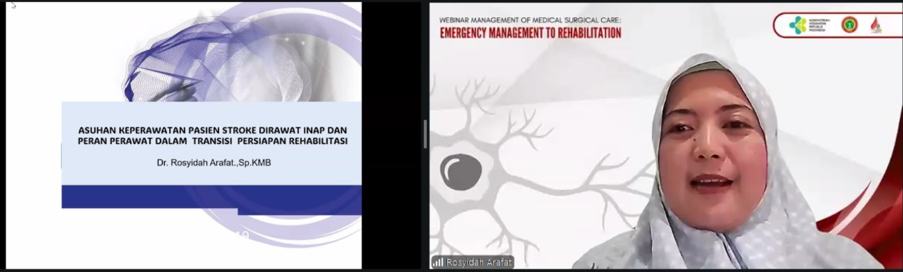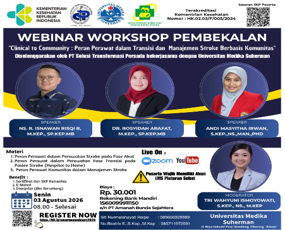

The advancement of evidence-based nursing practice relies not only on scientific research but also on the effective dissemination of knowledge among healthcare professionals. In support of this mission, a webinar entitled “Acute Stroke Management and Nursing Rehabilitation” was organized by the Indonesian Medical-Surgical Nurses Association (HIPMEBI) on 25 April 2026 through a Virtual Zoom Meeting. The webinar brought together 240 nurses from across Indonesia, providing an interactive learning platform to enhance professional competencies in stroke management and rehabilitation. During the event, a presentation entitled “Stroke Nursing Care and the Role of Nurses in the Transition to Rehabilitation Preparation” was delivered, emphasizing the critical role of nurses in ensuring continuity of care for patients recovering from stroke.
The primary objective of this educational activity was to strengthen nurses’ knowledge and clinical competencies in providing comprehensive, evidence-based stroke care while promoting effective transition planning from acute treatment to rehabilitation. As stroke remains one of the leading causes of disability and long-term dependence, the role of nurses extends far beyond acute clinical interventions. Nurses serve as educators, coordinators, advocates, and facilitators who help patients and their families prepare for recovery, adapt to functional changes, and achieve the highest possible level of independence.
The presentation highlighted the importance of comprehensive nursing assessment, early rehabilitation planning, patient education, and family engagement throughout the continuum of stroke care. Particular attention was given to the transition period between hospital discharge and rehabilitation, which is often a critical stage influencing long-term recovery outcomes. Participants learned how effective discharge planning, clear communication, and individualized nursing interventions can improve patients’ confidence, reduce complications, encourage treatment adherence, and facilitate successful reintegration into daily life.
The webinar also encouraged active discussions among participants regarding current challenges in stroke nursing practice across Indonesia. Nurses from different healthcare settings shared their experiences in managing patients with diverse clinical conditions, geographical limitations, and varying healthcare resources. This exchange of practical experiences enriched the learning process by connecting scientific evidence with real-world clinical practice, enabling participants to identify innovative and context-appropriate solutions for improving stroke rehabilitation services.
Beyond knowledge transfer, the event strengthened professional networking among Indonesian nurses who share a common commitment to improving neurological nursing care. The collaborative atmosphere fostered continuous learning, encouraged evidence-based practice, and reinforced the importance of interdisciplinary collaboration in delivering high-quality healthcare services. Such educational initiatives contribute significantly to developing a competent nursing workforce capable of addressing the increasing burden of stroke within Indonesia.
This webinar directly supports several United Nations Sustainable Development Goals (SDGs). It contributes to SDG 3: Good Health and Well-being by promoting evidence-based stroke management and improving the quality of rehabilitation services that enhance patients’ health outcomes and quality of life. The activity advances SDG 4: Quality Education through continuing professional education, lifelong learning, and the dissemination of up-to-date scientific knowledge among nursing professionals. In addition, it strengthens SDG 17: Partnerships for the Goals by bringing together healthcare professionals, professional organizations, and nursing experts to exchange knowledge and foster collaborative efforts aimed at improving national healthcare services. Furthermore, the activity indirectly supports SDG 1: No Poverty, as improved rehabilitation and patient independence can reduce the long-term socioeconomic burden experienced by stroke survivors and their families.
Through this national webinar, scientific knowledge was successfully translated into practical nursing strategies that can be implemented across diverse healthcare settings. By empowering nurses with updated competencies and encouraging collaborative learning, the event reaffirmed the essential contribution of nursing professionals in delivering patient-centered stroke care and advancing the quality of rehabilitation services throughout Indonesia.