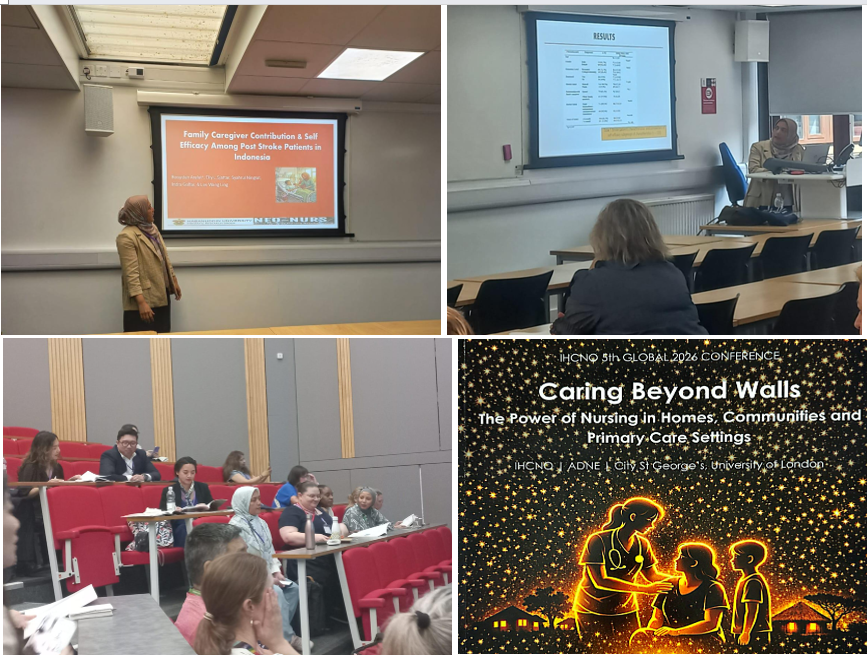
The dissemination of research findings is a vital step in translating scientific evidence into meaningful actions that improve healthcare practice and strengthen international collaboration. Demonstrating this commitment, an oral presentation titled “Family Caregiver Contribution and Self-Efficacy Among Post-Stroke Patients in Indonesia” was delivered at the 5th Global Conference “Caring Beyond Walls”, held from 17–19 June 2026 at the Oliver Thompson Lecture Theatre, Tait Building, University of Northampton, London, England. The conference brought together 150 participants from 31 countries, creating an inspiring platform for researchers, educators, healthcare professionals, policymakers, and students to exchange innovative ideas and discuss contemporary challenges in global health.
The primary objective of this participation was to disseminate research findings as an oral presenter, introducing evidence from Indonesia that highlights the essential role of family caregivers in supporting the recovery and self-efficacy of individuals living with stroke. Stroke remains one of the leading causes of disability worldwide, requiring not only comprehensive clinical management but also continuous support within the home environment. The presented study emphasized that family caregivers are indispensable partners in rehabilitation, encouraging patients to develop confidence in performing daily activities, adhering to treatment plans, and maintaining long-term recovery.
During the presentation, participants explored how family-centered care contributes to improved patient outcomes by strengthening self-efficacy, promoting independence, and fostering psychological resilience among post-stroke survivors. The discussion also provided valuable opportunities to compare caregiving experiences across different countries and healthcare systems, enabling participants to identify common challenges while sharing practical strategies that can be adapted to diverse cultural and clinical contexts. The interactive exchange of ideas reinforced the importance of integrating scientific evidence with local practices to improve the quality of stroke rehabilitation services globally.
Participation in this international conference also strengthened academic networking and encouraged future collaborative research among institutions from different regions. Engaging with experts from 31 countries broadened perspectives on interdisciplinary healthcare, opened opportunities for joint publications and research partnerships, and promoted the exchange of innovative educational approaches that support evidence-based nursing and rehabilitation practices.
This activity directly contributes to several United Nations Sustainable Development Goals (SDGs). It supports SDG 3: Good Health and Well-being by promoting evidence-based strategies that enhance rehabilitation outcomes and improve the quality of life for stroke survivors through effective family caregiving. It advances SDG 4: Quality Education by disseminating scientific knowledge, encouraging lifelong learning, and strengthening the global exchange of research findings among healthcare professionals and academics. Furthermore, the conference strongly reflects SDG 17: Partnerships for the Goals, as it fostered international cooperation, knowledge sharing, and cross-border collaboration among researchers and institutions committed to addressing global health challenges.
Ultimately, presenting Indonesian research on an international stage demonstrates the growing contribution of Indonesian nursing scholarship to global scientific dialogue. Beyond sharing research findings, the activity strengthened professional networks, inspired future collaborative initiatives, and reinforced the shared commitment to developing patient-centered, evidence-based healthcare solutions. Through international dissemination and meaningful collaboration, research can extend beyond academic publications to create tangible impacts on healthcare practice, education, and policy, ultimately improving the lives of patients and families worldwide.