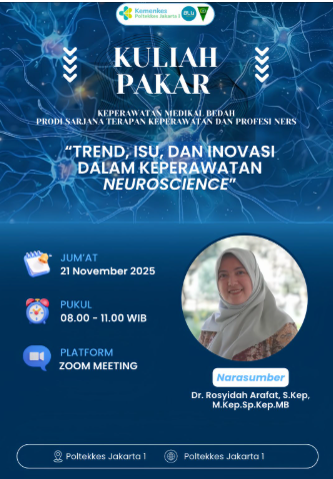
Continuous professional development is essential for preparing nurses to respond to the rapid evolution of healthcare and the increasing complexity of neurological disorders. As neuroscience continues to advance through new technologies, evidence-based interventions, and patient-centered approaches, nurses must continually update their knowledge and clinical competencies. In support of this commitment to lifelong learning, a Medical-Surgical Nursing Expert Lecture was held on 21 November 2025 through a Virtual Zoom Meeting. The lecture was attended by 120 participants, including nursing students, educators, clinicians, and healthcare professionals eager to enhance their understanding of contemporary neuroscience nursing. During the event, a guest lecture entitled “Trends, Issues, and Innovations in Neuroscience Nursing” was delivered, highlighting current developments that are shaping the future of neurological care.
The primary objective of this expert lecture was to enhance participants’ knowledge of emerging trends, current challenges, and innovative practices in neuroscience nursing while strengthening evidence-based clinical decision-making and encouraging continuous professional development among nursing professionals and students.
The presentation explored the dynamic transformation of neuroscience nursing, emphasizing how advances in medical technology, digital health, and multidisciplinary collaboration are improving the management of patients with neurological disorders such as stroke, traumatic brain injury, epilepsy, Parkinson’s disease, and other neurodegenerative conditions. Participants gained insight into the expanding role of nurses in early assessment, critical care, rehabilitation planning, patient education, and long-term management, demonstrating that nursing extends far beyond bedside care to include leadership, advocacy, and health promotion.
A significant focus of the lecture was placed on evidence-based practice as the foundation of high-quality neuroscience nursing. Participants were introduced to recent innovations in neurological assessment, rehabilitation strategies, telehealth applications, digital monitoring systems, and patient-centered care models that support better clinical outcomes. The discussion also addressed contemporary issues such as the growing burden of neurological diseases, workforce readiness, ethical considerations in advanced neurological care, and the importance of integrating scientific evidence into everyday nursing practice.
The interactive learning environment encouraged participants to exchange experiences, discuss clinical challenges, and explore practical solutions applicable to various healthcare settings. Through active dialogue, attendees were able to connect theoretical knowledge with real-world nursing practice, fostering critical thinking and strengthening their confidence in managing complex neurological cases. The lecture also inspired participants to remain engaged in research, innovation, and continuing education as essential components of professional nursing practice.
Beyond expanding scientific knowledge, the event strengthened academic and professional collaboration among participants from different institutions. The exchange of ideas promoted a culture of lifelong learning and reinforced the importance of interdisciplinary cooperation in addressing the evolving healthcare needs of patients with neurological conditions. Such educational activities contribute to building a highly competent nursing workforce capable of delivering safe, effective, and compassionate care.
This expert lecture contributes directly to several United Nations Sustainable Development Goals (SDGs). It advances SDG 3: Good Health and Well-being by promoting evidence-based neuroscience nursing practices that improve patient care and rehabilitation outcomes. The activity strongly supports SDG 4: Quality Education by providing continuing professional education, encouraging lifelong learning, and disseminating current scientific knowledge to healthcare professionals. It also strengthens SDG 17: Partnerships for the Goals by fostering collaboration among academic institutions, healthcare professionals, and educators to advance nursing excellence through knowledge sharing. Furthermore, the initiative indirectly contributes to SDG 1: No Poverty, as improved neurological care and effective rehabilitation can reduce long-term disability, enhance patients’ independence, and lessen the financial burden experienced by individuals and their families.
By bringing together experts and healthcare professionals in an accessible virtual learning environment, this Medical-Surgical Nursing Expert Lecture successfully promoted the exchange of scientific knowledge and innovative ideas in neuroscience nursing. The activity reaffirmed the vital role of continuing education in preparing nurses to deliver high-quality, patient-centered neurological care while supporting the advancement of nursing practice and healthcare outcomes in an ever-changing clinical landscape.