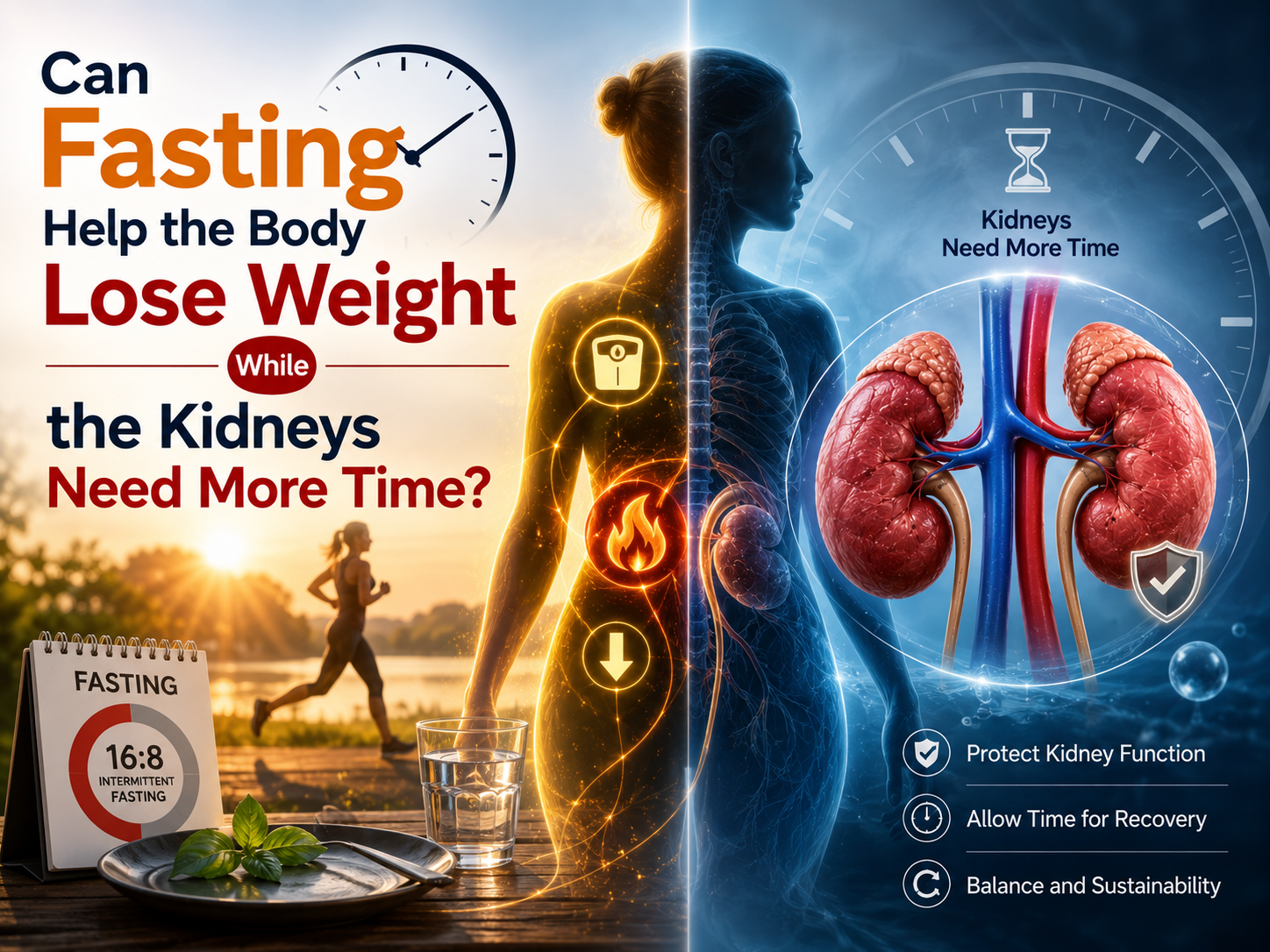

Alternate-day fasting has become a popular strategy for people trying to lose weight. The idea is straightforward: alternate between days of eating and days of fasting. But losing weight is only one part of the story. What happens inside important organs such as the kidneys?
A recent experimental study explored this question using male Wistar rats fed a high-calorie diet. The researchers were particularly interested in endothelin-1 (ET-1), a powerful substance involved in blood vessel constriction and the regulation of blood flow. When ET-1 activity becomes elevated, it may contribute to vascular stress and problems affecting organs such as the kidneys.
The study involved 18 male Wistar rats, divided into three groups of six. All animals were first exposed to a high-calorie diet to create an overweight condition. One group then received alternate-day fasting (ADF), another received an anti-endothelin drug, and the control group received no additional intervention. The experiment included nine weeks of high-calorie diet exposure followed by four weeks of intervention.
The most obvious effect of ADF was on body weight.
After the fasting intervention, rats in the ADF group lost weight. Their average weight fell from about 310 grams to 278 grams. The researchers also observed a reduction in the Lee Index, a measurement used to describe body composition in the rats.
But the kidney story was different.
Although the rats lost weight, ADF did not significantly reduce plasma ET-1. The plasma levels were 0.718 pmol/L in the ADF group, compared with 0.596 pmol/L in the control group, and the difference was not statistically significant.
More surprisingly, ET-1 levels in the kidneys remained significantly higher in the ADF group than in the healthy control group. Renal ET-1 was 0.538 pmol/L in the ADF group versus 0.416 pmol/L in controls.
What could this mean?
The researchers suggest that the body may respond to dietary changes at different speeds. Weight can change relatively quickly, while organs may require more time to recover from the effects of prolonged excess nutrition. In this study, the kidneys appeared to retain signs of metabolic and vascular stress even after body weight improved.
This research supports SDG 3: Good Health and Well-Being because it highlights the importance of preventing overweight and understanding how dietary interventions may affect the body beyond the number on the scale.
However, there is an important warning: these findings come from rats, not humans, and the article is a preprint that has not yet undergone peer review. The results therefore should not be interpreted as proof that alternate-day fasting protects or harms human kidneys.
The bigger lesson is fascinating: the scale may change before the organs do. Losing weight can be an important health goal, but true recovery may require more time—and careful scientific investigation.
Article Metadata
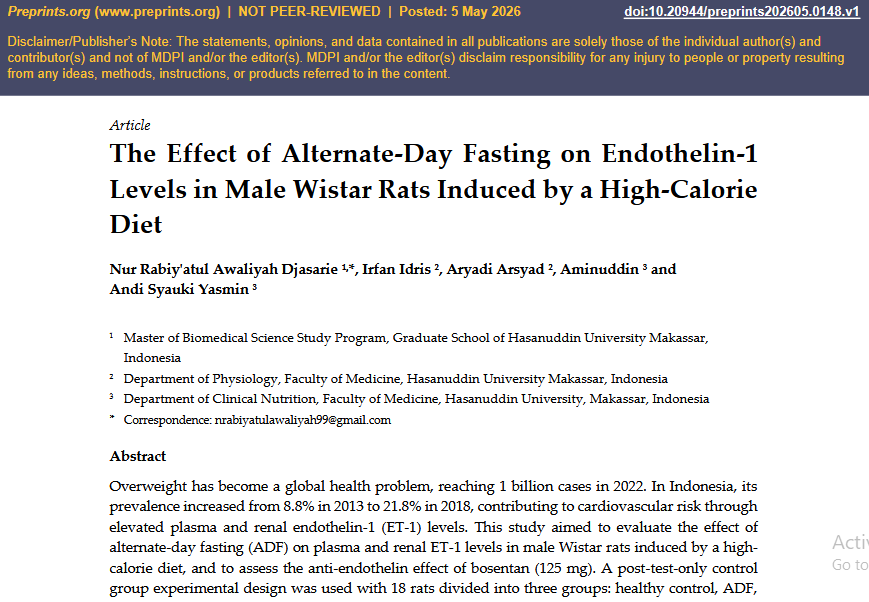
Article title: The Effect of Alternate-Day Fasting on Endothelin-1 Levels in Male Wistar Rats Induced by a High-Calorie Diet
Journal: Preprints 2026
Publisher: MDPI AG (Preprints.org)
Publication date: 5 May 2026
DOI: https://doi.org/10.20944/preprints202605.0148.v1
Authors: Nur Rabiy’atul Awaliyah Djasarie; Irfan Idris; Aryadi Arsyad; Aminuddin; Andi Syauki Yasmin
Aryadi Asryad
Email: aryadi.arsyad@med.unhas.ac.id