Cardiovascular disease remains one of the world’s biggest health challenges. Conditions such as thrombosis and atherosclerosis can contribute to heart attacks and strokes, while anticoagulant medicines are often needed to reduce harmful blood clotting. Heparin is a widely used anticoagulant, but it can cause problems such as bleeding and thrombocytopenia. It also commonly requires injection, which may be uncomfortable and can reduce treatment convenience.
A recent study offers an intriguing alternative: a patch covered with microscopic dissolving needles. The research article, “Fucoidan-Incorporated Dissolving Microneedles: A Novel Approach to Anticoagulant Transdermal Delivery,” was published in the Journal of Drug Delivery Science and Technology by Science Direct in May 2024. The study explores whether fucoidan, a bioactive substance obtained from marine sources, can be delivered through the skin using dissolving microneedles.
Why fucoidan? This sulfated polysaccharide has anticoagulant and antithrombotic properties similar to heparin. However, delivering fucoidan effectively is not simple. Oral administration can result in low absorption, while injections may cause discomfort and require trained healthcare professionals. Fucoidan also has a relatively large molecular size, making it difficult to pass through the skin’s natural outer barrier, the stratum corneum.
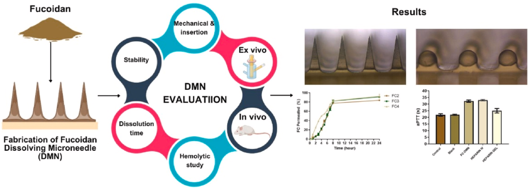
The researchers tackled this problem by placing fucoidan inside dissolving microneedles made from gelatin and polyvinyl pyrrolidone (PVP). These needles are microscopic, sharp enough to create tiny openings in the skin, and designed to dissolve after insertion. In simple terms, the patch temporarily creates a pathway through the skin so fucoidan can move toward systemic circulation.
Among the tested formulations, FC3 was selected as the optimum formula because it combined strong mechanical properties, good penetration, and high fucoidan permeation while using less excipient. In an ex vivo skin experiment, the formulations showed substantial fucoidan permeation, with FC3 reaching 91.23 ± 0.12%. The safety test was also encouraging: all tested formulations showed hemolytic activity below 5%, suggesting no substantial damage to red blood cells under the tested conditions. After seven days of treatment, FC-DMN increased both prothrombin time (PT) and activated partial thromboplastin time (aPTT), indicators of anticoagulant activity. Importantly, there was no significant difference between FC-DMN and injected heparin in the tested rats. However, this does not mean the microneedle patch is ready to replace injections in humans. The study used a small number of rats, and the authors emphasize that further research, including pharmacokinetic studies, is needed. This innovation strongly connects with SDG 3: Good Health and Well-Being. By exploring a potentially safer, painless, and more convenient way to deliver anticoagulant therapy, FC-DMN could contribute to better treatment experiences and future cardiovascular care.