


On 14–15 November 2024, a strategic Project Meeting was successfully conducted at the National Technical University of Athens (NTUA), Athens, Greece. The meeting brought together international consortium members to review project achievements, evaluate the progress of each Work Package, and establish a shared direction for the upcoming implementation phase. This collaborative forum served as an important milestone to ensure that project objectives remain aligned with planned outcomes while strengthening international cooperation and institutional partnerships.
The meeting involved 14 participants representing 10 consortium members from Indonesia and Europe. The consortium reflects a multidisciplinary and cross-sector collaboration designed to encourage knowledge exchange, strengthen institutional capacity, and generate sustainable project outcomes.
The Indonesian consortium members consisted of Faculty of Animal Science, Universitas Gadjah Mada (UGM), Yogyakarta; Faculty of Animal Science, Universitas Hasanuddin (UNHAS), Makassar represented by Prof. Dr. Muhammad Irfan Said and Prof. Dr. Ihsan A. Dagong; Faculty of Animal Science, Universitas Mataram (UNRAM), Mataram, West Nusa Tenggara; Indonesian Tanners Association (APKI), Yogyakarta; and Center for Standardization and Industrial Service of Leather, Rubber, and Plastic Industries, Ministry of Industry, Yogyakarta.
Meanwhile, European consortium institutions included EGE University, Izmir, Türkiye; National Technical University of Athens (NTUA), Athens, Greece; University of Pisa, Pisa, Italy; Cre Thi Dev (NGO), Greece; and CGS, Pisa, Italy.
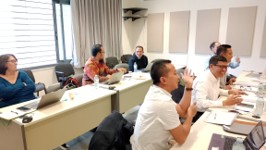
The meeting was further strengthened by the active participation of distinguished international partners, namely Prof. Dr. Mehmet Mete Mutlu, Prof. Dr. Hasan Ozgunay, Prof. Dr. Maurizia Seggiani, Prof. Dr. Constantina Kollia, Michail Delagrammatikas, Michael Collucia, Maya Dimitriadou, and Dimos Papakonstatinou. Their contributions provided valuable scientific insights, strategic recommendations, and perspectives that supported constructive discussions and future project planning.
Throughout the sessions, participants reviewed project implementation status, evaluated the performance and deliverables of each Work Package, identified opportunities for improvement, and formulated strategies for the next project phase. Particular attention was given to ensuring effective coordination among partners, maintaining quality standards, and maximizing the long-term impact of project outputs.
This meeting also demonstrated a strong commitment to advancing the Sustainable Development Goals (SDGs). The activities directly contributed to SDG 1 – No Poverty by supporting capacity building and sustainable development opportunities; SDG 4 – Quality Education through international academic exchange, collaborative learning, and knowledge transfer; and SDG 17 – Partnerships for the Goals by strengthening cooperation among universities, government institutions, industry associations, and international organizations.
As the project enters its next implementation stage, all consortium partners reaffirmed their commitment to completing upcoming tasks and ensuring that project outcomes deliver meaningful scientific, educational, and societal benefits through continued international collaboration.
Contact:
Muhammad Irfan said
08124206293
Email: irfanunhas@gmail.com / irfan.said@unhas.ac.id


