


Gowa— As part of its commitment to the Tri Dharma of Higher Education—education, research, and community service—Hasanuddin University conducted a community engagement program focused on producing SINHAS-1 maize seed to support maize cultivation on dry and marginal lands. The program aimed to improve farmers’ access to affordable, high-quality, and stress-adaptive seed while strengthening the university’s role in agricultural innovation and seed entrepreneurship. The activity involved 24 participants, including students, farming community members, government representatives, and partners from the cereal agricultural research institution in Maros. It was conducted on 22 September 2025 as part of a broader seed production program implemented from May to October 2025 at the Experimental Farm (Exfarm), Faculty of Agriculture, Hasanuddin University, and partner farmers’ fields in Bajeng District, Gowa Regency.
The program responded to the limited availability of suitable maize seed for dry and marginal environments, where water and nitrogen constraints can reduce crop productivity. SINHAS-1, an open-pollinated maize variety developed by Hasanuddin University and officially released by the Ministry of Agriculture of the Republic of Indonesia, provides an alternative due to its ability to maintain productivity under drought and low-nitrogen conditions. The variety has a potential yield of 10.71 tons per hectare.
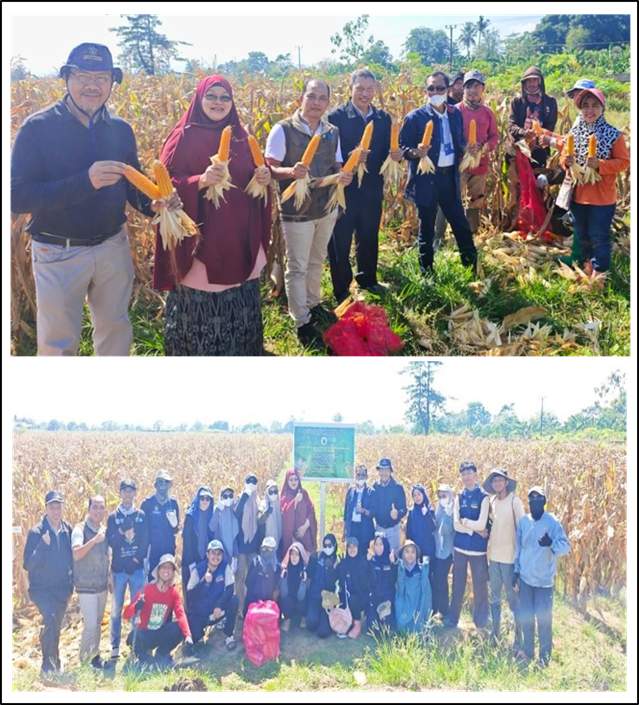
Rather than focusing only on seed multiplication, the program implemented an integrated seed production system covering on-farm and post-harvest activities. Participants were directly involved in land preparation, planting, crop maintenance, varietal isolation, roguing, harvesting, drying, cleaning, certification, packaging, and labeling. The process followed Good Seed Production Practices (GSPP) to maintain varietal identity and seed quality. Production was organized through successive seed classes, from Breeder Seed to Basic Seed, Stock Seed, and Extension Seed, supporting a continuous supply of quality planting material.
The program produced promising results. SINHAS-1 seed achieved at least 98% genetic purity and more than 90% germination, meeting the national maize seed quality standard. Seed production reached approximately 2.5 tons per hectare under dry-season conditions despite limited irrigation. These results highlight the potential of SINHAS-1 as an adaptive option for maize cultivation in areas affected by water scarcity and other abiotic stresses.
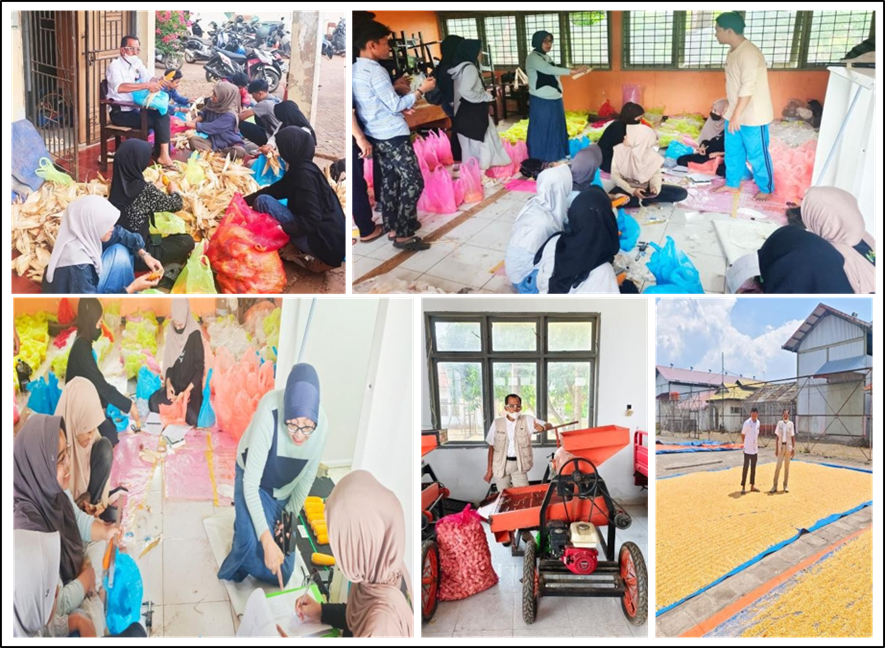
The program also improved seed accessibility for smallholder farmers. SINHAS-1 seed was priced at approximately IDR 15,000 per kilogram, considerably lower than hybrid seed, which can exceed IDR 100,000 per kilogram. This affordability can help farmers with limited capital obtain quality seed and reduce dependence on high-cost inputs.
For students, the activity provided practical experience in seed production, post-harvest handling, quality management, and seed entrepreneurship. Institutionally, it strengthened the role of the Exfarm Faculty of Agriculture as a university-based seed production and entrepreneurship unit.
The initiative also contributes to SDG 1 (No Poverty), SDG 4 (Quality Education), and SDG 17 (Partnerships for the Goals) through affordable seed provision, hands-on learning, and collaboration among universities, government institutions, students, and farming communities.
Overall, the production of SINHAS-1 maize seed demonstrates a practical model of university–community engagement that connects agricultural research, education, entrepreneurship, and farmer empowerment. Continued testing and wider dissemination can further support resilient and sustainable maize production on dry and marginal lands.


