
MAKASSAR, Indonesia May 22 2026 /GLOHAMOD/– What if the key to predicting future earthquakes and tsunamis in Sulawesi lies deep beneath the ocean floor? A new scientific discovery is offering fresh insight into one of Indonesia’s most complex and dangerous tectonic systems, revealing hidden structures beneath the Celebes Sea that may help scientists better understand how devastating submarine earthquakes can occur.
A recent study titled Offshore Crustal Thickness Variation Along the Palu–Koro Strike–Slip Fault in the Sulawesi Region from OBS Receiver Function Analysis, published in Solid Earth by EGU on March 12, 2026, provides important new evidence about the geological structure beneath the North Sulawesi Subduction Zone and the offshore extension of the Palu–Koro Fault.
The North Sulawesi Subduction Zone is one of the youngest active subduction systems in the western Pacific. In western Sulawesi, the well-known Palu–Koro Fault connects directly to the North Sulawesi Trench, forming a rare subduction–transform fault system. This interaction creates intense tectonic stress that can trigger powerful earthquakes and even tsunamis.
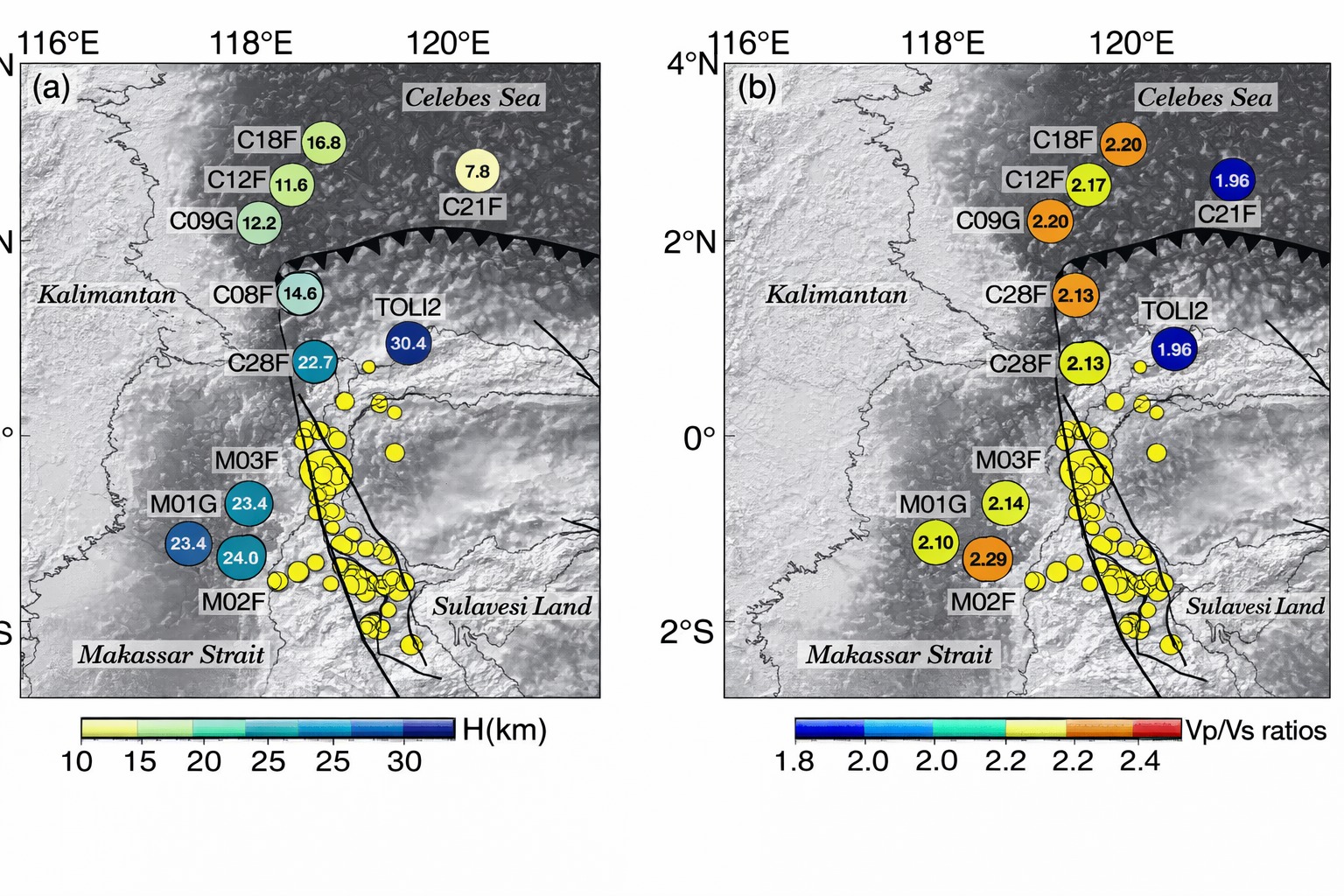
Using data collected from nine ocean bottom seismometers placed across the fault zone, researchers applied advanced receiver function analysis to estimate the thickness of Earth’s crust beneath the Celebes Sea. Their findings reveal that the crust beneath the Celebes Sea is remarkably thin, with the boundary between crust and mantle located at only around eight kilometers deep. This is significantly shallower than neighboring areas such as eastern Kalimantan and northern Sulawesi, where crustal thickness reaches approximately twenty-five kilometers.
Scientists also identified sharp changes in crustal depth near the Palu–Koro Fault, indicating the collision of two distinct geological blocks. Combined with seismic wave velocity patterns and earthquake records, the results confirm that the Palu–Koro Fault is a major left-lateral strike-slip fault extending offshore into the Celebes Sea.
These findings strongly support SDG 3: Good Health and Well-being, as improved earthquake and tsunami hazard understanding directly contributes to safer communities, stronger disaster preparedness systems, and reduced loss of life during major seismic events.
The study also contributes to SDG 4: Quality Education by transforming highly technical geophysical research into practical scientific knowledge that strengthens public understanding of natural hazards. Better awareness allows communities to prepare more effectively for future disasters.
For Indonesia, where tectonic activity is unavoidable, this research provides more than scientific curiosity. It offers a critical foundation for improved coastal planning, safer infrastructure design, and more accurate tsunami risk assessments.
By listening to signals recorded deep beneath the sea, scientists are uncovering the hidden mechanics of Sulawesi’s restless earth. Their work reminds us that understanding what happens below the ocean floor may one day save countless lives above it.
Reference:
DOI: https://doi.org/10.5194/se-17-453-2026
Article Title: Offshore Crustal Thickness Variation Along the Palu–Koro Strike–Slip Fault in the Sulawesi Region from OBS Receiver Function Analysis
Journal: Solid Earth
Publisher: EGU
Publication Date: March 12, 2026
Contact:
Saaduddin, M. Sc., PhD
+62 8992890320
Saad@sci.unhas.ac.id