
MAKASSAR, Indonesia May 22 2026 /GLOHAMOD/– Far below the islands of Sulawesi, where no human eye can see, powerful currents of slowly flowing rock are shaping the future of one of Indonesia’s most tectonically active regions. These hidden movements, occurring hundreds of kilometers beneath the Earth’s surface, control how tectonic plates interact, where stress builds up, and how future earthquakes may unfold.

A groundbreaking new study is now shedding light on these invisible forces.
The study, titled Mantle Flow Induced by the Interplay of Downgoing Slabs Revealed by Seismic Anisotropy Beneath the Sula Block in Eastern Indonesia, published in Solid Earth by AGU on May 16, 2024, reveals how overlapping tectonic slabs beneath North Sulawesi create complex underground flow patterns that influence earthquake behavior across eastern Indonesia.
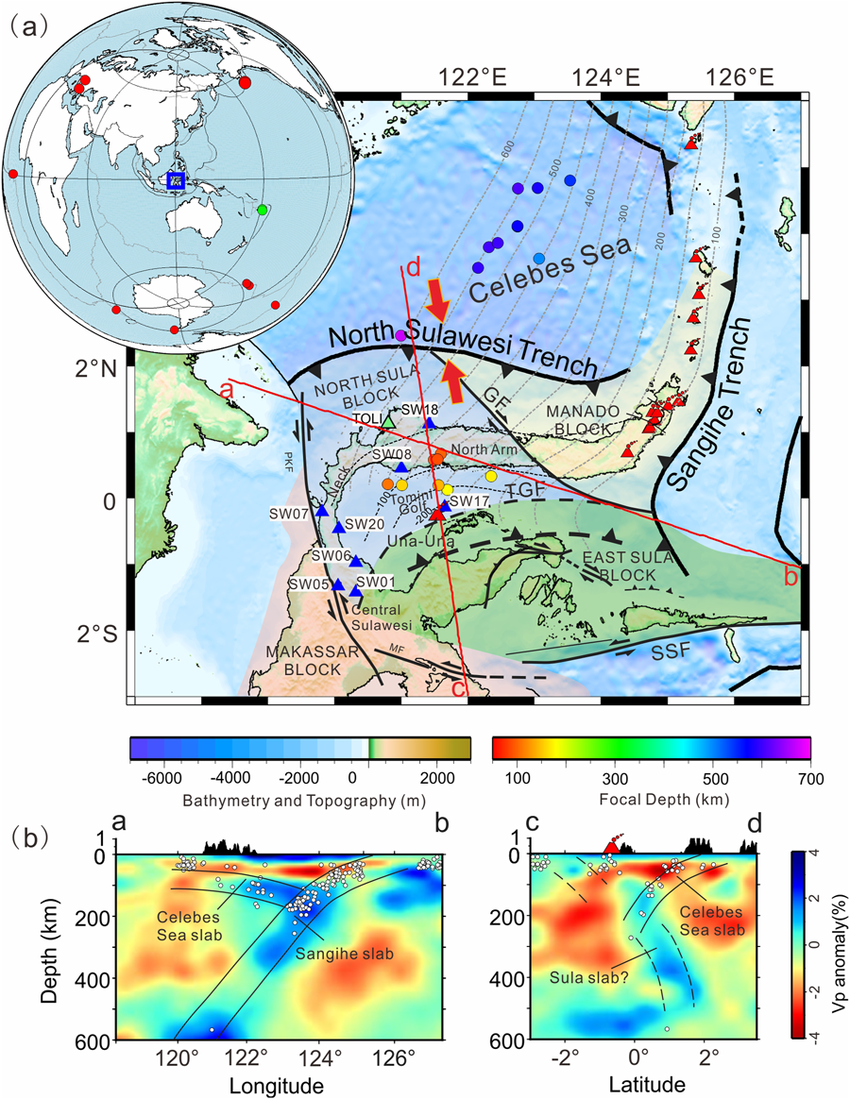
The North Sulawesi subduction zone is one of the most geologically complicated regions in the world. Here, the Celebes Sea plate dives southward beneath Sulawesi, while the Sangihe slab pushes westward from the Molucca Sea. Beneath both lies the ancient Sula slab, which continues to affect deep Earth dynamics.
To investigate these interactions, scientists used advanced seismic wave analysis, studying how earthquake-generated waves split and change direction as they travel through Earth’s interior. This process, known as seismic anisotropy analysis, allows researchers to map underground mantle flow patterns much like doctors use ultrasound to examine the human body.
The results reveal that beneath parts of Sulawesi, mantle material flows in curved circulation patterns known as mantle wedge corner flow. In the Gulf of Tomini, however, unusual wave directions suggest direct interaction between overlapping slabs, creating more complicated movement deep underground.
Near the southern segment of the Palu-Koro Fault, researchers observed seismic patterns aligned with the fault itself. This suggests large-scale shearing forces deep within the Earth are directly connected to the surface fault system that caused the devastating 2018 Palu earthquake.
These findings strongly support SDG 3: Good Health and Well-being, because understanding deep tectonic processes helps improve earthquake hazard forecasting and reduces risks to human life.
The research also contributes to SDG 4: Quality Education by transforming highly specialized geophysical science into practical knowledge that strengthens public understanding of Indonesia’s seismic landscape.
Equally important, the study advances SDG 17: Partnerships for the Goals, reflecting the collaborative efforts of global researchers working together to improve earthquake science and resilience planning.
For Indonesia, this discovery provides more than scientific curiosity. It offers a clearer picture of how hidden mantle flows shape the stress patterns that drive major earthquakes.
By listening to seismic whispers from deep within the planet, scientists are uncovering the invisible machinery beneath Sulawesi—knowledge that may one day help protect millions living above these restless tectonic boundaries.
Reference:
DOI: https://doi.org/10.1029/2023JB028110
Article Title: Mantle Flow Induced by the Interplay of Downgoing Slabs Revealed by Seismic Anisotropy Beneath the Sula Block in Eastern Indonesia
Journal: Solid Earth
Publisher: AGU
Publication Date: May 16, 2024
Contact:
Saaduddin, M. Sc., PhD
+62 8992890320
Saad@sci.unhas.ac.id