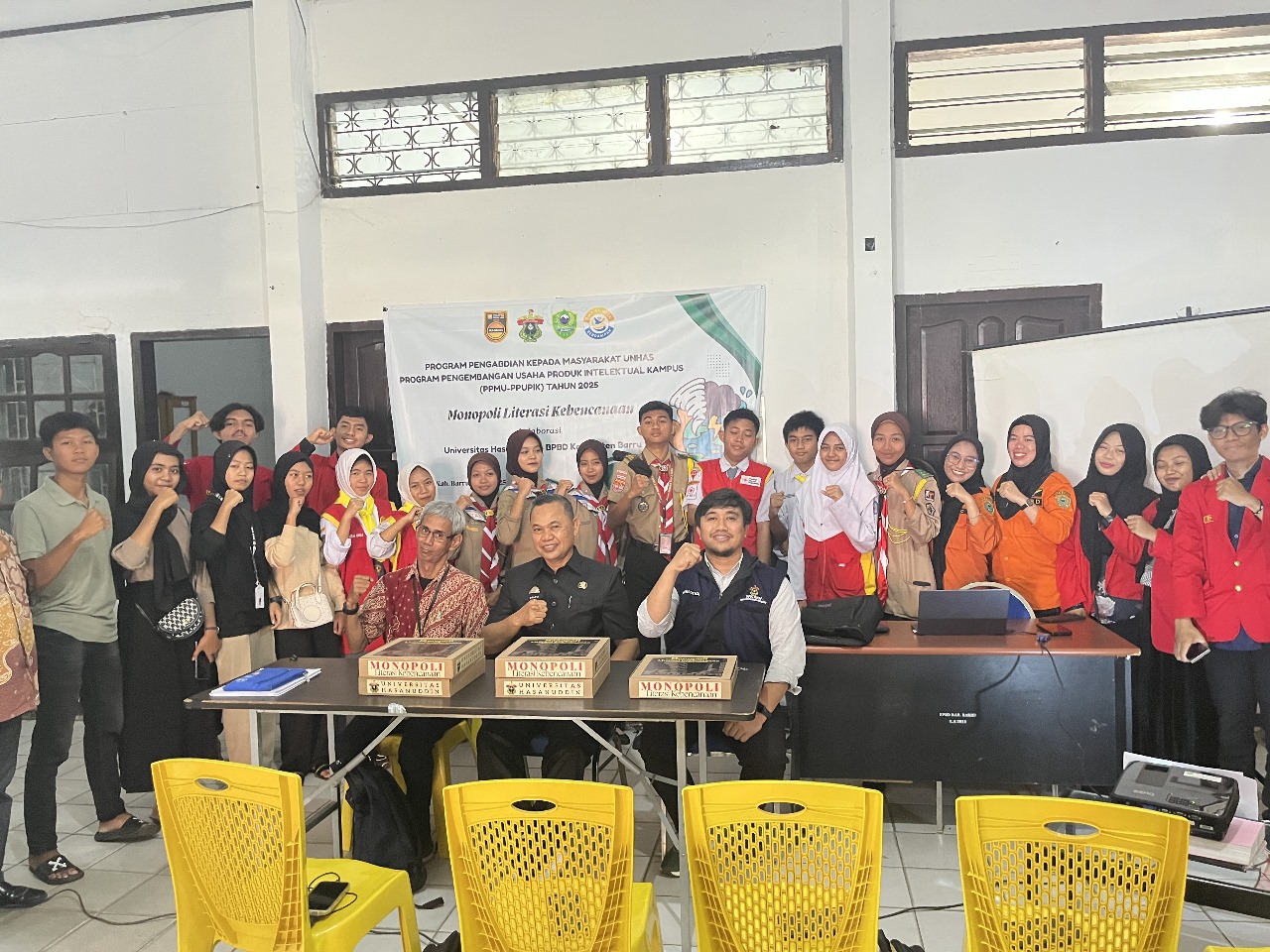

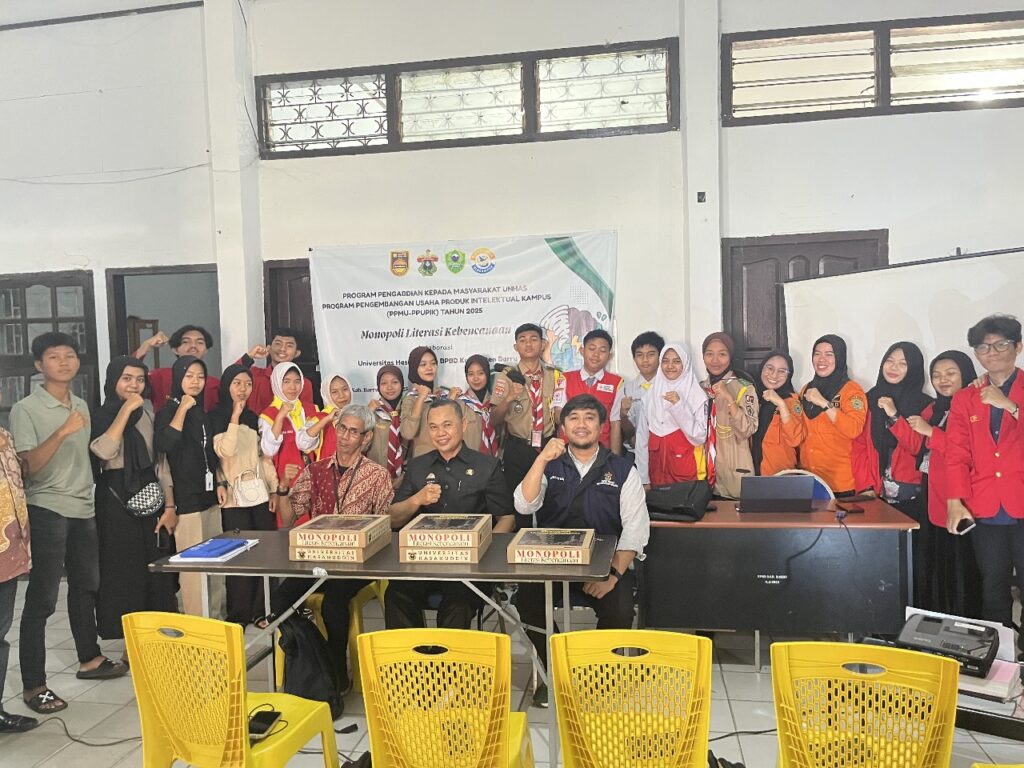
On Thursday, July 3, 2025, the Community Service Team of Hasanuddin University conducted an innovative educational program titled Disaster Literacy Monopoly at the Barru Regional Disaster Management Agency (BPBD) Hall. This initiative was specifically designed to strengthen disaster preparedness among high school students as representatives of Generation Z, utilizing an interactive and participatory approach that transforms complex disaster management concepts into accessible learning experiences.
The program represents a strategic collaboration under the Campus Intellectual Property Business Development Program (PPUPIK) of Hasanuddin University, coordinated by the Institute for Research and Community Service (LP2M) UNHAS, bringing together expertise from the Department of Geological Engineering and the Department of Geophysics. This interdisciplinary approach ensures comprehensive knowledge transfer regarding disaster risk reduction and community resilience.
The team received a warm welcome from the Head of BPBD Barru, H. Umar Sinampe, S.KM., M.Kes., who underscored the critical importance of multi-stakeholder cooperation in disaster mitigation efforts. He elaborated on Barru Regency’s challenging geographical landscape, characterized by mountainous terrain in the eastern region susceptible to landslides, and low-lying coastal areas along the Makassar Strait vulnerable to flooding and coastal erosion. These conditions necessitate robust disaster literacy programs targeting young populations who will become future community leaders.
The educational session commenced with a comprehensive presentation by Saaduddin, who systematically explained disaster classifications as defined in Indonesian Law No. 24 of 2007, encompassing natural disasters, non-natural disasters, and social disasters. This foundational knowledge provided participants with essential understanding of the disaster management framework in Indonesia.
The centerpiece of the program was the Disaster Literacy Monopoly game, an innovative educational tool that adapts the familiar Monopoly board game format with disaster-related content and scenarios. This gamification approach successfully transformed theoretical disaster preparedness concepts into practical, engaging learning experiences, enabling participants to understand risk assessment, emergency response protocols, and community resilience strategies through immersive gameplay.
This initiative directly contributes to multiple Sustainable Development Goals (SDGs), particularly SDG 1 (No Poverty) by building community capacity to reduce disaster-related economic losses that disproportionately affect vulnerable populations; SDG 4 (Quality Education) through innovative educational methodologies that enhance disaster literacy among youth; and SDG 17 (Partnerships for the Goals) by fostering collaboration between academic institutions, government agencies, and local communities in achieving disaster resilience objectives.
By equipping Generation Z with critical disaster awareness and response capabilities, this program establishes a foundation for sustainable community resilience. The participatory learning methodology ensures knowledge retention and practical application, empowering young people to become agents of change in their communities and building their leadership capacity. Furthermore, the program demonstrates how creative educational approaches can effectively address complex societal challenges while promoting inclusive, quality education that prepares youth for environmental uncertainties and strengthens inter-institutional partnerships essential for sustainable development.