
Makassar, Indonesia 27 May 2026/FCVC/-Rice is more than just food in Indonesia. For millions of rural families, rice is also the main source of income, employment, and survival. Yet behind every plate of rice lies a complex chain of farmers, traders, millers, distributors, retailers, and government institutions. A recent study titled “Power and Governance in Indonesia’s Rice Value Chain: Evidence from South Sulawesi” reveals that the biggest challenge in Indonesia’s rice sector is not only production, but also the unequal distribution of power and benefits across the value chain
The findings were published in the article titled “Power and Governance in Indonesia’s Rice Value Chain: Evidence from South Sulawesi,” published in Social Sciences & Humanities Open by Elsevier on 25 May 2026. The study explains that the biggest challenge in Indonesia’s rice sector is not only increasing production, but also addressing unequal power relations and unfair value distribution within the supply chain. This work is part of a collaborative research project with the University of Adelaide that began in 2024, when a group from Hasanuddin University and Dr. Rida Akzar from the University of Adelaide visited Soppeng to explore the governance and value chain mechanisms for various food commodities in South Sulawesi
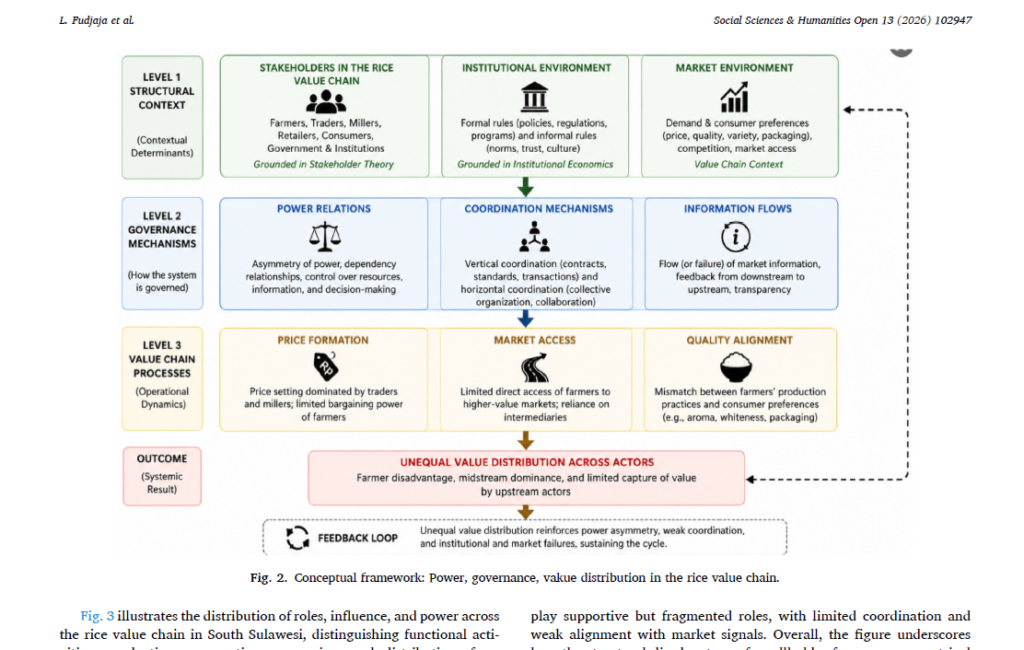
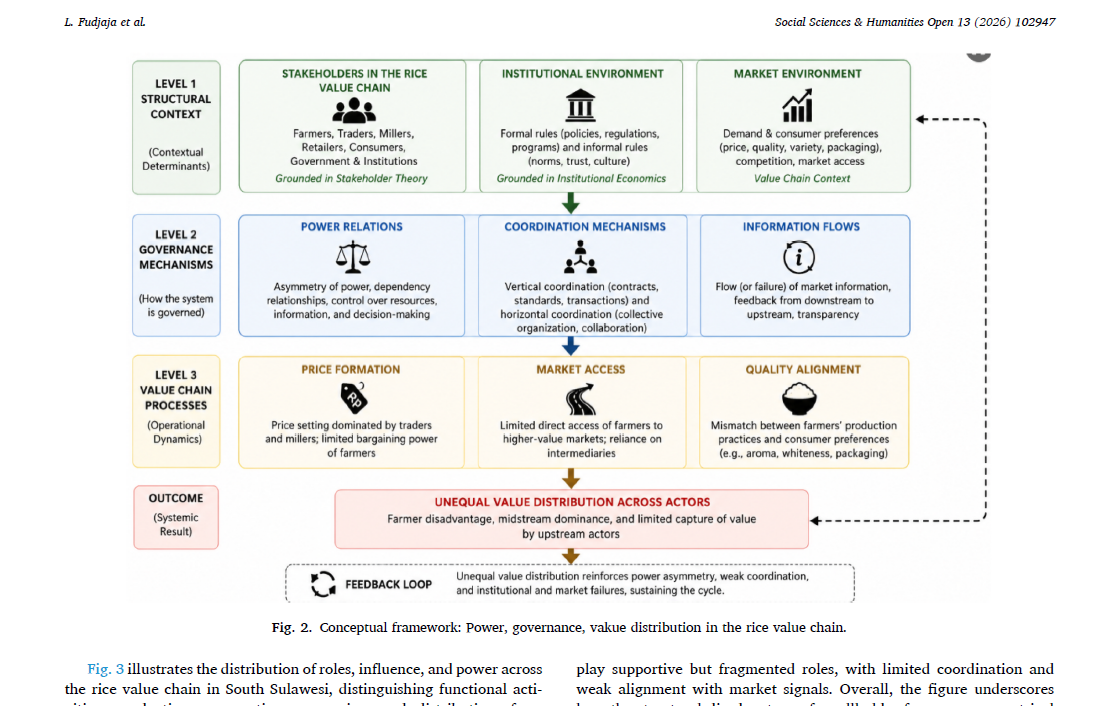
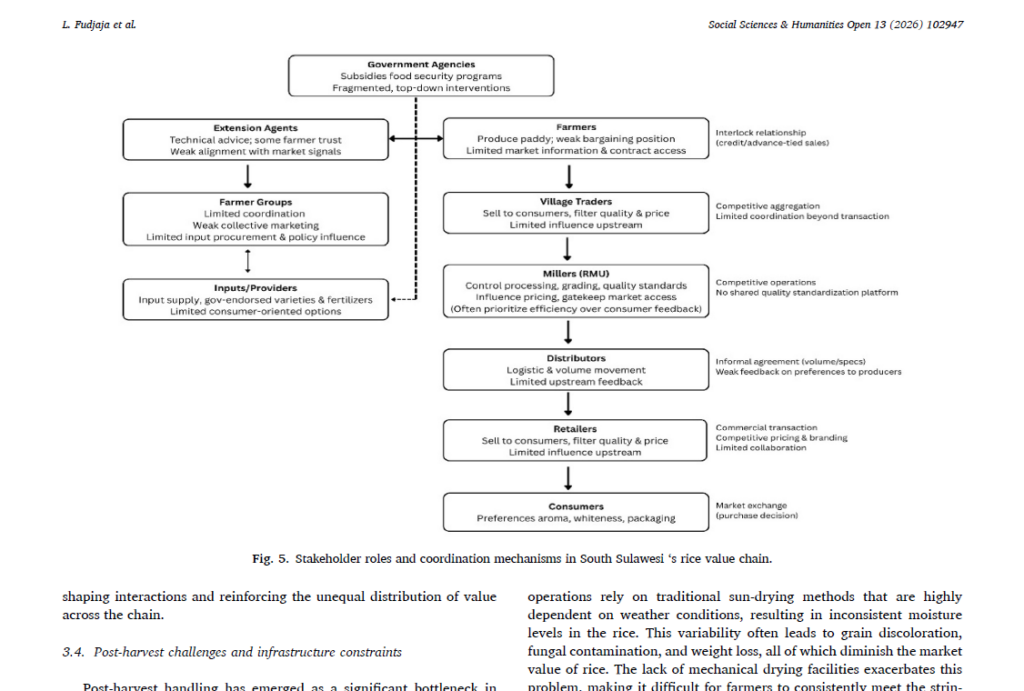
The research highlights how smallholder rice farmers in South Sulawesi remain structurally disadvantaged despite being the backbone of rice production. Farmers often depend on traders and millers for loans, market access, and price information. Because of this dependency, many farmers have limited bargaining power and are forced to accept prices determined by middlemen. Meanwhile, traders and millers maintain stronger control over quality standards, market access, and pricing systems. As a result, the study reveals that farmers contribute the most labor and production activities, yet receive a smaller share of the economic benefits generated along the value chain.
Another important finding is the growing disconnect between production practices and consumer preferences. Urban consumers increasingly demand rice with better aroma, texture, packaging, and visual quality. However, many farmers continue focusing mainly on high-yield varieties because they rarely receive direct information about changing market preferences. Weak communication and fragmented coordination among actors make it difficult for farmers to enter premium markets and improve their incomes. This situation reflects broader governance challenges in the agricultural sector.
The study also emphasizes the serious limitations of post-harvest infrastructure. Many farmers still rely on traditional sun-drying methods that are highly dependent on weather conditions, resulting in inconsistent grain quality and post-harvest losses. Small-scale milling units also frequently use outdated technology, reducing rice quality and competitiveness. Beyond technical challenges, the study additionally identifies inequality in participation within the value chain, including the limited recognition of women’s roles in higher-value activities such as marketing, management, and decision-making. Women are often concentrated in lower-paid tasks despite their important contribution to rice production and processing.
These findings strongly relate to several Sustainable Development Goals. The study contributes to SDG 1: No Poverty by emphasizing the importance of improving farmer income and bargaining power. It supports SDG 2: Zero Hunger through efforts to strengthen sustainable rice systems and food security. The research also aligns with SDG 5: Gender Equality, particularly in addressing unequal participation and opportunities for women within agricultural value chains. In addition, the study reflects the goals of SDG 12: Responsible Consumption and Production through improved post-harvest systems and market-oriented production. Finally, the findings highlight the importance of SDG 16: Peace, Justice and Strong Institutions and SDG 17: Partnerships for the Goals, especially through stronger governance, institutional coordination, and collaboration among researchers, policymakers, and agribusiness actors.
Ultimately, the study reminds us that sustainable agriculture is not only about increasing yields. It is also about creating a fairer system where farmers, women, and local communities can participate more equally in economic opportunities and decision-making processes.
Acknowledgement: This research was supported through the Thematic Research Group (TRG) Scheme of Hasanuddin University under research contract number 00773/UN4.22/PT.01.03/2025, in collaboration with the Centre for Global Food and Resources, The University of Adelaide.
Reference:
DOI: https://doi.org/10.1016/j.ssaho.2026.102947
Contact:
Prof. Rahim Darma, Ph.D
+62 852-5564-6556
rdarma@unhas.ac.id