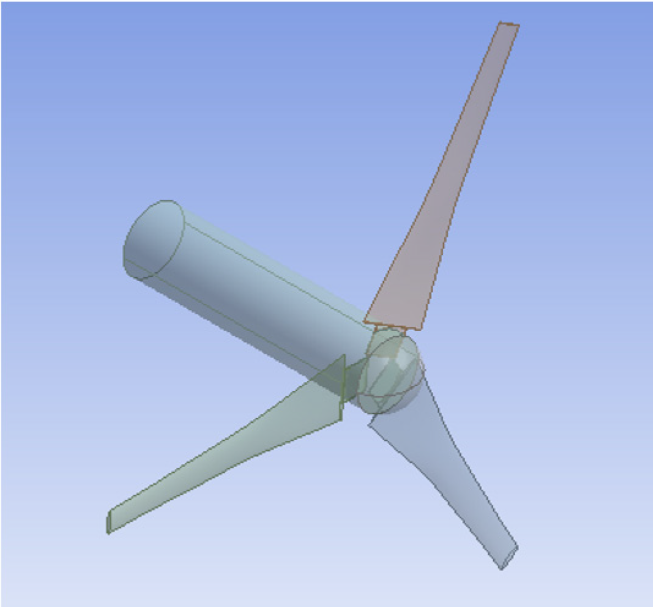

Fluid Dynamics and Energy Research Group (FDERG), Universitas Hasanuddin, continues to develop research in renewable energy and maritime engineering through computational approaches. One of its recent studies investigates the aerodynamic characteristics of a small-scale horizontal-axis wind turbine using Computational Fluid Dynamics (CFD).
Wind energy offers an important opportunity to support the transition toward cleaner and more sustainable energy systems. However, the performance of a wind turbine depends strongly on aerodynamic behavior, including how airflow interacts with the turbine blades. Understanding this interaction is essential for improving turbine efficiency and identifying suitable designs for small-scale applications.
The study, entitled Computational Fluid Dynamics Analysis of Aerodynamic Characteristics in a Small-Scale Horizontal-Axis Wind Turbine, applies numerical simulation to investigate airflow and aerodynamic characteristics around a small-scale horizontal-axis wind turbine. Through CFD analysis, the researchers can visualize and evaluate the flow field around the turbine blades without relying entirely on expensive physical testing during the early stages of development.
The research contributes to the development of renewable energy technology that can potentially be applied in areas where decentralized electricity generation is needed. Small-scale wind turbines are particularly relevant for coastal and remote areas, where renewable energy can complement existing electricity systems and reduce dependence on conventional fossil-fuel-based energy sources.
Beyond its engineering contribution, this research supports the broader Sustainable Development Goals (SDGs). The development of renewable energy technologies contributes to SDG 1 by supporting opportunities for sustainable economic development, SDG 3 through cleaner energy systems and a healthier environment, and SDG 4 by strengthening knowledge and technological learning in renewable energy engineering. The research also supports SDG 14 and SDG 15 by contributing to cleaner energy solutions that can help reduce environmental pressures on marine and terrestrial ecosystems. Furthermore, the study supports SDG 17 by encouraging research collaboration and knowledge exchange in the development of sustainable technologies.
This research demonstrates how CFD can serve as a powerful engineering tool for understanding and improving renewable energy systems. The findings provide a scientific basis for further development of small-scale wind turbine technology and open opportunities for future research involving experimental validation, blade optimization, and applications in coastal and maritime environments.
Publication: Wind, Volume 6, Issue 2, Article 18, 2026
DOI: 10.3390/wind6020018
Publication Link: https://doi.org/10.3390/wind6020018
Contact Person:
Faisal Mahmuddin
Fluid Dynamics and Energy Research Group (FDERG), Universitas Hasanuddin
Email: f.mahmuddin@unhas.ac.id