
Fluid Dynamics and Energy Research Group (FDERG), Universitas Hasanuddin, contributes to the development of alternative fuel technologies through research on biodiesel derived from waste cooking oil. One of its recent studies investigates how methanol and NaOH catalyst variations influence the characteristics and performance of B50 biodiesel when used in a compression ignition diesel engine.
Used cooking oil is commonly generated by households and food businesses. When improperly disposed of, this waste can create environmental problems, while its chemical properties also make it a potential feedstock for biodiesel production. Converting used cooking oil into fuel therefore offers an opportunity to combine waste management with renewable energy development.
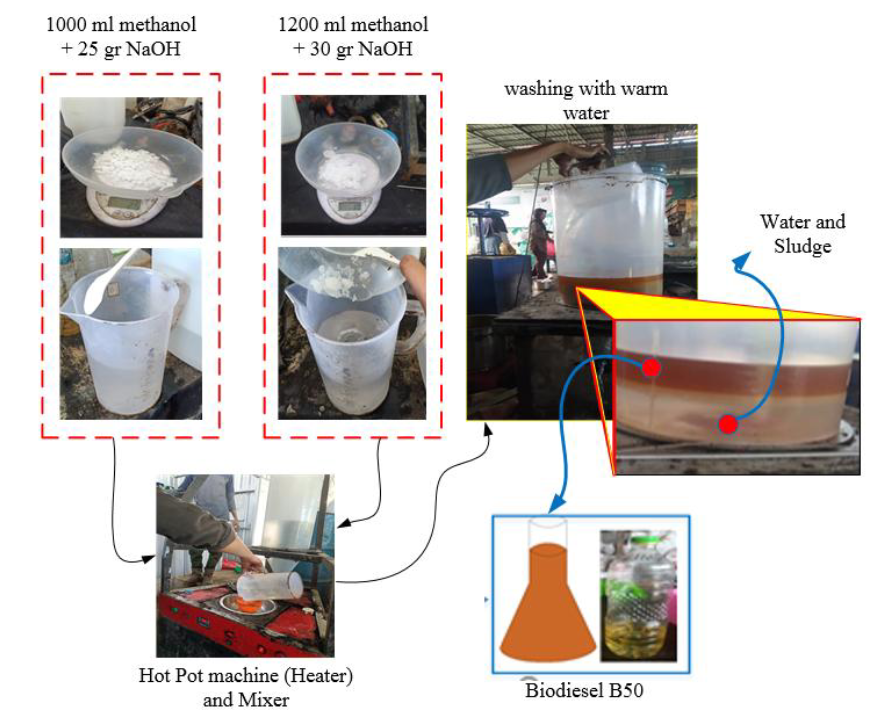
The research, entitled Effect of Methanol–NaOH Catalyst Variations on the Properties and Engine Performance of B50 Biodiesel from Waste Cooking Oil, uses the transesterification method to produce B50 biodiesel. Two catalyst combinations were investigated: 1,000 mL methanol with 25 g NaOH and 1,200 mL methanol with 30 g NaOH for every 5 liters of feedstock. The resulting biodiesel was evaluated based on density, viscosity, calorific value, torque, specific fuel consumption, thermal efficiency, and exhaust opacity.
The experimental results show that both biodiesel blends met the Indonesian density standard, while the blend produced using 1,200 mL methanol and 30 g NaOH met the required viscosity standard. However, the lower catalyst formulation—1,000 mL methanol and 25 g NaOH—provided the strongest overall engine performance. At 1,000 RPM and a 4,000 W load, this formulation achieved a maximum torque of 8.92 Nm, minimum specific fuel consumption of 406.90 g/kWh, and maximum thermal efficiency of 21.28%. Meanwhile, the higher catalyst formulation produced lower exhaust opacity.
The findings demonstrate that biodiesel production requires a balance between fuel quality and engine performance. Increasing catalyst and methanol quantities can improve certain fuel characteristics, but the lower catalyst formulation may provide a better balance for engine operation.
This research contributes to SDG 1 by supporting sustainable economic opportunities through waste-to-energy technology, SDG 3 through efforts to reduce environmental pollution associated with waste and diesel emissions, and SDG 4 through the development and dissemination of scientific and engineering knowledge. The study also contributes to SDG 14 by supporting cleaner energy alternatives that can help reduce environmental pressures associated with transportation, and SDG 15 through the productive utilization of waste materials. SDG 17 is supported through collaboration between researchers from Universitas Hasanuddin and Institut Teknologi Kalimantan.
The research demonstrates that waste cooking oil can be transformed into a useful alternative fuel while maintaining acceptable diesel engine performance. Further research can explore long-term engine operation, optimization of biodiesel composition, emission reduction, and potential applications in marine diesel engines.
Publication:
Suardi, S., Hariyono, H., Mahmuddin, F., Alwi, M. R., Pawara, M. U., Alamsyah, A., & Setiawan, W. (2026). Effect of Methanol–NaOH Catalyst Variations on the Properties and Engine Performance of B50 Biodiesel from Waste Cooking Oil. Jurnal Teknik Pertanian Lampung, 15(1), 79–89.
DOI:
10.23960/jtepl.v15i1.79-89
Publication Link:
https://jurnal.fp.unila.ac.id/index.php/JTP/article/view/11282
Contact Person:
Suardi
Institut Teknologi Kalimantan
Email: suardi@lecturer.itk.ac.id