
Fluid Dynamics and Energy Research Group (FDERG), Universitas Hasanuddin, is developing computational approaches to address challenges in marine and coastal engineering. One of its research activities focuses on improving seawater desalination technology through Computational Fluid Dynamics (CFD) simulation of a Sea Water Reverse Osmosis (SWRO) membrane system.
Access to reliable freshwater remains an important challenge for many coastal and island communities. Seawater desalination provides an opportunity to produce freshwater from abundant seawater resources, but the efficiency of the process depends on several operating and membrane parameters. Understanding water flow through the membrane is therefore important for improving system performance and supporting the development of more efficient desalination technology.
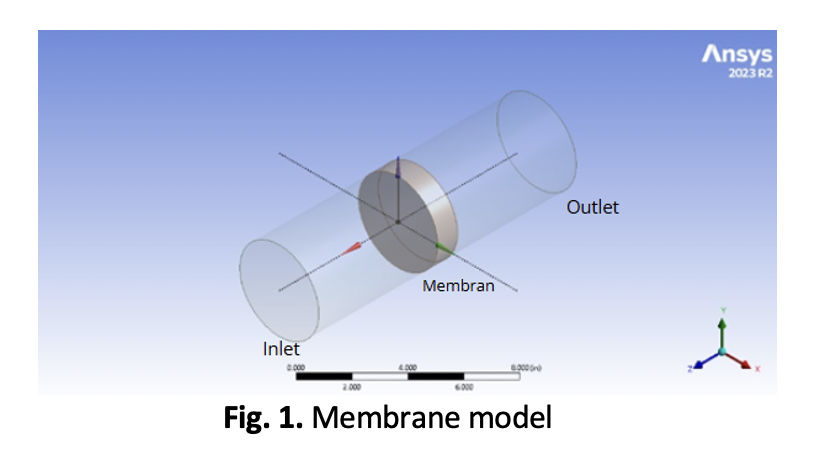
The research, entitled CFD Simulation of Water Flow through a SWRO Membrane, investigates the flow characteristics of seawater passing through an SWRO membrane using numerical simulation. The study applies Computational Fluid Dynamics to examine the influence of membrane pore size and inlet pressure on water flow and flux. Three membrane pore sizes, namely 1, 2, and 3 micrometers, were investigated under different inlet pressure conditions.
The simulation results demonstrate that operating pressure has an important influence on water flux through the membrane. At an inlet pressure of 145.04 psi, the membrane with a 3-micrometer pore size achieved a water flux of approximately 23.4 liters per square meter per hour (LMH). These results provide useful information for understanding the relationship between operating conditions and desalination performance.
The research has potential relevance to coastal and island communities where freshwater availability can be affected by geographical conditions and limited infrastructure. More efficient desalination systems can support the availability of clean water while reducing the pressure on limited freshwater resources.
The study contributes to several Sustainable Development Goals (SDGs). It supports SDG 1 by contributing to infrastructure and technological solutions that can improve the resilience of communities facing resource limitations. It supports SDG 3 through improved access to clean water and healthier living environments, and SDG 4 by strengthening knowledge and technological capacity in marine and environmental engineering. The research also contributes to SDG 14 by supporting responsible management of marine resources and SDG 15 by encouraging technological approaches that can reduce pressure on freshwater and terrestrial ecosystems. In addition, the research supports SDG 17 through scientific collaboration and knowledge exchange in the development of sustainable water technologies.
This study demonstrates how CFD can be used as an efficient tool for evaluating and optimizing desalination systems before extensive physical testing. The results provide a foundation for further research into membrane configuration, operating conditions, energy efficiency, and experimental validation of SWRO systems for coastal and maritime applications.
Publication: CFD Letters, Volume 18, Issue 4, pp. 94–102, 2025
DOI: 10.37934/cfdl.18.4.94102
Publication Link:
https://doi.org/10.37934/cfdl.18.4.94102
Contact Person:
Faisal Mahmuddin
Fluid Dynamics and Energy Research Group (FDERG), Universitas Hasanuddin
Email: f.mahmuddin@unhas.ac.id