
Unmet need for family planning remains a major public health challenge across Indonesia, particularly in remote regions like South Sorong, Southwest Papua. High rates of unmet need contribute directly to unintended pregnancies, high maternal risk, and gaps in reproductive decision-making. Traditional health counseling methods, such as passive flip charts, frequently encounter barriers including low community health literacy, persistent myths, and limited engagement. To address these challenges, researchers from the Graduate School of Midwifery Science at Hasanuddin University—Mirnawati, Mardiana Ahmad, Andi Nilawati Usman, and Darmawansyah—conducted a quasi-experimental study to evaluate the impact of a high-intensity, multi-session animated video intervention compared to conventional flip charts on contraceptive knowledge and usage interest among high-risk women of childbearing age.
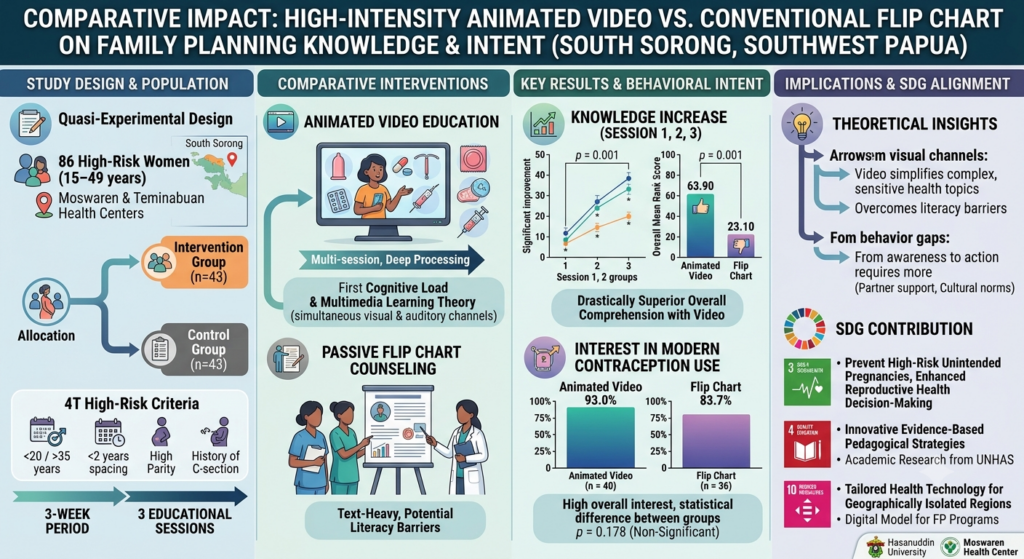
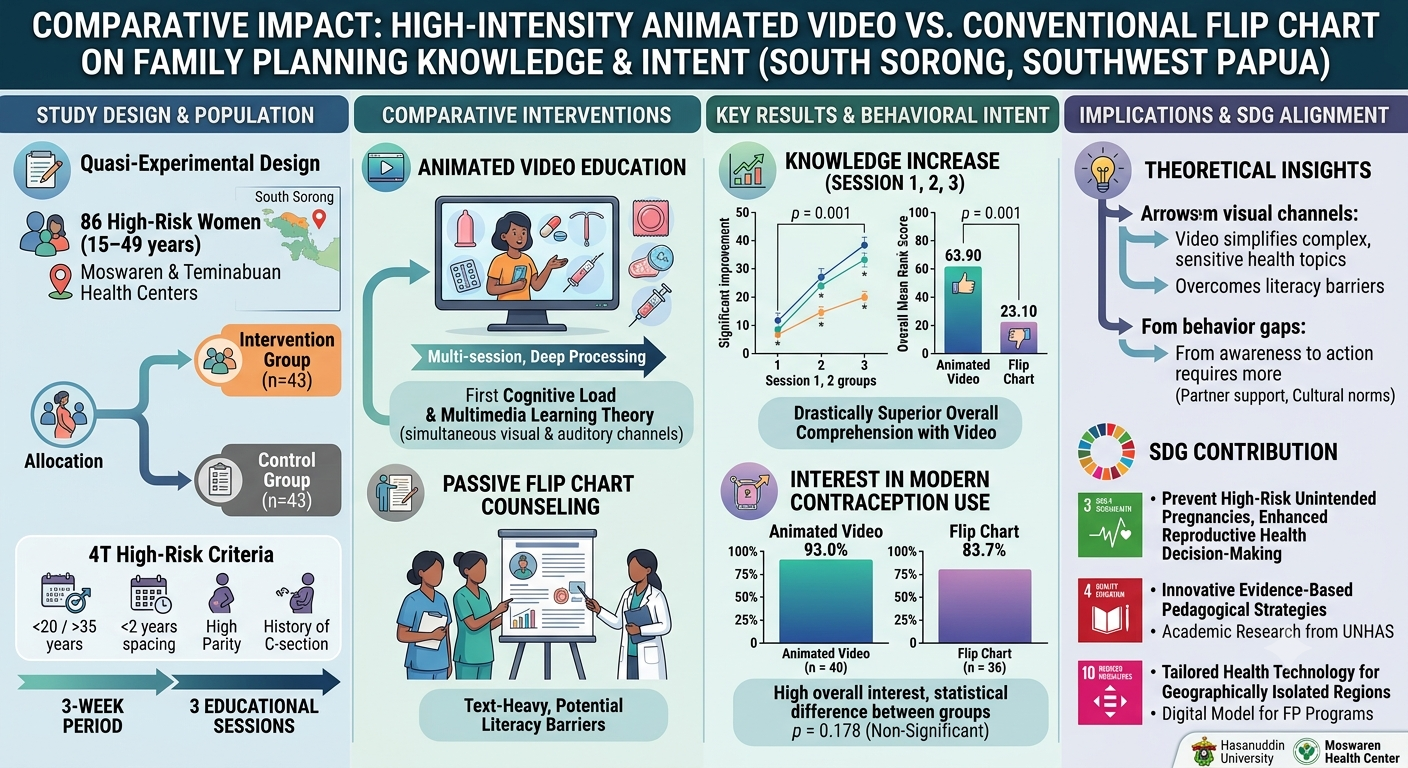
The study evaluated 86 high-risk women (15-49 years) with unmet contraceptive needs attending the Moswaren and Teminabuan Health Centers, who were allocated into an intervention group (n = 43) and a control group (n = 43). High-risk status was defined using the 4T framework, incorporating factors such as maternal age (<20 or >35 years), pregnancy spacing (<2 years), high parity, or a history of C-section complications. Over a three-week period involving three distinct educational sessions, the intervention group viewed animated contraceptive videos while the control group received counseling using standard flip charts. The statistical analysis demonstrated that while both modalities significantly increased knowledge scores across all sessions (p = 0.001), the animated video group achieved drastically superior overall comprehension, yielding a mean rank score of 63.90 compared to just $23.10$ in the flip chart group (p = 0.001).
The theoretical basis for the video’s success lies in Cognitive Load and Multimedia Learning theories, where simultaneous visual and auditory channels process information more deeply, simplifying complex or sensitive health topics and overcoming literacy barriers inherent in text-heavy media. Regarding behavioral interest, 93.0% of respondents ($n = 40$) in the animated video group expressed interest in using modern contraception following the intervention, compared to 83.7% (n = 36) in the control group. However, the statistical difference between groups for uptake interest did not reach significance (p = 0.178). This highlights that while dynamic visual media excels at accelerating cognitive knowledge acquisition, bridging the gap from awareness to actual behavioral action requires additional strategies to address lingering external obstacles, such as fear of side effects, partner support, and deeply rooted cultural norms.
Beyond its immediate clinical relevance, this research aligns with key Sustainable Development Goals (SDGs). By enhancing reproductive health literacy and decision-making in underserved communities, the study advances SDG 3 (Good Health and Well-Being) through the prevention of high-risk unintended pregnancies. It supports SDG 4 (Quality Education) by demonstrating innovative, evidence-based pedagogical strategies developed through interdisciplinary academic research at Hasanuddin University. Lastly, it contributes to SDG 10 (Reduced Inequalities) by delivering tailored, accessible health technology to women living in geographically isolated regions with limited health infrastructure, offering a modern digital model for family planning programs across Indonesia.
Contact:
Dr. Andi Nilawati Usman
+62 852-4009-3168
andinilawati@pasca.unhas.ac.id