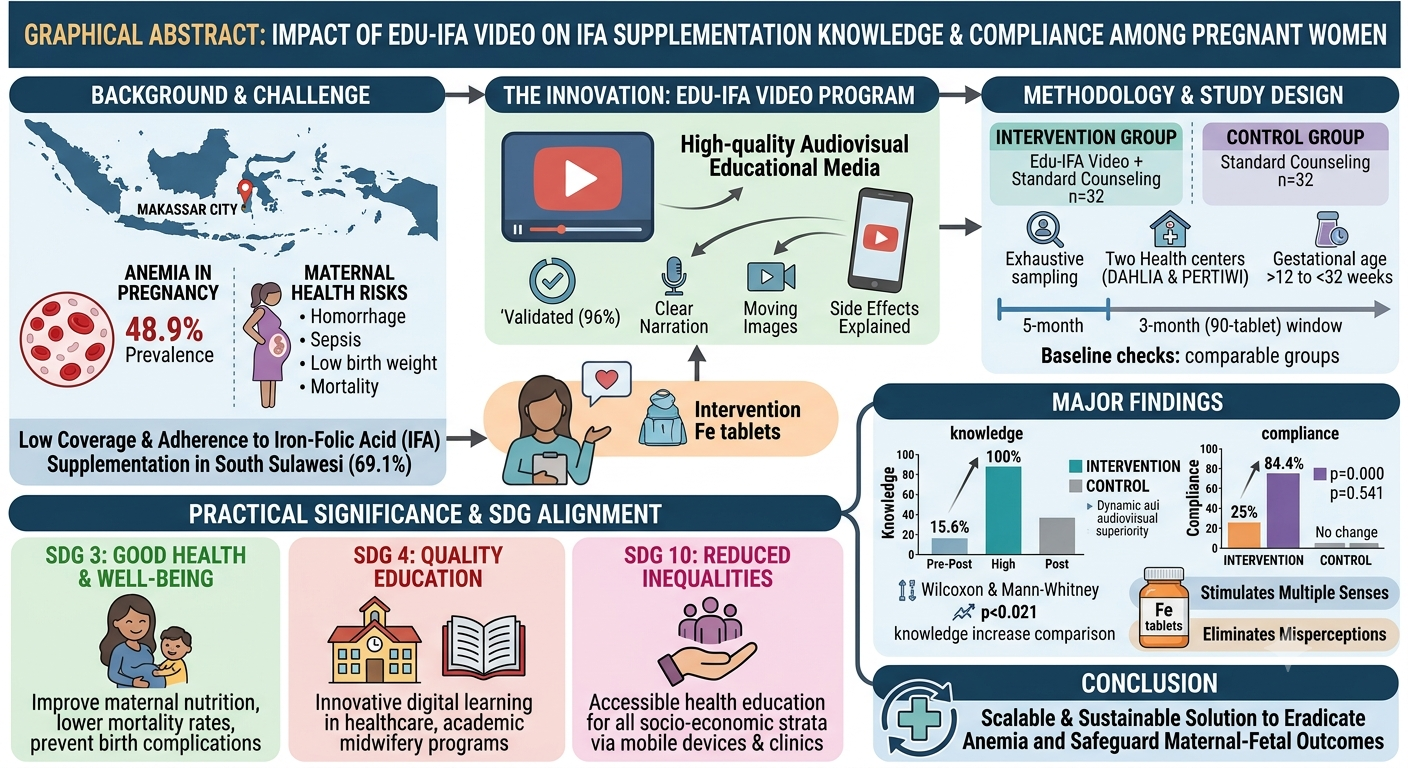

MAKASSAR, Indonesia April 23 2026/WOMENHEALTH/ – Anemia during pregnancy remains a severe public health challenge in Indonesia, where national data from Riskesdas reveals a prevalence rate of 48.9%, driven predominantly by iron deficiency and low adherence to iron-folic acid (Fe) supplementation. Severe maternal anemia carries critical health risks, including increased susceptibility to intrapartum hemorrhage, sepsis, low birth weight, and maternal mortality. Although the Indonesian government mandates that every pregnant woman receive at least 90 blood supplement tablets to prevent complications, regional statistics show that South Sulawesi ranks among the provinces with the lowest coverage at only 69.1%. Furthermore, standard health counseling often fails to overcome common barriers such as lack of knowledge, forgetfulness, and fear of side effects like nausea. To address this gap using modern communication technology, researchers Tira Zhagira, Elizabet Catherine Jusuf, Andi Nilawati Usman, Mardiana Ahmad, Werna Nontji, Aryadi Arsyad, and Intan Idiana Hassan from Hasanuddin University, Primadani Soppeng, and Universiti Sains Malaysia evaluated the impact of an educational video program called Edu-IFA on pregnant women’s knowledge and compliance in Makassar City.
The study employed a quasi-experimental design with a non-equivalent control group across two public health centers with the highest anemia prevalence in Makassar: Dahlia Health Center and Pertiwi Health Center. A total of 64 pregnant women (gestational age >12 to <32 weeks) were selected through exhaustive sampling and divided into an intervention group (n = 32) receiving the Edu-IFA video program and a control group (n = 32) receiving standard health worker counseling over a 5-month period, involving a 3-month (90-tablet) supplementation window. Prior to deployment, the Edu-IFA media underwent rigorous validation, earning high feasibility scores from media experts (96%), material experts (94.4%), and pregnant women trials (94.6%). Baseline characteristic analysis confirmed that both groups were statistically comparable across key demographic parameters—including gestational age, educational background, employment status, and antenatal care (ANC) visits—ensuring an unbiased comparative framework.
Statistical evaluation demonstrated the superior educational efficacy of dynamic audiovisual media over conventional counseling methods. Following the intervention, the Wilcoxon and Mann-Whitney tests revealed a statistically significant increase in knowledge for both cohorts (p = 0.000), with posttest scores favoring the video intervention group (p = 0.021). Specifically, 100.0% of participants in the Edu-IFA intervention group experienced an increase in knowledge without a single respondent demonstrating stagnant or declining understanding. In contrast, the control group achieved a 90.6% increase in knowledge, with 6.2% remaining unchanged and 3.1% experiencing a decline. Regarding compliance, monitoring over the 90-tablet consumption period showed a significant improvement in the Edu-IFA group using the McNemar test (p = 0.000), rising to an 84.4% post-intervention compliance rate (with 59.4% showing direct adherence gains). Meanwhile, the control group showed no statistically significant change in compliance over time (p = 0.541). By combining moving images, clear narration, and animated demonstrations, the Edu-IFA video effectively stimulated multiple human senses, eliminating misperceptions regarding side effects and reinforcing proper intake timing.
DOI
https://jurnal.fkmumi.ac.id/index.php/woh/article/view/1533/401
Contact:
Andi Nilawati Usman
+62 852-4009-3168
andinilawati@pasca.unhas.ac.id
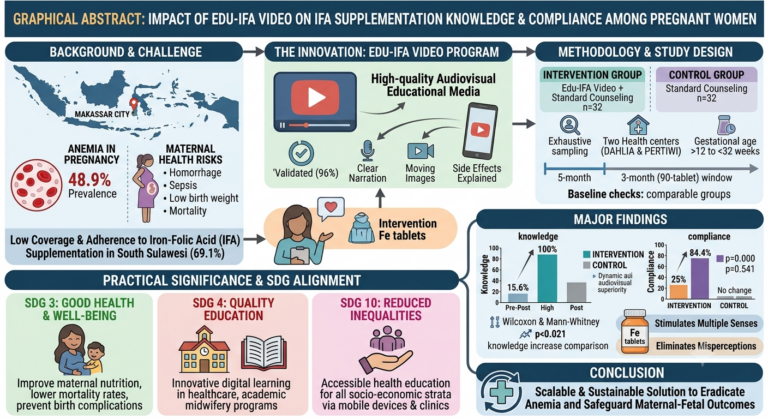
The practical significance of these findings extends to international health goals, aligning with the United Nations Sustainable Development Goals (SDGs). Primarily, the research advances SDG 3 (Good Health and Well-Being) by establishing an accessible, non-pharmacological strategy to improve maternal nutrition, prevent severe birth complications, and lower maternal and infant mortality rates in urban health settings. Furthermore, the collaborative design and validation of Edu-IFA support SDG 4 (Quality Education) by introducing innovative digital learning methodologies into maternal healthcare practices and academic midwifery programs. Lastly, by providing an easily accessible tool suitable for mobile devices and primary care clinics (Puskesmas), the initiative contributes to SDG 10 (Reduced Inequalities), ensuring that high-quality health education reaches vulnerable pregnant women across unequal socio-economic strata. Integrating validated educational video media like Edu-IFA into standard antenatal care counseling offers health centers a highly scalable, sustainable solution to eradicate pregnancy anemia and safeguard maternal-fetal outcomes.