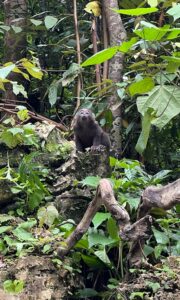
Understanding how primates communicate through gestures provides valuable insight into the evolutionary roots of human language. This research activity focuses on exploring the meaning, function, and context of gestural communication in a wild population of Macaca maura, an endemic primate species in South Sulawesi, Indonesia that remains relatively understudied. Through international collaboration with the University of Leipzig and the University of Lincoln, this study aims to contribute to a broader scientific understanding of primate communication systems and their relevance to human evolution.
The primary objective of this research is to investigate how gestures are produced and interpreted during social interactions among moor macaques. By systematically observing and documenting the variety, frequency, and context of gestures, the study seeks to uncover patterns of communication that reflect social structures, behavioral intentions, and interaction dynamics. These findings are expected to provide comparative insights with other macaque species and even hominids, enriching the scientific discourse on the origins of complex communication systems.
The research is conducted in the Hutan Pendidikan Universitas Hasanuddin, Bengo, South Sulawesi, Indonesia, where a wild group of macaques inhabits a natural forest ecosystem. Since the beginning of fieldwork in February 2024, the study has focused on three main stages: group habituation, individual identification, and the development of a gestural ethogram. The group is currently considered semi-habituated, as individuals tolerate human observers at a distance of approximately 20 meters. This progress is indicated by reduced stress-related behaviors, such as alarm vocalizations and excessive scratching, and an increased presence of macaques on the ground.
In terms of group composition, observations have identified approximately 26 individuals, consisting of 7 adult males, 9 adult females, and 10 juveniles. While adult individuals have been fully identified, juvenile identification remains ongoing due to morphological similarities. Additionally, around 20 distinct gesture types have been documented across different social contexts. These include agonistic gestures such as “shake branch,” play-related gestures like “bite” and “grab,” and affiliative gestures such as “mouth touch.” These preliminary findings form a strong foundation for further data collection and analysis.
This research activity also contributes to global development priorities. It supports SDG 4 (Quality Education) by providing hands-on research opportunities that enhance scientific skills and knowledge exchange. It aligns with SDG 15 (Life on Land) by generating critical knowledge for the conservation of endemic wildlife and forest ecosystems. Moreover, the international collaboration reflects SDG 17 (Partnerships for the Goals), emphasizing the importance of cross-institutional cooperation in addressing global scientific and environmental challenges. Additionally, the involvement of local assistants contributes indirectly to SDG 1 (No Poverty) by supporting community engagement and capacity building.
This activity involved 12 researchers and field assistants and was conducted from February to June 2024. Through this initiative, the research not only advances scientific understanding but also strengthens collaboration, education, and conservation efforts in Indonesia.