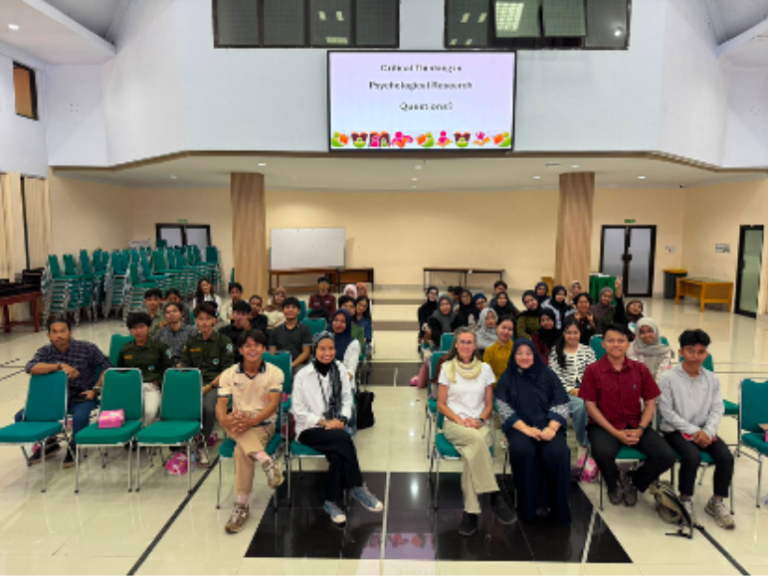
The relationship between children and nature plays a fundamental role in shaping future attitudes toward environmental conservation. Recognizing this, a collaborative research project entitled Children and Nature: The Interconnections for the Future was conducted to explore how children perceive animals and how these perceptions may influence their behavior in the long term. This study was a joint initiative between the Forest Conservation Study Program, Faculty of Forestry, Hasanuddin University, and international partners including the Max Planck Institute and the University of Leipzig, Germany, reflecting a strong interdisciplinary and cross-cultural collaboration.
The objective of the activity was to analyze children’s knowledge, perceptions, and attitudes toward animals, particularly in urban environments, and to understand how these factors may serve as a foundation for designing effective environmental education and conservation strategies. The location of the activity was in Makassar City, an urban area where access to natural environments and wildlife interaction is relatively limited. The study was conducted over February – June 2022, involving 81 participants, consisting of 60 child respondents, 20 adult respondents, and one Indonesian undergraduate student who actively contributed to the research process. The project was carried out in collaboration with Max Planck Institute and University of Leipzig (Germany) as the international partners, while the student involved was one bachelor’s student from the Faculty of Forestry, Hasanuddin University.
Using structured interview methods, the study gathered data on how children perceive different types of animals. The analysis was conducted using descriptive statistical methods in Microsoft Excel and correlation analysis with SPSS to identify relationships between age, education level, and perceptions of animals. The findings revealed that as respondents grow older and attain higher levels of education, their knowledge about animals tends to increase. However, perceptions among children showed a strong bias: more than 51% of child respondents associated wild animals with negative attributes such as dangerous, unattractive, unintelligent, disgusting, and frightening. In contrast, over 58% of children viewed pets as likeable, beautiful, and intelligent.
Interestingly, 70% of child respondents stated that animals they do not consume are generally categorized as wild animals, reflecting a disconnect between perception and ecological understanding. Despite these perceptions, a promising finding emerged: 93% of children expressed a willingness to protect and care for animals. This highlights a significant opportunity to reshape children’s attitudes through targeted education and increased exposure to nature.
This activity contributes directly to several Sustainable Development Goals (SDGs). It supports SDG 1 (No Poverty) by laying the groundwork for future community-based conservation awareness that can contribute to sustainable livelihoods. It advances SDG 4 (Quality Education) by emphasizing the importance of environmental education in shaping knowledge and attitudes from an early age. Furthermore, the project reflects SDG 17 (Partnerships for the Goals) through strong collaboration between local and international institutions. Additionally, it aligns with SDG 15 (Life on Land) by promoting awareness and long-term conservation of terrestrial biodiversity.
Overall, this research highlights the critical importance of early environmental education in urban settings. By understanding how children perceive animals, this study provides valuable insights for developing effective strategies to foster positive attitudes toward wildlife and conservation, ultimately contributing to a more environmentally conscious future generation.