
MAKASSAR, Indonesia, February 23, 2026 /TREDIC/ – Mining may fuel economic growth, but it often leaves behind landscapes that are severely damaged and difficult to restore. In Indonesia, open-pit nickel mining strips away fertile soil, disrupts ecosystems, and exposes land to toxic metals. The big question is: can these lands truly recover?
A recent study titled “Potential of Native Tree Species for Post-Nickel Mining Land Restoration”, published by Jurnal Penelitian Kehutanan Wallacea, Hasanuddin University, on May 24, 2025, offers a promising answer—yes, but only if we rethink how restoration is done.
Traditionally, companies attempt to restore mined land by planting fast-growing, non-native tree species. At first glance, this seems effective. These trees grow quickly and create green cover. However, the study shows that this success is often temporary. After a few years—especially once maintenance stops—many of these trees struggle to survive. Their roots expand beyond treated soil and encounter harsh conditions: acidic soil, low nutrients, and heavy metal contamination. As a result, growth declines and mortality increases.
But nature has its own strategy.
Researchers found that native tree species—those naturally adapted to local conditions—begin to “invade” these restored areas over time. In fact, the older the restoration site, the more native species appear. In 10-year-old sites, native trees not only dominate in number but also show strong regeneration patterns. Species such as Buchanania arborescens, Alstonia macrophylla, and Ficus spp. demonstrate the ability to grow, reproduce, and sustain themselves in these extreme environments .
This finding is critical. Unlike planted non-native species, native trees follow a natural regeneration pattern, ensuring long-term ecosystem recovery. In ecological terms, they form a stable “inverted J” population structure—meaning younger individuals are continuously replacing older ones. This is a sign of a healthy, self-sustaining forest.
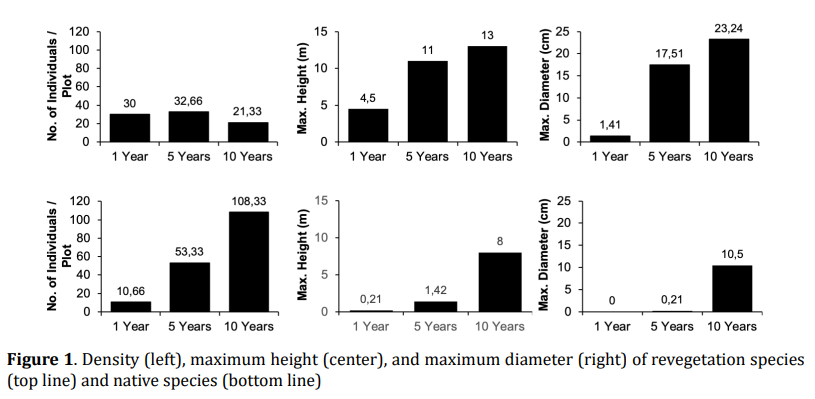
The implication is clear: restoration should not fight nature—it should work with it. Instead of relying heavily on imported species, restoration strategies should prioritize native trees that already possess the resilience needed to survive post-mining conditions.
This issue is closely linked to several Sustainable Development Goals (SDGs). First, SDG 15: Life on Land emphasizes restoring degraded ecosystems and promoting sustainable land use. Using native species directly supports biodiversity recovery and ecological balance. Second, SDG 13: Climate Action is relevant because restoring forests enhances carbon sequestration, helping mitigate climate change. Third, SDG 12: Responsible Consumption and Production reminds us that resource extraction, like mining, must be followed by responsible environmental restoration.
Ultimately, this research highlights a shift in mindset. Restoration is not just about planting trees—it is about rebuilding ecosystems that can survive on their own. Native species are not just part of the solution; they may be the key to turning damaged mining land into thriving forests once again.
Reference :
DOI : 10.24259/jpkwallacea.v14i1.44192
Contact:
Putu Oka Ngakan
ngakan.po@unhas.ac.id