
About Us
SESREG
The Seagrass Restoration and Ecosystem Services Research Group (SESREG), a collaborative team of researchers dedicated to advancing seagrass ecosystem restoration and its environmental benefits. They focus on creating innovative strategies, techniques, and policies to restore seagrass habitats, boost biodiversity, and improve ecosystem services in marine environments. By working together and sharing a commitment to tackling ecological challenges, the group aims to develop effective solutions that promote marine conservation, increase ecosystem resilience, and advance environmental science and sustainable resource management.
Our Mission
We focus on uncovering the exceptional potential of the seagrass ecosystem and its vital importance for Earth. Beyond serving as a marine habitat, seagrass beds act as natural carbon sinks, water filters, and coastal protectors. Through interdisciplinary research, innovative restoration efforts, and active partnerships with scientists, policymakers, and local communities, we aim to preserve the health of coastal ecosystems for future generations. Seagrass beds are essential for ocean health—they absorb carbon, improve water clarity, and provide habitats for countless marine species.
SESREG leads in researching, restoring, and safeguarding these critical ecosystems. By combining scientific innovation with community engagement, we translate research into tangible impact. Discover our mission and join us in making a difference! Beneath the peaceful waves, a hero ecosystem works tirelessly: seagrass beds. SESREG is dedicated to understanding and defending this vital resource from threats. We bring together advanced science, education, and community empowerment to ensure this blue legacy is sustainable. Together, we can restore the beauty of our coasts.
The Aim
Advancing Ecological Knowledge: Investigating the intricate roles of seagrass meadows in biodiversity, habitat provision, and nutrient cycling.
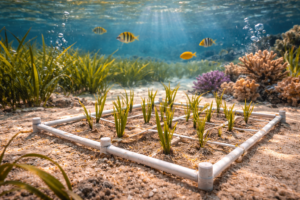
Pioneering Tropical Restoration: Developing and evaluating cutting-edge restoration methods, from tailored transplantation and seeding to water quality enhancement.
Quantifying Regulating Services: Measuring the tangible impacts of seagrass ecosystems—such as carbon sequestration, shoreline protection, and fisheries support—to highlight their societal and economic value.
Building Climate Resilience: Assessing climate change impacts on seagrass meadows and identifying actionable adaptation strategies to enhance their long-term survival.
Bridging Policy & Community: Partnering with local communities, stakeholders, and policymakers to drive collaborative conservation and restoration initiatives.
Empowering Through Education: Raising public and academic awareness through targeted outreach and educational programs to foster a culture of marine stewardship.
Road Map
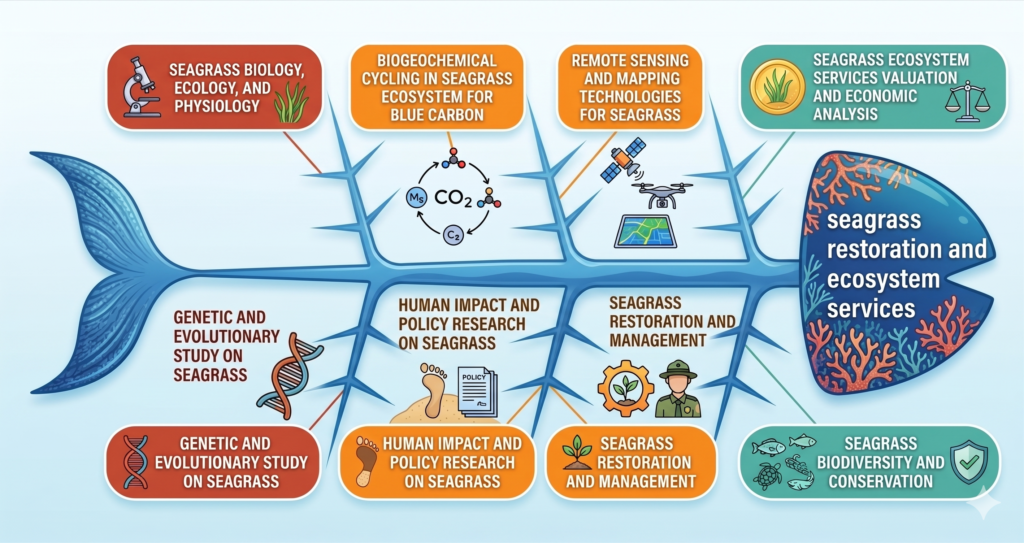
Research Group Theme
Biogeochemical Cycling in Seagrass Ecosystem for Blue Carbon
Seagrass Regulating Services & Blue Carbon Dynamics
Seagrass meadows are vital coastal biogeochemical engines, aiding climate mitigation and affecting ocean chemistry. Through photosynthesis, they absorb dissolved, converting it into organic material in their structures. Most carbon is stored in oxygen-poor sediments beneath, which can securely sequester it for centuries. As effective natural carbon sinks, they accumulate significant “Blue Carbon” despite occupying less than 0.2% of oceans. Beyond carbon storage, they act as filters and stabilizers, anchoring the seafloor, trapping particles, reducing erosion, and preventing buried carbon from re-entering water or air. Their photosynthesis releases oxygen, supporting marine life and lowering local $CO_2$ levels, which raises water pH and helps protect calcifying organisms from ocean acidification.
Biogeochemical Mechanisms & Climate Action
A seagrass meadow’s climate regulation relies on nutrient cycling, sediment management, and trace greenhouse gas emissions. Seagrasses transform key nutrients at the sediment boundary, with roots hosting bacteria that fix nitrogen. Dead leaves enrich sediments but also host microbes that produce methane and nitrous oxide. Balancing carbon storage with trace gas emissions is vital for climate impact assessment. Protecting these habitats offers environmental benefits and is included in climate policies. Human activities threaten these ecosystems, risking release of stored carbon. Conservation through spatial planning, runoff reduction, and restoration methods like seed broadcasting can restore meadows quickly. Including blue carbon in national inventories enables access to international funding, making local efforts part of a global climate strategy.
Seagrass Biodiversity and Conservation
The Architecture of Seagrass Biodiversity
Seagrass meadows are intricate, three-dimensional marine ecosystems that support biodiversity in coastal regions worldwide. Found across tropical, subtropical, and temperate waters, about 72 seagrass species, including key genera like Zostera, Posidonia, and Thalassia, create vast underwater canopies. These habitats are vital nursery areas for juvenile fish, crabs, and mollusks, offering shelter from predators and plentiful food. Besides aiding smaller species, seagrass ecosystems are essential to the broader marine food web, serving as primary feeding sites for large marine animals such as green sea turtles and dugongs, and indirectly supporting top predators like sharks and dolphins. Additionally, microscopic communities of epiphytic algae and microorganisms grow on seagrass blades, creating a highly productive living matrix that enhances biodiversity.
Seagrass Ecosystem Services Valuation and Economic Analysis
Ecosystem Services of Seagrass Meadows
Seagrass meadows are crucial ecosystems providing essential benefits, supporting local economies and combating climate change. They serve as nurseries for vital fish and shellfish, impacting food security and livelihoods. Locally, they are harvested for fertilizers, livestock feed, and crafts. They foster biodiversity, supporting coral reefs and mangroves, and play key roles in nutrient cycling, especially nitrogen and phosphorus. They store blue carbon, sequestering organic carbon in biomass and sediments for millennia. Nearshore, canopies trap sediments and absorb nutrients, improving water clarity. Roots stabilize sediments, leaves reduce wave energy, and protect shorelines from erosion. These habitats offer cultural and recreational benefits like snorkeling, diving, and fishing, and are integral to indigenous maritime heritage.
Economic Valuation Frameworks
Quantifying natural benefits’ monetary value via economic valuation is vital for effective cost-benefit analyses influencing environmental and coastal development decisions. Market valuation provides clear metrics like fisheries revenue and tourism income. Since many natural assets lack a direct price, researchers use non-market techniques, such as valuing carbon sequestration based on carbon market prices. For intangible assets, indirect and survey methods are employed, like estimating water purification savings by seagrass. Contingent valuation surveys gauge public Willingness to Pay for conservation, while the avoided costs approach measures damages prevented, such as infrastructure savings from seagrass wave-dampening and reduced biodiversity losses.
Seagrass Restoration and Management
Goals of Seagrass Restoration
- Restore Habitat: Recover degraded seagrass meadows to support marine biodiversity.
- Enhance Ecosystem Services: Reinstate carbon sequestration, water quality improvement, and coastal protection functions.
- Improve Fisheries: Rebuild nursery habitats to sustain fish and invertebrate populations.
- Combat Climate Change: Enhance the role of seagrass as a blue carbon sink
Remote Sensing and Mapping Technologies for Seagrass
Remote Sensing in Seagrass Research
Remote sensing has revolutionized coastal ecology by allowing researchers to observe large underwater meadows without relying solely on labor-intensive diving surveys. Through satellite imagery, aerial sensors, and drones, scientists can effectively map the extent and distribution of seagrass beds across vast areas. Advanced spectral analysis techniques help differentiate seagrass from similar-looking features, accurately distinguishing it from coral reefs, macroalgae, or bare ground. These digital tools not only facilitate mapping but also enable monitoring of changes in meadow health and physical characteristics over time. High-resolution sensors detect variations in leaf area index (LAI) and above-ground biomass, offering early indicators of environmental stress. When water quality deteriorates due to increased turbidity, runoff, or temperature spikes, spectral data can reveal reductions in photosynthesis and canopy cover.
Human Impact and Policy Research on Seagrass
Human Impacts on Seagrass
Seagrass meadows face severe threats from physical damage and environmental changes. Coastal development activities like land reclamation, dredging, and port construction destroy habitats and stir up sediments that smother beds. Recreational and commercial boating also damage seafloors with propellers and anchors, causing scars that take years to recover. Overfishing removes predators and herbivores, leading to algal overgrowth that outcompetes seagrass. Indirectly, human activities alter water chemistry—nutrient pollution from runoff and sewage fuels algal blooms that block sunlight, crucial for photosynthesis. Climate change worsens these effects, with rising sea levels, warming, and acidification disrupting seagrass growth pr
The Role of Policy Research
Biophysical data alone can’t protect ecosystems; policy research links science to conservation. It involves creating legal strategies to reduce human impacts and manage coasts sustainably. Establishing Marine Protected Areas (MPAs) and enforcing strict catch limits, bans on bottom-trawling protect ecosystems. On land, zoning laws and natural buffers prevent sediment and pollution damage. Climate mitigation via Blue Carbon efforts also plays a role, with governments encouraged to restore seagrass meadows and use carbon credits and Payments for Ecosystem Services. Pollution controls limit runoff from industries, cities, and farms. Sustainable tourism policies—such as visitor limits, boat speed rules, and eco-moorings—help preserve ecosystems while supporting local economies.