
MAKASSAR, Indonesia Aug 31 2026 /RICE-RG/– Rice feeds more than half of the world’s population, especially across Asia. Yet producing enough rice is becoming more difficult as farmers face changing climates, limited land, and the challenge of using fertilizer efficiently. Early-maturing rice varieties offer one possible solution because they complete their life cycle faster and can support more flexible cropping systems. But their shorter growth period also means that fertilizer must be managed more carefully.
But what if drones and data could tell farmers how much nitrogen early-maturing rice really needs?
A study titled “Comprehensive evaluation of nitrogen fertilization impact on early maturing rice varieties using multivariate analysis and vegetation indices,” published in Frontiers in Sustainable Food Systems by Frontiers Media SA on September 11, 2025, explored this question. Researchers tested five early-maturing rice varieties and two moderate-maturing varieties under five nitrogen levels across two locations in South Sulawesi: Sidenreng Rappang and Maros.
The study combined field measurements with drone-based vegetation monitoring. A DJI P4 Multispectral drone captured images in several spectral bands, including red, green, blue, red-edge, and near-infrared. From these images, researchers calculated vegetation indices such as NDVI, which provides a numerical picture of crop greenness and plant condition. This approach allows researchers to observe crop responses without relying only on manual field measurements.
The results showed that nitrogen dose, variety, environment, and their interactions significantly influenced many growth and yield traits. Importantly, the researchers found that more nitrogen was not always better. Early-maturing rice has a faster growth cycle, so its nitrogen requirement may differ from that of conventional varieties. Too little nitrogen can slow growth, while excessive nitrogen can increase disease risk and reduce efficient allocation of plant resources.
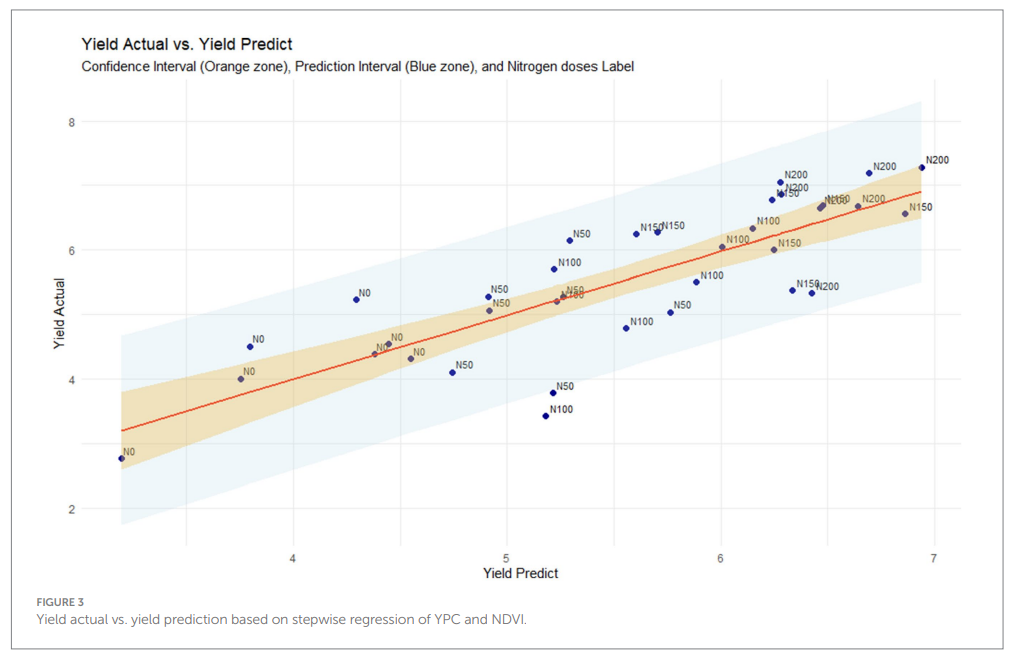
To make the information more practical, the researchers built a yield prediction model using yield per clump and NDVI. The final equation was: Yield per hectare = 0.877 + 0.093 (yield per clump) + 5.363 (NDVI). The model performed well in both training and testing data and could help estimate productivity earlier and more efficiently across larger planting areas.
This research is closely connected to SDG 15: Life on Land. Sustainable agriculture depends on using land and nutrients responsibly. Better nitrogen management can reduce unnecessary fertilizer use, improve crop efficiency, and help farmers maintain productive rice fields without adding avoidable pressure to soil and surrounding ecosystems. Combining early-maturing varieties with precision monitoring can therefore support more sustainable use of agricultural land.
For farmers, the message is practical: fertilizer decisions should not be based on habit alone. They can be guided by the crop’s actual response.
The future of rice production may depend not on applying more nitrogen, but on knowing exactly how much the plant needs—and when. With drones, vegetation indices, and better prediction models, that decision can become smarter, faster, and more sustainable.
Reference:
DOI: https://doi.org/10.3389/fsufs.2025.1615799
Contact:
Prof. Yunus Musa
+62 812-4219-968
ricerg@unhas.ac.id