
MAKASSAR, Indonesia Aug 31 2026 /RICE-RG/– Maize is a vital crop for food, animal feed, and industry, but farmers face a familiar problem: a hybrid that performs well in one place may disappoint in another. Soil type, rainfall, altitude, and local climate can all change how a maize variety grows. For plant breeders, finding a hybrid that is both productive and reliable across different environments is therefore just as important as achieving a high yield.
But how can breeders tell which maize hybrid is truly ready for farmers?
A study titled “Stability and adaptability analyses to identify suitable high-yielding maize hybrids using PBSTAT-GE,” published in Open Agriculture by Walter de Gruyter GmbH on July 7, 2025, offers a data-driven answer. The researchers evaluated eight candidate maize hybrids together with two commercial check varieties across eight locations in Indonesia with contrasting agro-climatic conditions, ranging from lowlands to highlands.
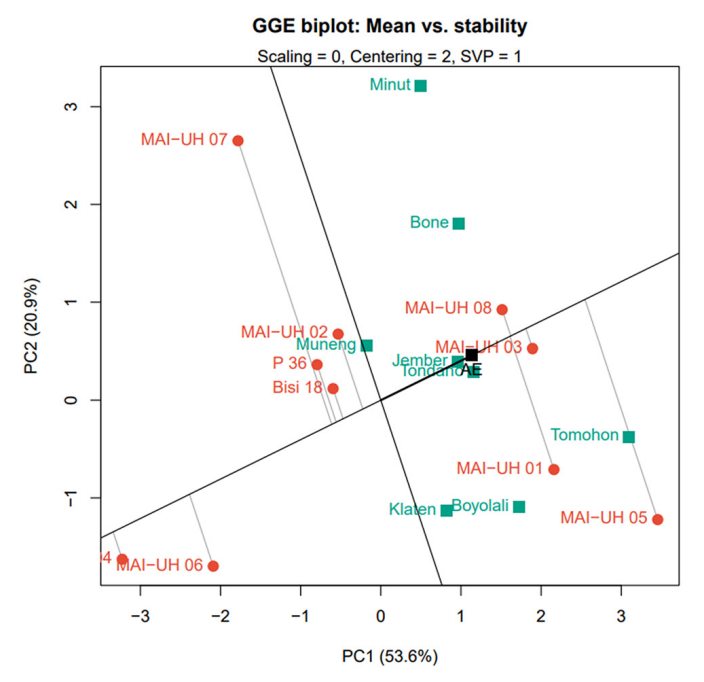
The study used PBSTAT-GE, a web-based statistical tool designed to analyze genotype-by-environment interaction. In simple terms, the software helps researchers answer two questions: does a hybrid produce consistently across locations, and does it have special advantages in particular environments? It combines several approaches, including AMMI, GGE biplots, and parametric and non-parametric stability analyses.
The field results showed why this matters. Average productivity across all environments was 10.55 tons per hectare, but yields varied substantially between locations. Klaten recorded the highest environmental average at 12.75 tons per hectare, while Bone recorded 9.01 tons per hectare. These differences confirmed that the environment strongly influences maize performance.
Two hybrids stood out. MAI-UH 03 and MAI-UH 08 showed strong combinations of productivity, stability, and adaptability. Their average yields reached 11.23 and 11.19 tons per hectare, respectively, and both performed better than the commercial comparison varieties in the final adaptability assessment. The researchers therefore recommended these two lines as promising candidates for hybrid maize variety release. Other hybrids, including MAI-UH 01, MAI-UH 02, and MAI-UH 05, showed useful location-specific adaptability, particularly for environments such as Tomohon and Boyolali.
This research is closely connected to SDG 15: Life on Land. Sustainable agriculture depends on crops that can use agricultural land effectively under diverse environmental conditions. Selecting maize hybrids that remain productive across changing soils, climates, and elevations can help farmers reduce the risk of poor harvests while making better use of existing farmland. It also highlights the importance of conserving and evaluating genetic diversity as a foundation for resilient crop production.
For farmers, the lesson is straightforward: the “best” maize is not simply the one with the highest yield in a single field. The better choice is often the hybrid that continues to perform when conditions change.
With tools such as PBSTAT-GE, plant breeding becomes more precise, helping turn complex field data into practical decisions about which seeds should be grown, where, and with greater confidence.
Reference:
DOI: https://doi.org/10.1515/opag-2025-0447
Contact:
Prof. Yunus Musa
+62 812-4219-968
ricerg@unhas.ac.id