
MAKASSAR, Indonesia Aug 31 2026 /RICE-RG/– Sugarcane supplies around 80% of the world’s sugar and about 40% of global biofuel production. Yet Indonesia still faces a gap between domestic sugar demand and production. In 2023, national sugar production fell to 2.23 million tons, down 7% from the previous year. Low-yielding varieties, unsuitable fertilization, and environmental stress are among the challenges limiting productivity.
But what if tiny particles could help sugarcane grow stronger and produce more?
A study titled “Productivity and Brix Content of Several Sugarcane (Saccharum officinarum) Varieties under Various Concentrations of Liquid Nanosilica Fertilizer,” published in the Sarhad Journal of Agriculture by ResearchersLinks Ltd on October 9, 2025, explored this possibility. The researchers tested three sugarcane varieties—Bululawang, TLH02, and PS 862—using four concentrations of liquid nanosilica fertilizer: 0, 1.0, 3.5, and 5.5 milliliters per liter.
Silicon is not considered an essential nutrient for most plants, but it can provide important benefits. Sugarcane is particularly good at accumulating silica, and previous research has linked silicon with stronger growth and better tolerance to stresses such as drought. Nanosilica, because of its extremely small particle size, offers a promising way to deliver this beneficial element more effectively.
The results were striking. Bululawang treated with 5.5 ml/L nanosilica produced the highest productivity, reaching 178.06 tons per hectare, with a Brix content of 20.63%. Brix is a simple measure of dissolved sugars in plant juice: the higher the Brix value, the sweeter and more sugar-rich the cane. Interestingly, the highest Brix value—24%—was recorded in PS 862 at the same nanosilica concentration, although its productivity was lower at 93.98 tons per hectare. This shows that producing more cane does not automatically mean producing sweeter cane.
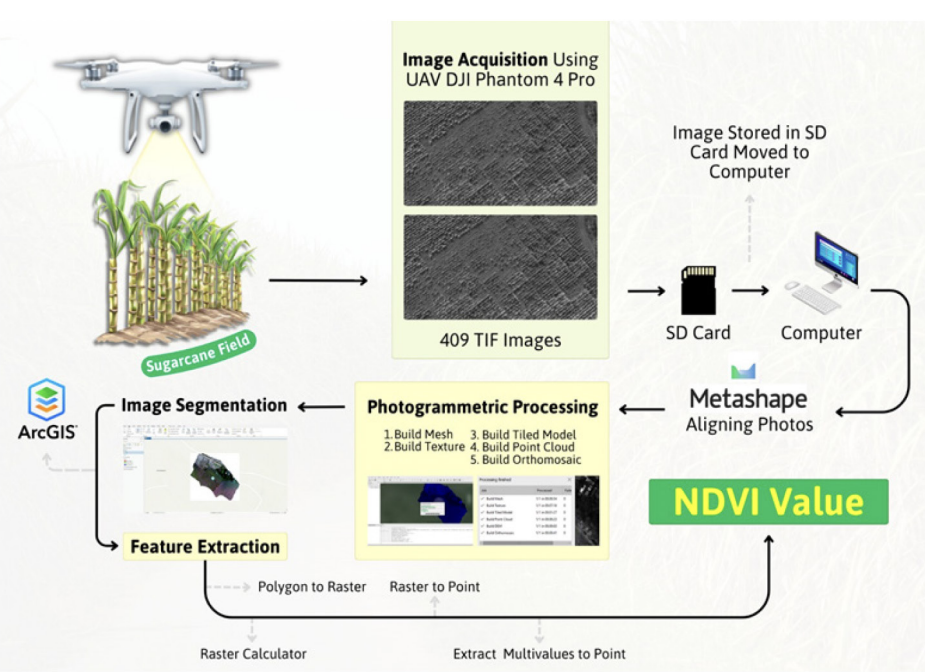
The study also found that the number of tillers and shoot weight had the strongest direct positive effects on productivity. Drone-based NDVI measurements were also used to observe crop condition, showing how field experiments can be combined with digital monitoring to better understand plant performance.
This innovation is closely connected to SDG 15: Life on Land. Sustainable agriculture requires productive land that can continue supporting crops without unnecessary pressure on natural resources. More precise fertilizer strategies can help farmers match inputs with the varieties that respond best, supporting more efficient use of agricultural land and healthier crop production.
For sugarcane growers, the message is practical: the best fertilizer strategy may depend on the variety and the goal. Bululawang showed exceptional yield potential, while PS 862 stood out for sugar concentration. Choosing the right combination can therefore help farmers target both productivity and quality.
Sometimes, improving a harvest does not require simply adding more fertilizer. It requires understanding what each variety needs—and using science to deliver it with greater precision.
Reference:
DOI: https://doi.org/10.17582/journal.sja/2025/41.4.1507.1522
Contact:
Prof. Yunus Musa
+62 812-4219-968
ricerg@unhas.ac.id