
Makassar, Indonesia, August 21, 2026/NUTRIFEED/— For many duck farmers, feed is more than just a daily requirement for their animals. It is one of the largest production costs and an important factor in determining productivity and farm income. Finding practical ways to improve feed efficiency while maintaining animal health is therefore essential.
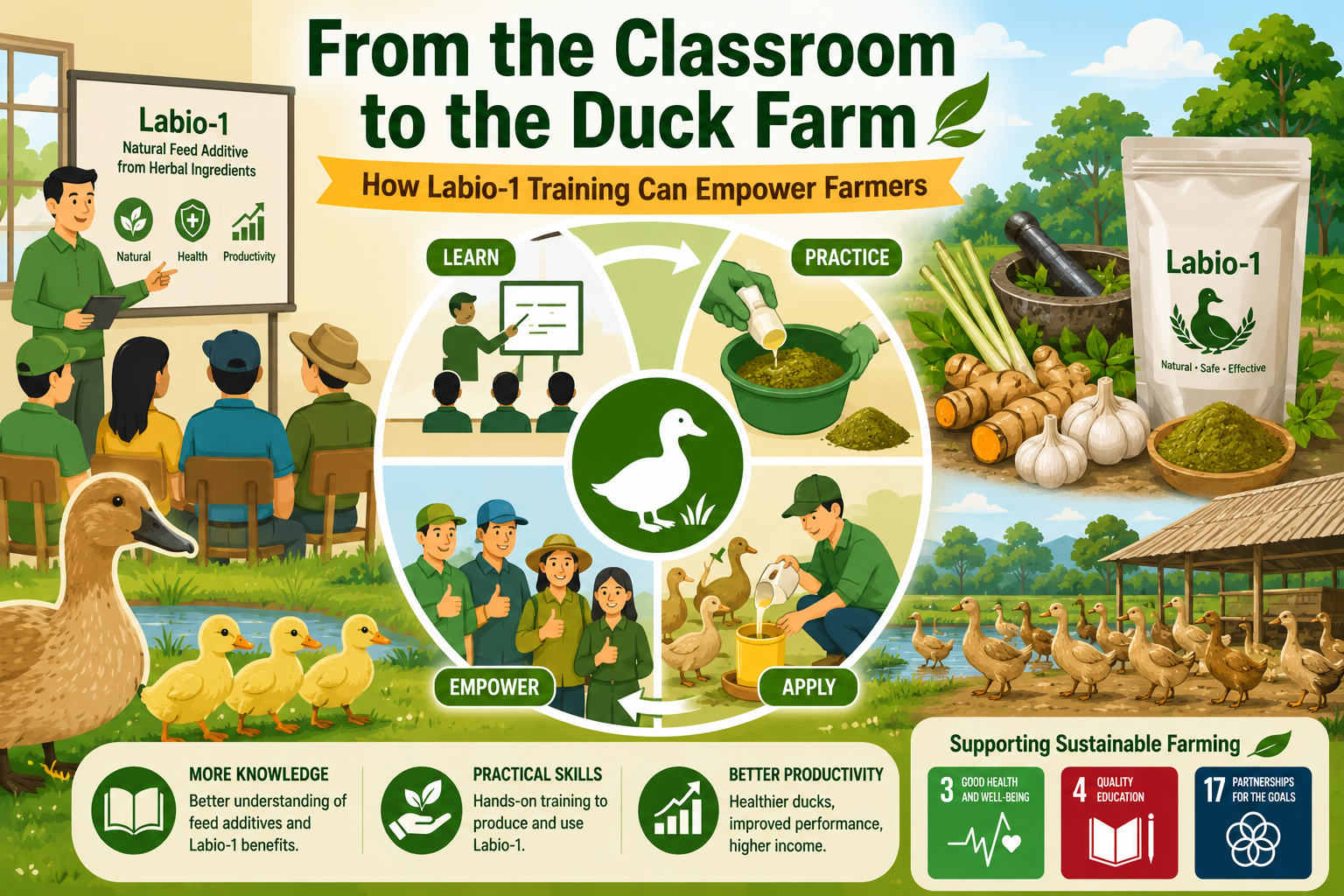
One promising approach may come from a natural innovation known as Labio-1, a phytobiotic-based feed additive developed from herbal ingredients.
But can an innovation developed through research make a real difference when farmers are given the knowledge and skills to use it themselves?
Feed additives are substances added to feed or drinking water to support animal health, digestion, and productivity. For many years, antibiotics were commonly used for this purpose. However, concerns about antimicrobial resistance and chemical residues have increased interest in safer and more natural alternatives. Phytobiotics, which contain active compounds derived from plants, offer one possible solution.
This issue is explored in the article “Peningkatan Pengetahuan Peternak Itik melalui Pelatihan Inovasi Teknologi Labio-1 sebagai Feed Additive.” Published in the Jurnal Pengabdian Inovasi dan Teknologi Kepada Masyarakat (JDISTIRA) by Yayasan Rahmatan Fiddunya Wal Akhirah on November 28, 2025, the article examined how training and hands-on practice could improve farmers’ knowledge and skills in producing and using Labio-1.
The community-based activity was conducted at Fajar Farm in Malimpung Village, Patampanua District, Pinrang Regency. It involved 22 participants, including duck farmers and agricultural and livestock extension workers. The program combined classroom learning with direct practical activities, allowing participants to move from understanding the concept of phytobiotic feed additives to learning how Labio-1 can be prepared.
The participants were evaluated through pre-tests and post-tests covering four areas: the basic concepts of feed additives and phytobiotics, the benefits of feed additives for duck productivity, the technical stages of making Labio-1, and hygiene and safety standards. The results showed significant improvement in all knowledge areas (p < 0.01), with the greatest improvement occurring in the technical aspects of producing Labio-1.
For duck farmers, training is not simply about receiving information. Practical learning can help transform scientific innovation into a skill that farmers can understand and apply. During the hands-on session, participants were directly involved in preparing ingredients, mixing materials, and packaging Labio-1. This approach helped bridge the gap between research developed at universities and its application on smallholder farms.
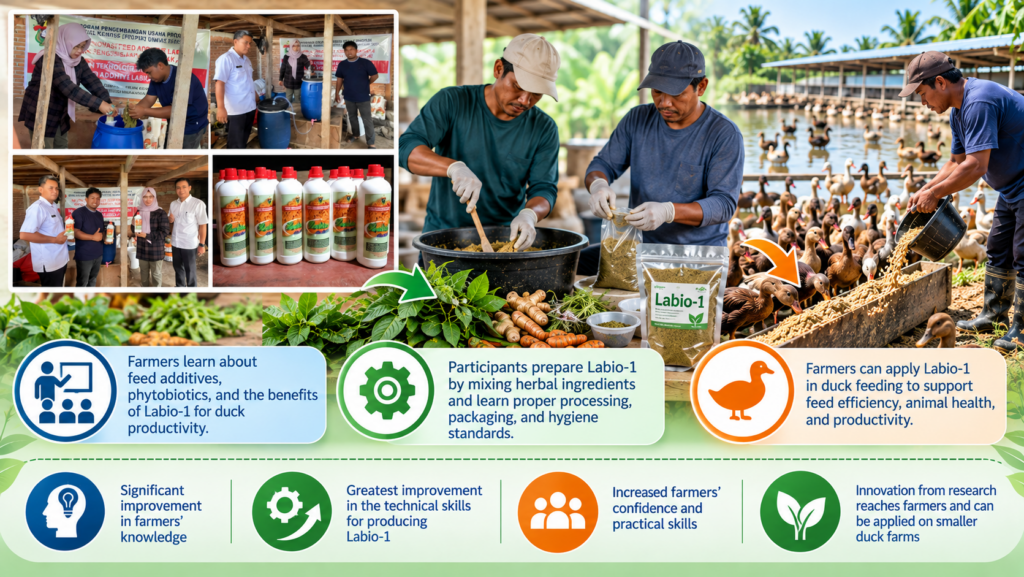
The study also highlights the importance of technology transfer. A promising innovation may remain limited if farmers do not have access to the knowledge, skills, and support needed to use it. Continuous training can therefore help farmers become more independent while encouraging local innovation.
This work supports SDG 3: Good Health and Well-Being by promoting phytobiotic alternatives that may support healthier duck production. It also supports SDG 4: Quality Education through practical knowledge and skills development for farmers. In addition, it connects with SDG 17: Partnerships for the Goals, demonstrating the importance of collaboration among universities, researchers, farmers, and extension workers.
The message is simple: innovation becomes more meaningful when knowledge leaves the laboratory and reaches the hands of farmers. Through training, practice, and collaboration, technologies such as Labio-1 can help strengthen knowledge, independence, and innovation in duck farming.
References
DOI: https://doi.org/10.58794/jdt.v5i2.1689
Contact:
Prof. Sri Purwanti
+62 811-4103-775
sripurwanti@unhas.ac.id