
Makassar, Indonesia August 22, 2026/NUTRIFEED/– For the animal feed industry, ensuring the safety of corn is an important step toward protecting livestock health and maintaining food quality. Corn may look acceptable at first glance, yet hidden risks can develop during harvesting, drying, transportation, and storage. One of the most concerning risks is aflatoxin, a toxin produced by certain molds that can contaminate corn and potentially affect animal health and food safety.
What if the physical condition of corn could provide an early warning before a serious contamination problem develops?
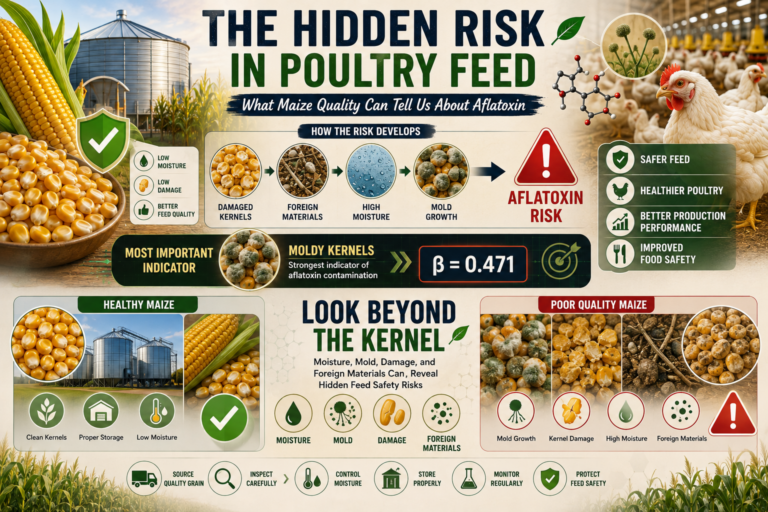
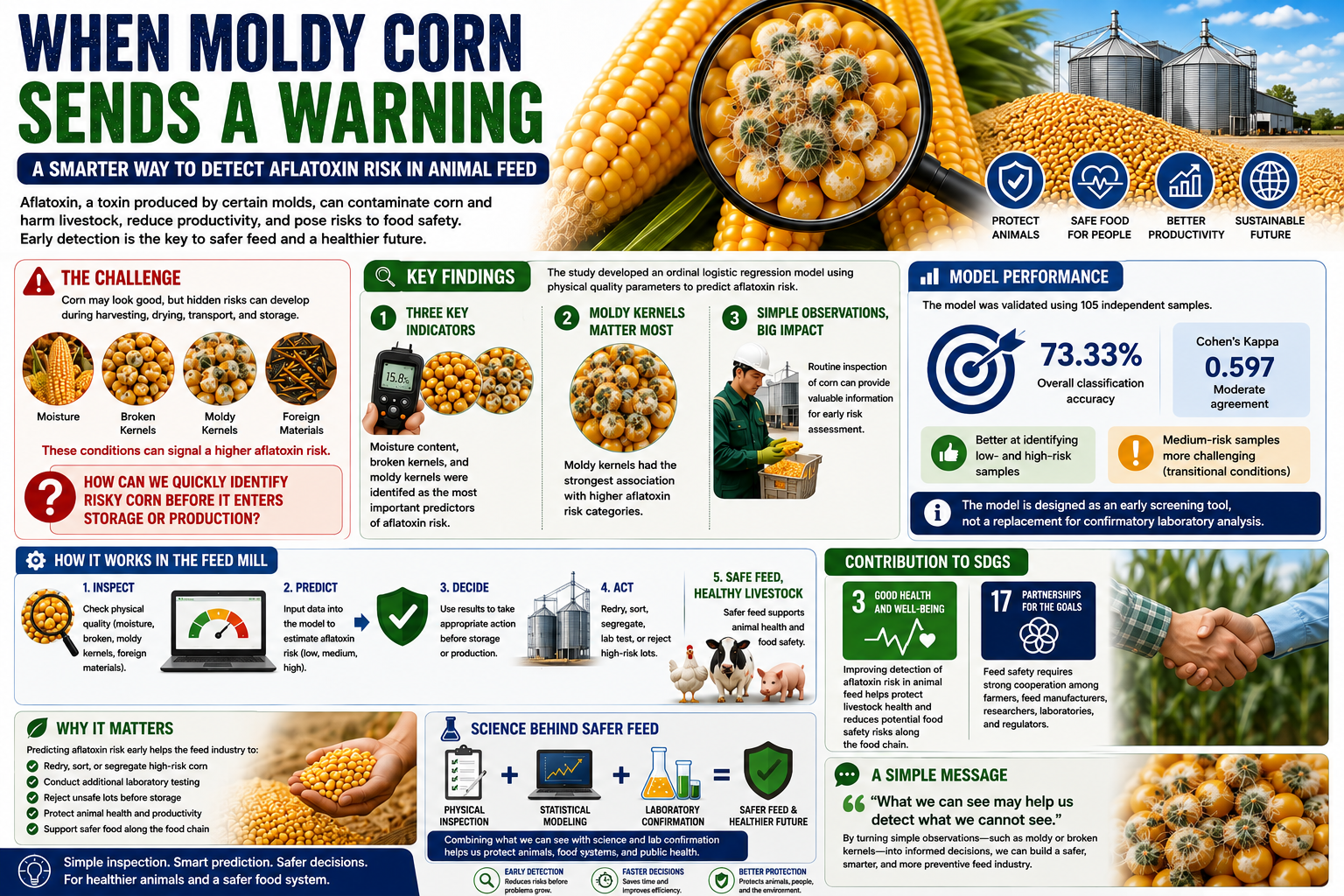
Aflatoxin contamination is closely associated with conditions that encourage fungal growth. Moisture, damaged grain, broken kernels, and visible mold can provide important clues about the quality and potential risks of corn used as animal feed. However, identifying these risks quickly can be challenging, particularly when large quantities of raw materials arrive at feed mills.
This issue is examined in the article “Prediction Of Aflatoxin Risk In Corn Feed Based On Physical Quality Parameters: Development And Validation Of Ordinal Models,” published in Agrobiological Records by Unique Scientific Publisher on July 09, 2026. The study developed and validated an ordinal logistic regression model to predict aflatoxin risk using physical quality parameters that can be observed during routine inspection.
The researchers examined several physical characteristics of corn, including moisture content, damaged kernels, broken kernels, moldy kernels, and foreign materials. The final model identified three particularly important predictors: moisture content, broken kernels, and moldy kernels. Among these indicators, moldy kernels showed the strongest association with a higher aflatoxin risk category. This finding highlights how simple physical observations can provide valuable information for early risk assessment.
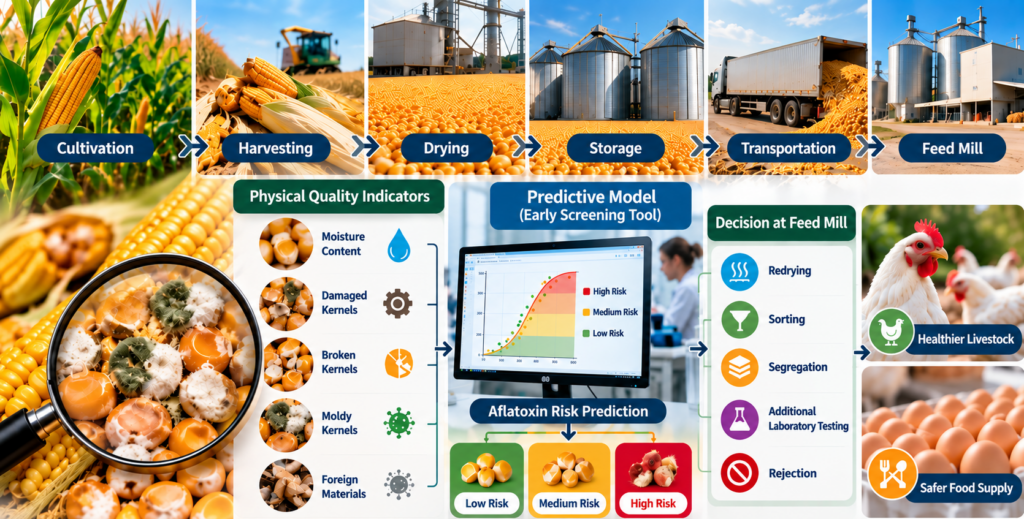
The model was validated using 105 samples and achieved an overall classification accuracy of 73.33%, with a Cohen’s Kappa value of 0.597, indicating moderate agreement between predicted and actual risk categories. The model performed better in identifying low- and high-risk samples, while medium-risk samples were more difficult to classify because they represent transitional conditions. These findings demonstrate that predictive models can support faster decisions at the feed mill. High-risk corn lots may be considered for redrying, sorting, segregation, additional laboratory testing, or rejection before entering storage. Importantly, the model is designed as an early screening tool, not as a replacement for confirmatory laboratory analysis.
The research is closely connected to SDG 3: Good Health and Well-Being. Improving the detection of aflatoxin risk in animal feed can contribute to healthier livestock and help reduce potential food safety risks along the food chain. It also supports SDG 17: Partnerships for the Goals, because effective feed safety requires cooperation among farmers, feed manufacturers, researchers, laboratories, and regulators.
For the feed industry, the message is simple: what we can see may help us detect what we cannot see. By combining routine physical inspection, statistical prediction, and laboratory confirmation, corn quality management can become faster, smarter, and more preventive. Science becomes most valuable when it transforms a simple observation—such as a moldy or broken kernel—into an informed decision that protects animals, food systems, and public health.
References
DOI: https://doi.org/10.47278/journal.abr/2026.045
Contact:
Prof. Sri Purwanti
+62 811-4103-775
sripurwanti@unhas.ac.id