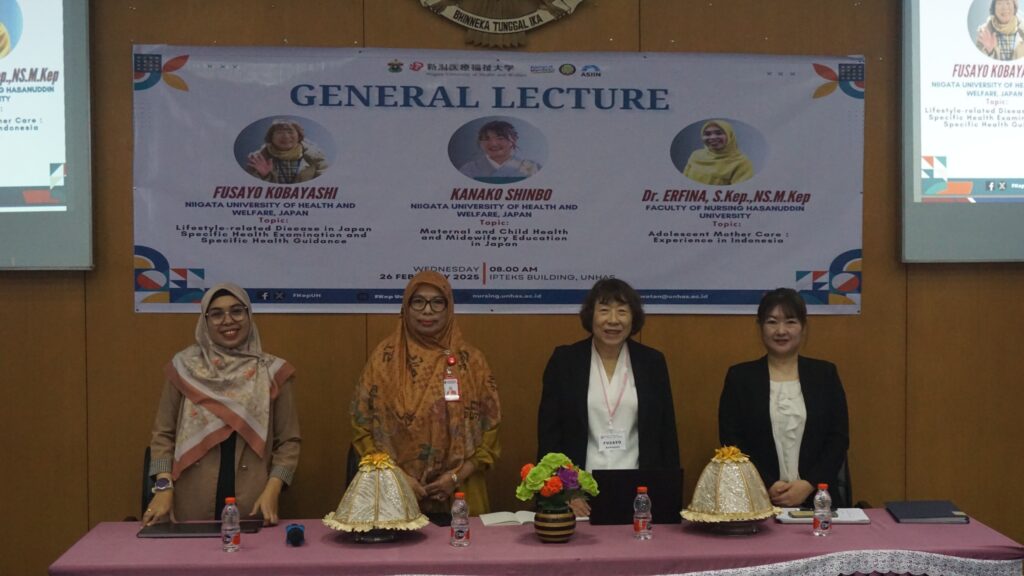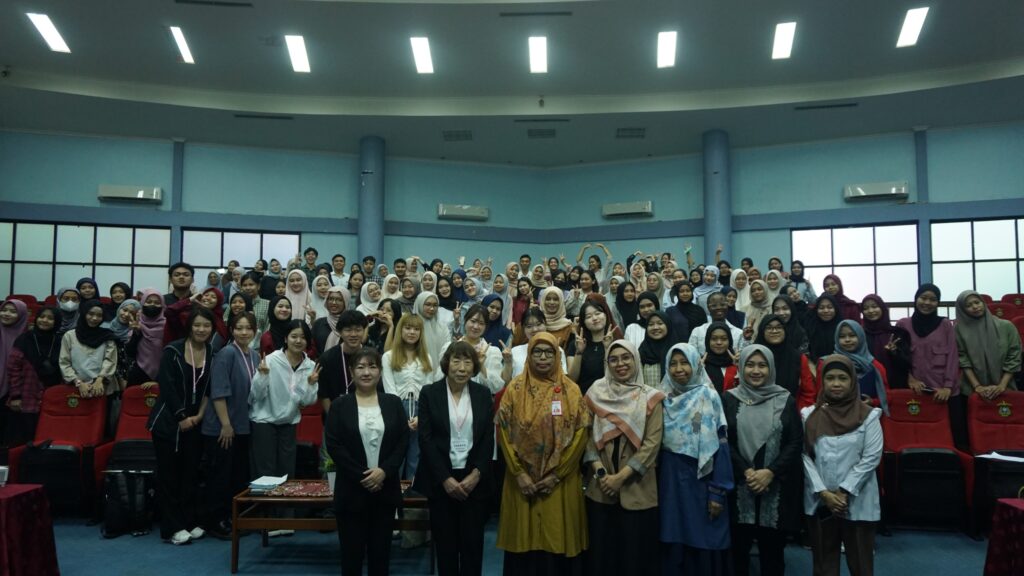

The Faculty of Nursing, Hasanuddin University, strengthened its international academic collaboration by conducting a General Lecture in collaboration with Niigata University of Health and Welfare, Japan. The activity provided a valuable platform for knowledge exchange, cross-cultural learning, and academic interaction between nursing students, faculty members, and international nursing professionals.
The General Lecture was held at Gedung IPTEKS Unhas on 26 February 2025, with 80 participants, primarily comprising undergraduate nursing students (S1 Keperawatan). The activity featured international speakers and collaborators, Fusayo Kobayashi, RN., PHN., Ph.D and Kanako Shinbo, RN., PHN., Midwife, who shared their professional and academic perspectives with participants.
The lecture served as a concrete implementation of institutional cooperation between Hasanuddin University and Niigata University of Health and Welfare. Beyond delivering academic content, the activity encouraged students to engage with perspectives from the Japanese nursing and healthcare context. Exposure to international practices allowed students to broaden their understanding of how nursing education and professional practice can respond to different population needs, healthcare systems, and community contexts.
Throughout the session, participants had the opportunity to learn from the experiences and expertise of the international speakers. The exchange highlighted the importance of communication, cultural understanding, professional competence, and lifelong learning in nursing. Such interactions are particularly valuable for undergraduate students as they prepare to enter a healthcare environment that increasingly requires professionals to understand both local priorities and global developments.
The General Lecture also created opportunities for students and faculty members to strengthen their academic networks. International academic activities such as this can encourage further collaboration in education, research, professional development, and knowledge exchange. For students, direct interaction with international experts can provide a broader perspective on nursing careers and encourage them to develop competencies that extend beyond classroom learning.
The activity contributes to SDG 1: No Poverty by supporting the development of a skilled nursing workforce capable of contributing to equitable and accessible healthcare, particularly for vulnerable populations. It directly supports SDG 3: Good Health and Well-Being by strengthening nursing education and professional knowledge that underpin quality healthcare services. The activity also advances SDG 4: Quality Education by providing students with access to international expertise and enriching learning experiences beyond conventional classroom instruction. Furthermore, the collaboration supports SDG 17: Partnerships for the Goals by strengthening institutional partnerships and facilitating international knowledge exchange between higher education institutions.
The General Lecture demonstrated how international cooperation can create meaningful learning opportunities while strengthening the capacity of future healthcare professionals. Through continued academic exchange with international partners, Hasanuddin University remains committed to developing globally informed, culturally responsive, and competent nursing graduates who can contribute to improving health and well-being in their communities and beyond.