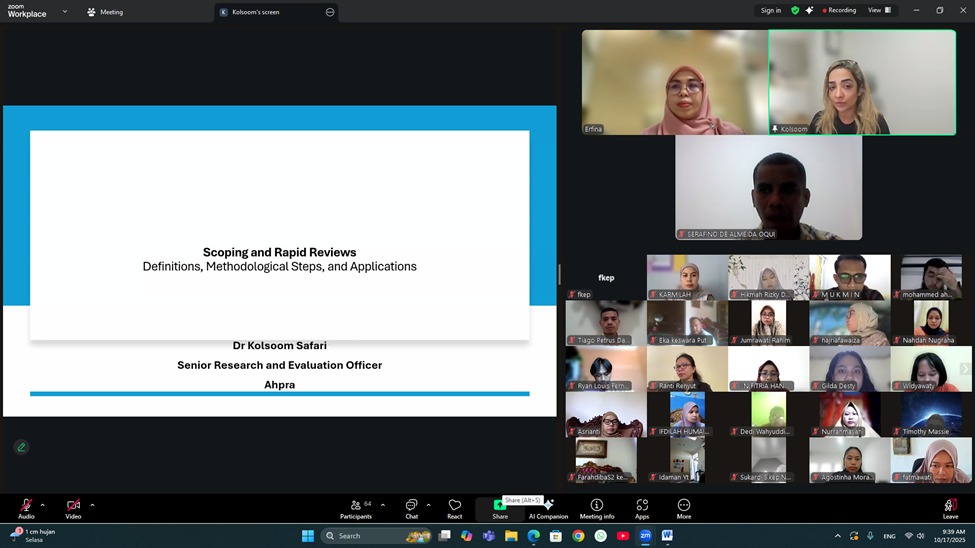

To strengthen academic capacity and promote evidence-based practice in nursing, the Master’s Program in Nursing, Faculty of Nursing, Hasanuddin University, organized a virtual international sharing session focusing on scoping review and rapid review. The session provided an opportunity for postgraduate students and academic participants to expand their understanding of evidence synthesis methods and their application in nursing research.
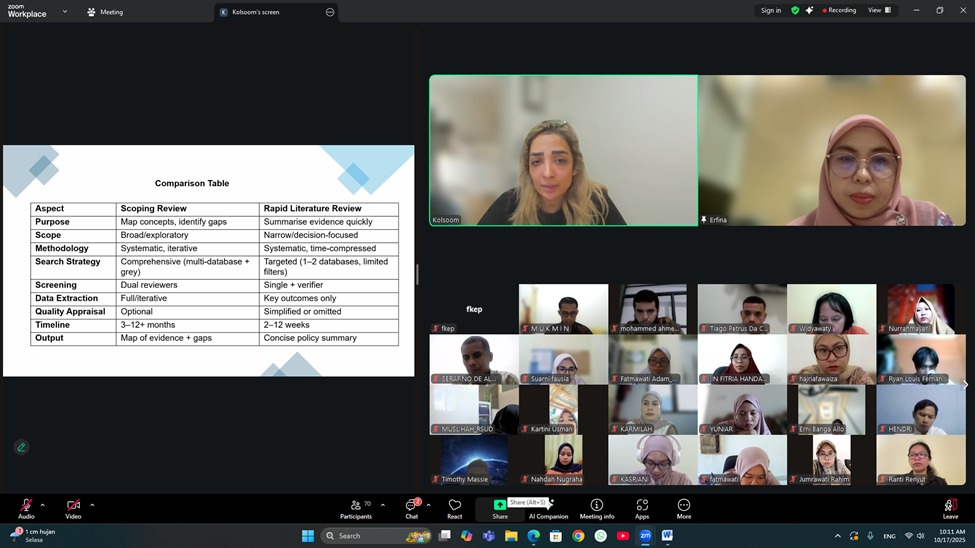
The sharing session was conducted virtually via Zoom on 17 October 2025, with 68 participants, including master’s nursing students, including Fadiah Izzati Salim, Dedi Wahyuddin, Erni Banga Allo, and other postgraduate students. The session featured an international expert, Dr. Kalsoom Safari from La Trobe University, Australia, who shared her expertise and practical perspectives on conducting scoping and rapid reviews.
The session introduced participants to the purpose and characteristics of different evidence synthesis approaches. Scoping reviews can be particularly useful for mapping the available evidence, identifying key concepts, and exploring gaps within a broad research area. Rapid reviews, meanwhile, provide a more streamlined approach to synthesizing evidence when findings are needed within a shorter timeframe. Understanding the differences between these approaches can help researchers select an appropriate method based on their research questions, available resources, and intended outcomes.
Dr. Kalsoom Safari provided practical insights into important stages of the review process, including developing a focused research question, identifying relevant literature, establishing eligibility criteria, searching academic databases, screening studies, extracting information, and synthesizing findings. The discussion also emphasized the importance of maintaining methodological rigor and transparency throughout the review process.
For the participating master’s nursing students, the session served as an opportunity to connect theoretical knowledge with practical research skills. Through international academic exchange, students could gain broader perspectives on evidence-based research and better understand how evidence synthesis can contribute to nursing practice, education, and health policy. The session also encouraged participants to critically evaluate published evidence and identify research gaps that may inform future studies.
The activity contributes to SDG 4: Quality Education by strengthening postgraduate research competencies and expanding access to international academic knowledge. It also supports SDG 3: Good Health and Well-Being, as stronger evidence synthesis skills can contribute to the development of evidence-based nursing practices and improved healthcare decision-making. Furthermore, the session reflects SDG 17: Partnerships for the Goals by facilitating academic collaboration and knowledge exchange between Hasanuddin University and an international academic expert from Australia.
The international sharing session concluded with an emphasis on continued learning, collaboration, and the application of evidence synthesis methods in nursing research. By strengthening research capacity and connecting students with international expertise, the activity contributes to building a more evidence-informed academic and professional nursing community.