

MAKASSAR, Indonesia, 30 June 2026/neuro-onc – Growing older is a natural part of life, but losing the ability to remember, learn, and make decisions should not be considered inevitable. As populations continue to age, protecting brain health has become one of the world’s most important public health priorities.
A scientific study entitled “The Relationship between Brain-derived Neurotrophic Factor (BDNF) Levels and Cognitive Function in the Elderly,” published in the Pakistan Journal of Life and Social Sciences on 17 July 2024 by Elsevier, provides encouraging evidence that a simple biological marker may help identify cognitive decline earlier. The research explored how Brain-Derived Neurotrophic Factor (BDNF), often referred to as the brain’s “growth and repair” protein, is associated with cognitive function in older adults.
The researchers conducted the study among 64 older adults aged 60–75 years in Gowa Regency, Indonesia. Blood samples were collected to measure BDNF levels using the ELISA method, while cognitive function was assessed using the Indonesian version of the Montreal Cognitive Assessment (MoCA-INA). The results revealed a strong positive relationship between higher BDNF levels and better cognitive performance. Furthermore, the researchers identified that a BDNF level of 1.99 ng/mL or lower could predict cognitive impairment with high sensitivity and specificity, suggesting that BDNF has great potential as an early biomarker for cognitive decline.
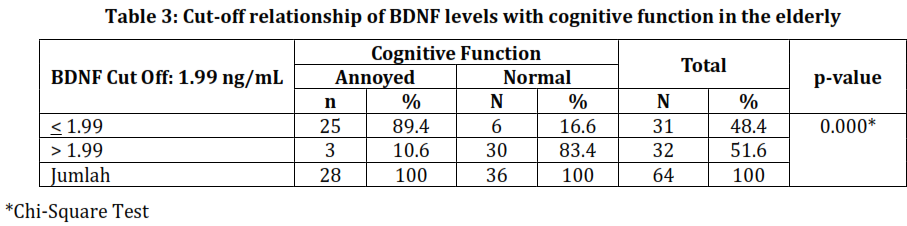
Why is this finding important? BDNF plays a vital role in helping brain cells survive, grow, and communicate with each other. It supports learning, memory formation, and the brain’s remarkable ability to adapt throughout life. Unfortunately, BDNF levels naturally decrease with aging, making the brain more vulnerable to memory loss and neurodegenerative diseases. However, scientific evidence also suggests that healthy lifestyle habits—particularly regular physical exercise—can help increase BDNF production and support better cognitive health.
Interestingly, the study also found that cognitive function is influenced not only by biological factors but also by education, age, gender, and occupation. This means that maintaining brain health requires more than medical treatment alone. Lifelong learning, active social engagement, and healthy living all contribute to preserving cognitive abilities as people age.
The significance of this research extends beyond the laboratory. It directly supports Sustainable Development Goal (SDG) 3: Good Health and Well-being, which promotes healthy lives and well-being for people of all ages. Earlier identification of cognitive decline through biomarkers such as BDNF could enable healthcare professionals to provide timely interventions, improve the quality of life of older adults, and reduce the social and economic burden of dementia on families and healthcare systems.
Although the authors emphasize that further studies involving larger populations and longer follow-up periods are still needed before BDNF can be widely adopted in clinical practice, the findings offer an important message: protecting brain health should begin before serious symptoms appear. By combining scientific innovation with healthy lifestyles and preventive healthcare, we can help older adults remain independent, mentally active, and socially engaged for longer. After all, successful aging is not simply about living longer—it is about living better.
Reference:
https://doi.org/10.57239/PJLSS-2024-22.1.00395
Contact:
Dr. Rosyidah Arafat, S.Kep., Ns.,M.Kep., Sp.KMB
+6282112862492