MAKASSAR, Indonesia September 2020/MARGO/ For decades, sea cucumber hatcheries have operated on a simple assumption: bigger is better. To produce millions of baby sandfish (Holothuria scabra), you need large broodstock—fish weighing 450 grams or more. But finding such large specimens in the wild has become increasingly difficult. Overfishing has decimated populations across Southeast Asia, and the few large individuals that remain are often too stressed to spawn in captivity.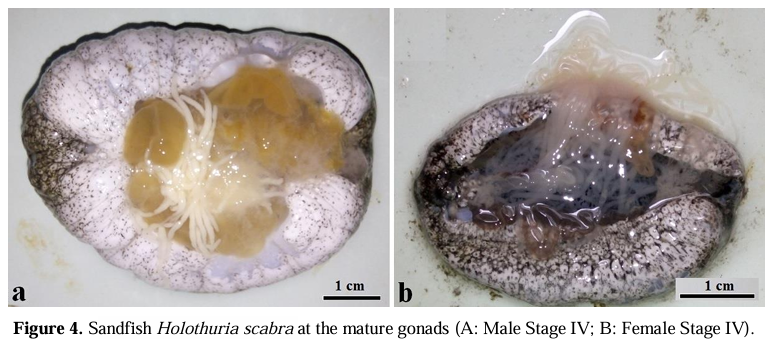
What if this assumption was wrong?
A study published in September 2020 in the IOP Conference Series: Earth and Environmental Science (Publisher: IOP Publishing) titled “Early maturity of Sandfish Holothuria scabra offers more prospective broodstock supply of a commercially important aquaculture species” challenges everything we thought we knew about sea cucumber reproduction.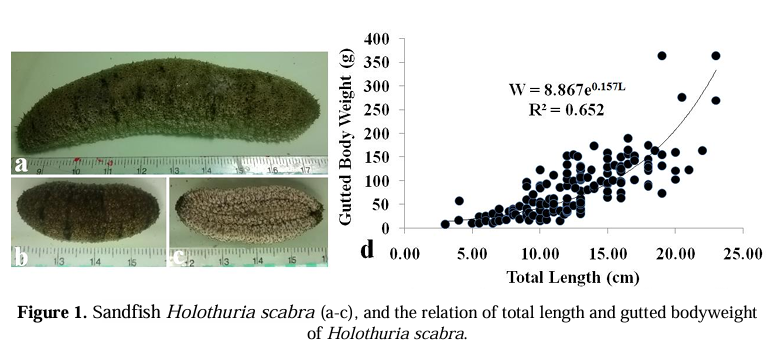
Researchers from Hasanuddin University in Indonesia collected 178 sandfish from the waters of Pangkep Regency, South Sulawesi. They measured total length, gutted body weight, and gonad weight, and determined the maturity stage of each individual. What they discovered was astonishing: sandfish can reach sexual maturity at just 42 grams—far smaller than the 450-500 grams previously reported.
Among the 178 individuals observed, mature gonads (stages III, IV, and V) were found in sandfish as small as 18 grams. The smallest mature individual weighed only 42 grams—less than a tenth of the size previously thought necessary for reproduction. Even more remarkable, mature individuals were found in all weight classes, from tiny juveniles to larger specimens.
Why does this matter? Because it completely changes the game for sea cucumber aquaculture. Instead of relying on rare, overfished large specimens, hatcheries can now use small, abundant sandfish as broodstock. These small individuals are easier to collect from shallow waters, less likely to eviscerate (expel their internal organs) when handled, and can be spawned in large numbers through mass spawning events.
This research directly supports the United Nations’ Sustainable Development Goal 14: Life Below Water. By reducing pressure on wild populations and providing a more sustainable source of broodstock, it helps conserve marine biodiversity and promotes responsible aquaculture. It also contributes to poverty reduction (SDG 1) by making sea cucumber farming more accessible and economically viable for small-scale farmers. The tiny sandfish, once overlooked, may hold the key to a more sustainable future for both the species and the communities that depend on it.
Reference
DOI:
https://iopscience.iop.org/article/10.1088/1755-1315/564/1/012089/pdf
Contact:
Prof. Dr. Ir. Ambo Tuwo DEA
+628124206391
ambotuwo62@gmail.com