MAKASSAR, Indonesia November 1 2019/MARGO/ For years, seaweed farmers in South Sulawesi, Indonesia, have been cultivating two types of Gracilaria—a red seaweed prized for its agar content. One grows in brackish water ponds and is called Gracilaria verrucosa. The other grows in the open sea and is called Gracilaria gigas. They look different: pond-grown Gracilaria has curly, twisted branches, while sea-grown Gracilaria grows straight and upright. Farmers have always assumed they were two distinct species.
But were they?
A study published on 1 November 2019 in the IOP Conference Series: Earth and Environmental Science (Publisher: IOP Publishing) titled “Morphological and genetic analysis of Gracilaria sp. cultured in ponds and coastal waters” set out to answer this question once and for all.
Researchers from Hasanuddin University and Universitas Sulawesi Barat collected Gracilaria samples from Ujung Baji Village in Takalar Regency—the heart of South Sulawesi’s seaweed production. They examined the seaweed in two ways: by looking at their physical characteristics (morphology) and by analyzing their DNA using a technique called DNA barcoding, which targets a specific gene (COI) that acts like a genetic fingerprint.
The results were surprising. When the researchers compared the DNA sequences of the two Gracilaria types, they found an astonishing 99.64% similarity—practically identical. Both sequences also closely matched known sequences of Gracilaria changii, G. blodgettii, and G. firma in global genetic databases. In other words, the “two species” were genetically the same organism.
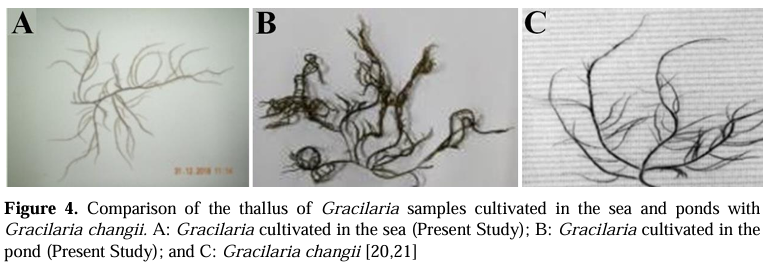
What about the physical differences? The researchers concluded that the curly versus straight shapes are not signs of different species, but rather different growth forms caused by environmental conditions. In ponds, the seaweed thalli overlap and compete for sunlight, forcing them to grow in twisted, curly shapes. In the sea, the seaweed hangs down from longlines, and gravity pulls it straight. The environment, not genetics, shapes their appearance.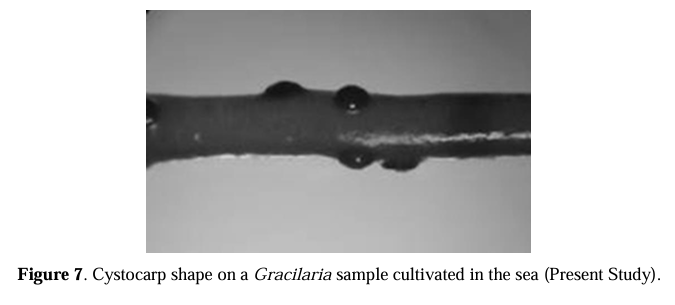
Why does this matter? Because correct species identification is essential for sustainable management. If farmers and policymakers mistakenly think they are managing two different species, they might make poor decisions about cultivation practices, market strategies, and conservation efforts. Knowing that they are the same species simplifies everything—farmers can share knowledge, markets can standardize products, and researchers can focus on improving a single species rather than two.
This research directly supports the United Nations’ Sustainable Development Goal 14: Life Below Water. By improving our understanding of marine biodiversity and promoting sustainable aquaculture, it helps protect ocean resources and supports the livelihoods of coastal communities (SDG 1). In a world where misidentification can lead to mismanagement, this study reminds us that science—and DNA—can help us see the truth beneath the surface.
Reference
DOI:
https://iopscience.iop.org/article/10.1088/1755-1315/370/1/012018/pdf
Contact:
Prof. Dr. Ir. Ambo Tuwo DEA
+628124206391
ambotuwo62@gmail.com