


MAKASSAR, Indonesia Apr 21 2026/MALRESVEK/ – For decades, malaria prevention has focused on what happens indoors—sleeping under bed nets and spraying insecticides inside homes. But what about the moments people spend outside? In many parts of Indonesia, including forest areas of Sumatra, people are often exposed to mosquito bites outdoors, where traditional protection methods are less effective. A recent study offers a promising solution to this overlooked challenge.
As part of a collaborative research effort, we contributed to a study titled “Longitudinal Field Evaluation of Outdoor Anopheles and Non-Anopheles Host-Seeking in Response to a Volatile Pyrethroid Spatial Emanator (SE) Product among Forest-Dwelling Indigenous Residents of Sumatra, Indonesia,” published in Malaria Journal by BioMed Central on April 10, 2025.
The study tested a simple device called a spatial emanator (SE), which releases a small amount of insecticide (transfluthrin) into the air to repel mosquitoes. The goal was to see whether this tool could help reduce mosquito bites in outdoor and open living environments. The study was conducted among the Orang Rimba, an indigenous forest-dwelling community living near Bukit Duabelas National Park in central Sumatra. Their homes are typically open-walled, making them more vulnerable to mosquito bites, especially outdoors.
To understand how effective this device is, researchers carried out weekly observations over 16 weeks. They used mosquito traps placed near households to measure how many mosquitoes were actively trying to bite humans. The results were striking.
When the spatial emanator was used, the number of malaria-carrying mosquitoes (Anopheles) attempting to bite dropped significantly—by about 70%. This means that the device reduced mosquito activity to less than one-third compared to areas without protection. Even other types of mosquitoes showed a decrease, although less dramatic.
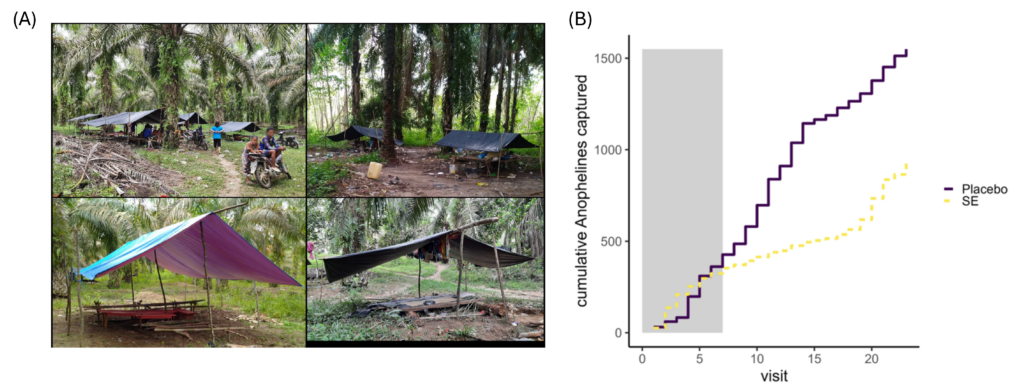
Figure 1. (A) Typical structures and local environment inhabited by Orang Rimba study participants in the study area in Jambi, Indonesia. Orang Rimba are mobile, frequently relocating their camps as needed and, therefore, tend to live in light, temporary open-walled structures. (B) The graph shows the total number of Anopheles mosquitoes collected over time in two groups: one using the device and one without it. The early period (visits 1–7), shown in gray, is the baseline before the device was used. After that, during the study period, many more mosquitoes were found in places without the device. In the control group, 1,123 mosquitoes were collected over 320 nights (about 3–4 mosquitoes per night). In contrast, in places using the device, only 576 mosquitoes were collected over 316 nights (about 2 mosquitoes per night). Overall, the device reduced the number of malaria-carrying mosquitoes by about 70%, showing that it was very effective in lowering mosquito activity.
In simple terms, the device worked. It created a kind of invisible protective “bubble” around people, making it harder for mosquitoes to find and bite them—especially outdoors, where protection is usually limited.
Interestingly, the effectiveness of the device did not decrease even after being used for a month, suggesting it is practical and durable for real-world use. The study also found that mosquito activity increased in areas with higher humidity, wetter landscapes, and more human structures—factors that are common in tropical forest environments.
This innovation is important because it addresses a major gap in malaria prevention: outdoor transmission. Many communities, especially indigenous and rural populations, spend a significant amount of time outside for daily activities such as cooking, socializing, or working. Without protection in these settings, malaria transmission can continue despite strong indoor interventions.
Importantly, this study is the result of a broad and meaningful international collaboration. It involves researchers and institutions from the Eck Institute for Global Health, University of Notre Dame (USA); Eijkman Research Center for Molecular Biology, National Research and Innovation Agency (BRIN), Indonesia; Jambi Provincial Health Department; Indonesian Conservation Community WARSI; and our research group from Universitas Hasanuddin. This collaboration highlights how complex health challenges like malaria require joint efforts across disciplines, institutions, and countries.
This research strongly supports SDG 3: Good Health and Well-being, as it contributes to reducing malaria transmission and improving community health. It also aligns with SDG 15: Life on Land, by recognizing the interaction between human health and forest ecosystems where malaria vectors thrive. In addition, it reflects SDG 17: Partnerships for the Goals, as the study integrates scientific research with local community settings to develop practical, scalable solutions.
In conclusion, this study highlights that protecting people from malaria requires thinking beyond traditional approaches. By extending protection to outdoor environments, tools like spatial emanators could play a crucial role in accelerating malaria control and moving closer to elimination—especially in high-risk, underserved communities.
Reference
DOI: 10.1186/s12936-025-05284-y
Contact: Prof. dr. Din Syafruddin, Ph.D
+62 811-9898-766
dinkarim@yahoo.com; syafruddin@unhas.ac.id


