

MAKASSAR, Indonesia Apr 21 2026/MALRESVEK/ – Malaria remains a serious health problem in eastern Indonesia, especially in areas like West Sumba and Kupang where transmission is still ongoing. But an important question remains: is the current treatment still working effectively?
In our study, titled “Monitoring the effectiveness of malaria treatment using dihydroartemisinin–piperaquine (DHA-PPQ),” published in BIO Web of Conferences (Volume 184, 2025) from The 3rd International Seminar of the Indonesian Society for Biochemistry and Molecular Biology (ISISBMB 2025) by EDP Sciences on August 12, 2025, we set out to answer this question.
We evaluated how well this commonly used malaria drug works by screening hundreds of patients. Among them, 41 participants were closely followed for 42 days to track their recovery and detect any signs that the treatment might be losing its effectiveness.
The results are reassuring. Every patient who completed the study responded well to treatment, achieving what scientists call a “100% adequate clinical and parasitological response.” In simpler terms, the drug successfully cleared the malaria parasites from all patients observed. This means DHA-PPQ is still doing its job effectively in these regions.
But the story doesn’t end there. Scientists didn’t just look at whether patients recovered—they also examined the genetic “fingerprints” of the malaria parasite Plasmodium falciparum. Why? Because tiny genetic changes can signal the early stages of drug resistance, even before treatment failures become visible.
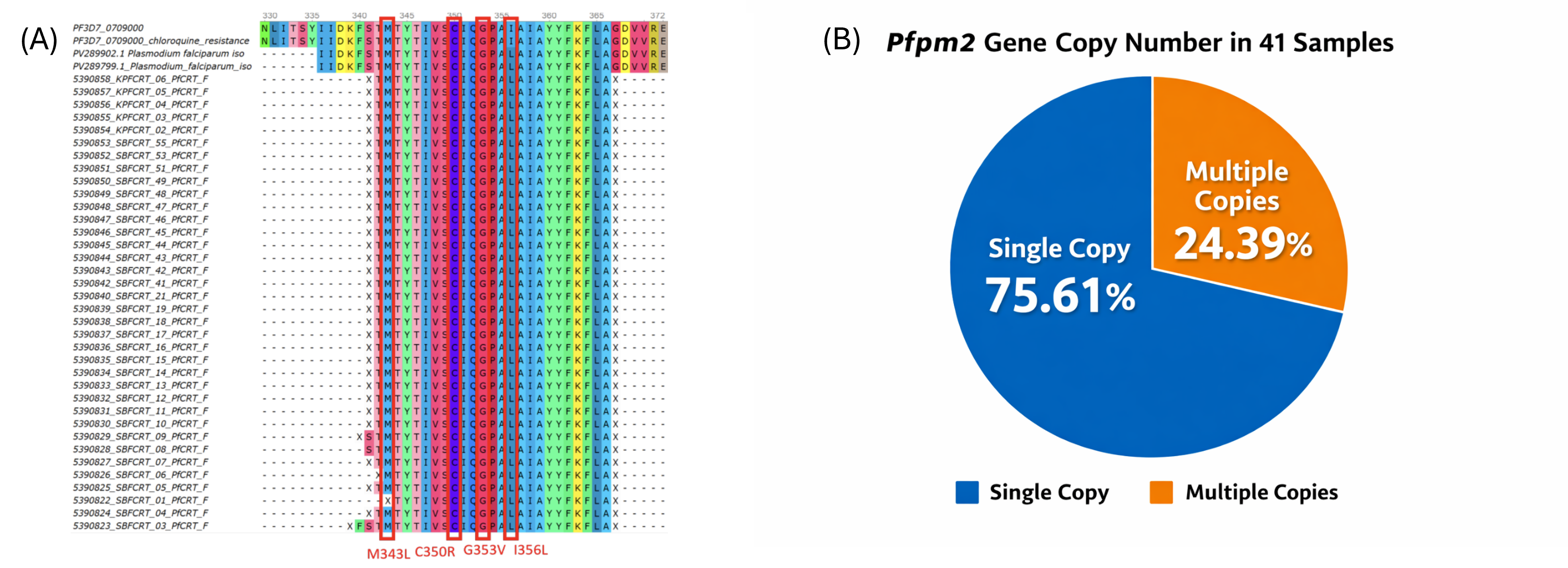
Encouragingly, the study found no mutations in key genes (Pfk13 and Pfcrt) that are known to cause resistance to artemisinin or piperaquine. This suggests that, for now, there is no strong evidence that the parasite has developed resistance to these drugs in the study areas.
However, researchers did notice something worth paying attention to: about 24% of the samples showed an increase in copies of another gene, called Pfpm2. This genetic change does not immediately cause treatment failure, but it may indicate early “selection pressure”—a warning sign that the parasite could eventually adapt to the drug if monitoring is not maintained.
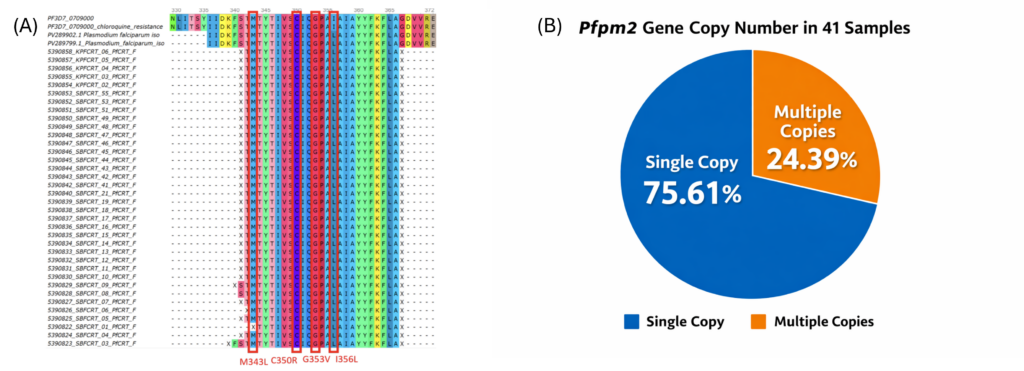
Figure 1. (A, Left) From 41 malaria parasite samples (Plasmodium falciparum), researchers were able to successfully examine a specific gene related to drug response. The results showed that there were no changes in this gene that are known to cause resistance to piperaquine. In simple terms, this means the parasites in this study are still sensitive to the drug and have not developed resistance. (B, Right) Researchers also looked at another gene (Pfpm2) to see how many copies of it were present in each parasite sample. Out of 41 samples, 31 (75.61%) had only one copy of the gene, while 10 samples (24.39%) had more than one copy. Having multiple copies of this gene may be an early sign that the parasite is starting to tolerate or adapt to the drug piperaquine. Although the treatment is still effective, this finding suggests that scientists need to keep monitoring for possible future resistance.
Why does this matter? Because history has shown that malaria parasites can evolve quickly. Artemisinin resistance, for example, first appeared in Southeast Asia in 2009 and spread across the region. Without early detection, such resistance can undermine years of progress in malaria control.
This is where science plays a crucial role. Continuous monitoring, especially using molecular tools, allows researchers to detect warning signs early and respond before a public health crisis emerges. It also helps policymakers decide whether treatment strategies need to be adjusted.
This research strongly supports SDG 3: Good Health and Well-being, as it contributes to controlling malaria and ensuring effective treatment remains available. It also aligns with SDG 4: Quality Education, by advancing scientific knowledge and training young researchers in molecular epidemiology. Furthermore, it reflects SDG 17: Partnerships for the Goals, as the study involved collaboration between universities, government institutions, and international organizations.
Ultimately, the message is clear: while current malaria treatment in Indonesia remains effective, vigilance is essential. Science is not only about solving today’s problems—but also about anticipating tomorrow’s challenges.
Reference
DOI: 10.1051/bioconf/202518401018
Contact:
Prof. dr. Din Syafruddin, Ph.D
+62 811-9898-766
dinkarim@yahoo.com; syafruddin@unhas.ac.id


