
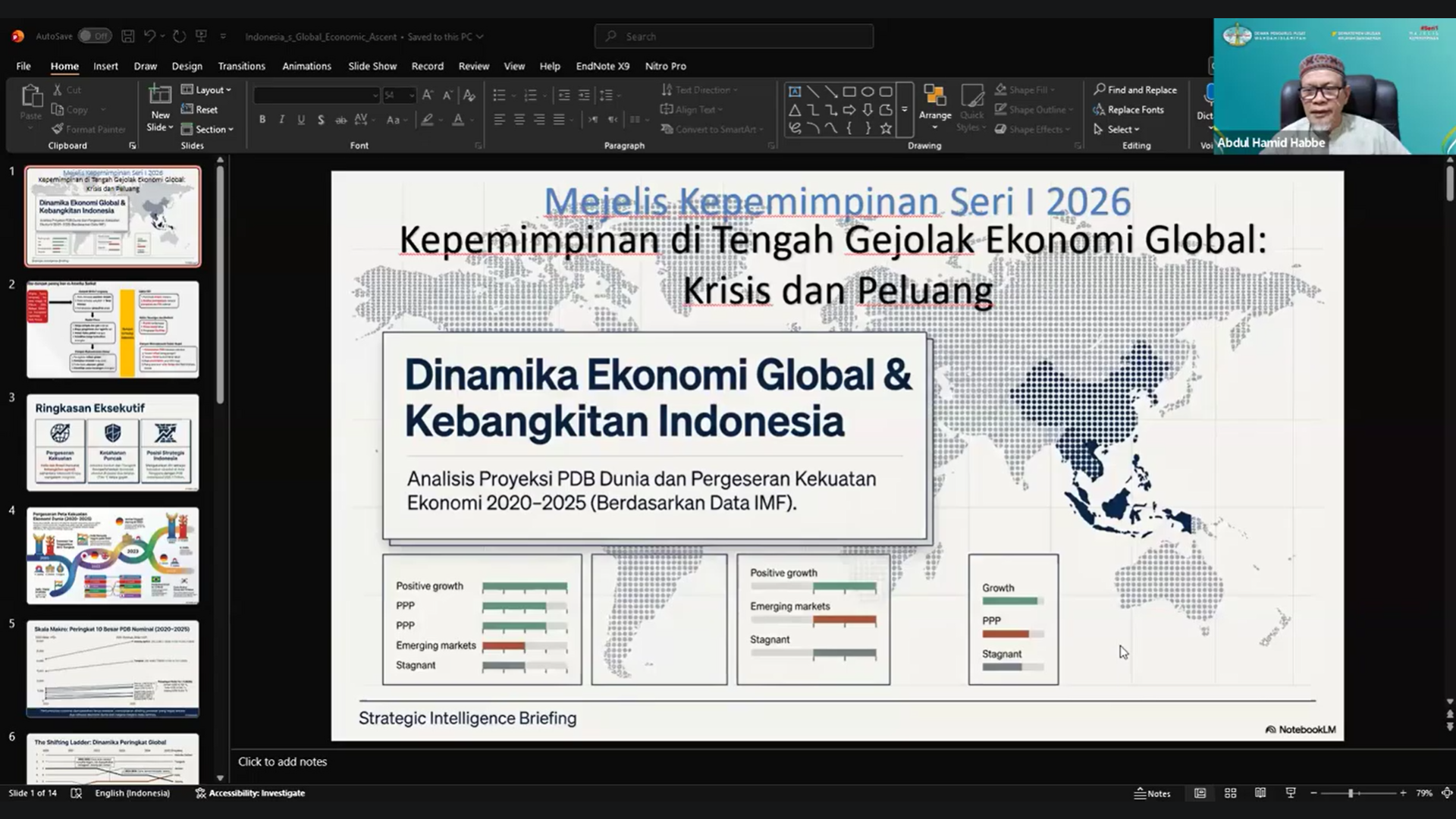

The global landscape is currently witnessing a profound transformation, driven by intensifying geopolitical tensions and economic instability. From the persistent friction involving major powers in the Middle East to the protracted conflict between Russia and Ukraine, the traditional foundations of international cooperation are being tested. In response to these pressing issues, a high-level webinar was convened to explore the shifting paradigms of world leadership and the resulting economic ripples.
On April 10, 2026, an insightful virtual session titled “Leadership Amidst Global Economic Turbulence: Opportunities and Challenges” was held online. The event featured the esteemed Prof. Abdul Hamid Habbe, S.E., M.Si., a distinguished expert who provided a comprehensive analysis of how current conflicts—specifically the American-Israeli alignment versus Iran and the ongoing Russia-Ukraine war—are reshaping the global order. The webinar successfully gathered 120 participants, comprising Regional and District Administrators of Wahdah Islamiyah from across Indonesia, who engaged in a strategic dialogue regarding the future of organizational and national resilience.
The discussion emphasized that modern leadership must transcend traditional management, requiring a deep understanding of “geoeconomics.” As global supply chains face disruption and energy markets fluctuate, leaders are tasked with finding opportunities within the chaos. Prof. Habbe highlighted that while the “geopolitical earthquake” creates significant risks, it also paves the way for emerging economies and grassroots organizations to redefine their roles in a multipolar world.
Central to this narrative is the commitment to global sustainability. The event underscored that economic stability is inseparable from the United Nations Sustainable Development Goals. Specifically, the discussion addressed SDG 1 (No Poverty), noting how global inflation and conflict-driven price hikes disproportionately affect the most vulnerable populations, demanding empathetic and strategic leadership to safeguard economic welfare.
Furthermore, the session reinforced the importance of SDG 4 (Quality Education). By hosting such intellectual forums, the organization ensures that its leaders are equipped with high-level literacy in global affairs, fostering a culture of lifelong learning and informed decision-making. This transfer of knowledge is essential for navigating the complexities of the 21st century.
Finally, the activity served as a practical manifestation of SDG 17 (Partnerships for the Goals). By bringing together 120 participants from various regions across Indonesia, the webinar strengthened the internal and external networks necessary to tackle cross-border challenges. The collaboration between academic experts and community leaders exemplifies the collective action required to maintain stability amidst global geopolitical shifts.
In conclusion, the webinar provided a vital roadmap for leadership in an era of uncertainty. By analyzing the intersections of war, economy, and diplomacy, participants left with a clearer vision of how to turn global challenges into local opportunities, ensuring that the spirit of progress remains resilient despite the volatile global climate.
Abdul Hamid Habbe
0811469002


