Study Highlights Indigenous Knowledge in Diabetic Foot Care Among the Mandar Tribe
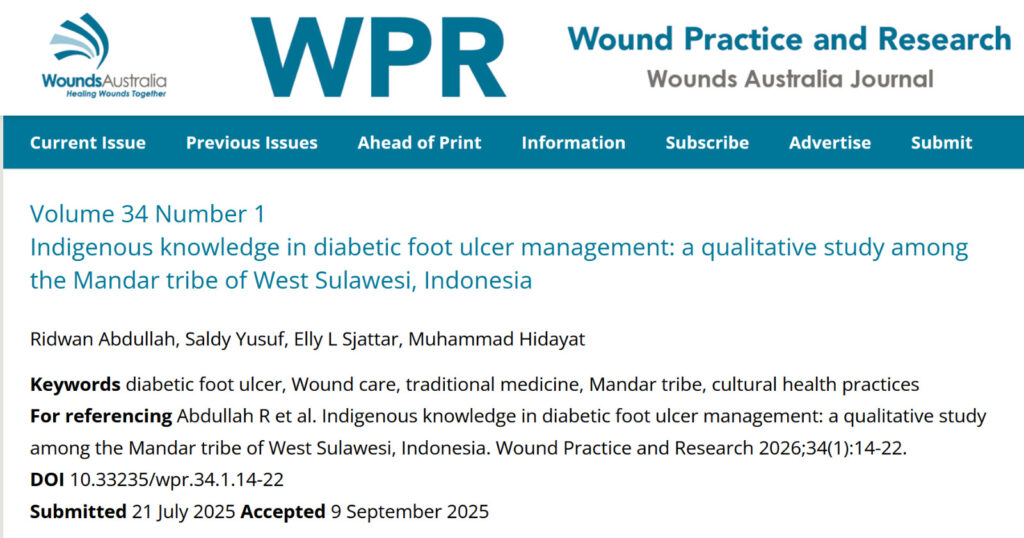
Makassar, Indonesia – A recent study published in Wound Practice and Research (2026; Vol. 34, Issue 1) sheds light on the significant role of indigenous knowledge in managing diabetic foot ulcers (DFUs) among the Mandar tribe in West Sulawesi, Indonesia.
Conducted by Ridwan Abdullah, Saldy Yusuf, and colleagues, the study offers valuable insights into how cultural beliefs and traditional practices shape wound care behaviors in local communities.
Traditional Medicine Remains a Primary Choice
Diabetic foot ulcers are among the most serious complications of diabetes, often leading to infection, hospitalization, and even amputation when not properly managed. Despite advances in modern medicine, traditional healing practices remain deeply embedded in many Indonesian communities.
In West Sulawesi, the Mandar ethnic group continues to rely on traditional remedies—either as a first-line treatment or in combination with clinical care.
Understanding Lived Experiences Through Qualitative Inquiry
Using a phenomenological qualitative approach, the researchers explored the lived experiences of 18 individuals with diabetic foot ulcers who had undergone traditional treatments.
Data were collected through in-depth, semi-structured interviews and analyzed thematically. To strengthen the analysis, digital tools such as MaxQDA and Gephi were used to visualize patterns between treatment choices, perceived outcomes, and sources of knowledge.
Natural Ingredients Dominating Traditional Care
The study identified several commonly used natural remedies, including:
- Turmeric (the most frequently used)
- Honey
- Guava leaves
- Coconut oil
- Castor leaves
These treatments were generally applied in raw and unstandardized forms, reflecting a strong reliance on generational knowledge rather than clinical protocols.
Diverse Outcomes Shaped by Cultural Beliefs
Patient experiences varied widely. While some participants reported early improvements in their wounds, others experienced worsening conditions.
Knowledge of these treatments was primarily transmitted through:
- Family traditions
- Community elders
- Traditional healers
Importantly, the study found that treatment decisions were not solely based on physical symptoms, but were also deeply influenced by cultural values and spiritual beliefs.
The Need to Bridge Tradition and Modern Medicine
Although traditional practices reflect valuable empirical knowledge and cultural identity, the study highlights critical concerns regarding safety, consistency, and clinical effectiveness.
The authors emphasize the importance of:
- Rigorous scientific evaluation of traditional therapies
- Development of culturally sensitive healthcare models
- Strengthening collaboration between healthcare professionals and local communities
Towards Culturally Integrated Wound Care
This research underscores a crucial message: effective diabetic foot management in diverse settings requires more than clinical intervention—it requires cultural understanding.
By integrating indigenous knowledge with evidence-based medical practice, healthcare systems can deliver more acceptable, accessible, and sustainable wound care solutions—particularly in culturally rich regions such as Indonesia.
Alignment with Sustainable Development Goals (SDGs):
This study contributes to SDG 3 (Good Health and Well-being) by exploring approaches to improve diabetic foot ulcer management and patient outcomes. It also aligns with SDG 10 (Reduced Inequalities) by addressing healthcare disparities and recognizing the role of indigenous knowledge in underserved communities. Furthermore, the study supports SDG 4 (Quality Education) through knowledge generation and SDG 17 (Partnerships for the Goals) by promoting collaboration between healthcare professionals and local communities in developing culturally sensitive care models.
DOI:
https://doi.org/10.33235/wpr.34.1.14-22
Contact Person:
Saldy Yusuf
saldy_yusuf@yahoo.com