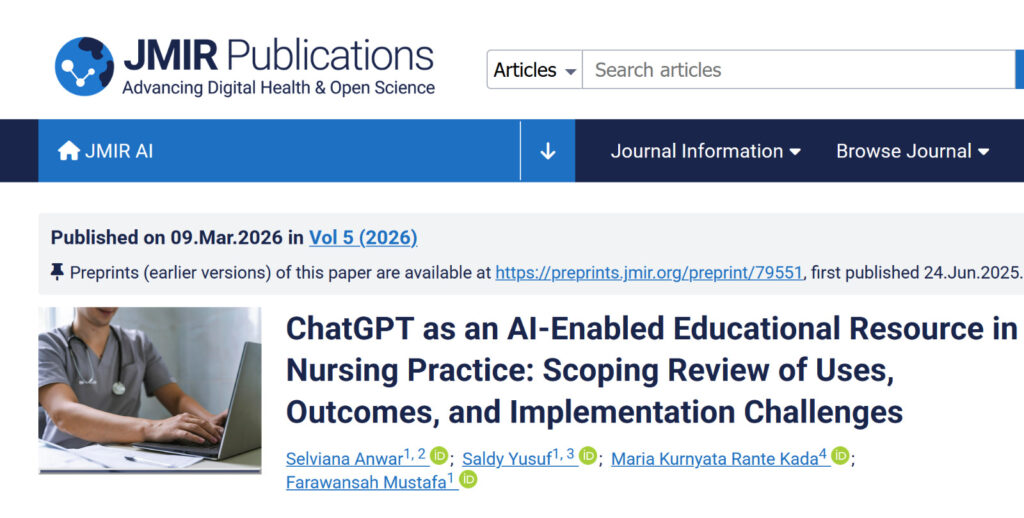
New Study Explores the Role of ChatGPT in Nursing Education and Practice
Makassar, Indonesia – A recent study published in JMIR AI (2026; Vol. 5) highlights the growing role of artificial intelligence, particularly ChatGPT, as an innovative educational resource in nursing practice. The study, led by Selviana Anwar and Saldy Yusuf along with their team, provides a comprehensive overview of how AI is transforming patient education, clinical support, and nursing training.
AI as a New Frontier in Nursing
High-quality nursing care plays a crucial role in improving patient outcomes and satisfaction. In recent years, AI technologies have emerged as potential tools to support nurses in delivering accurate, timely, and personalized information.
Among these technologies, ChatGPT—developed by OpenAI—has gained attention for its ability to generate human-like responses and simplify complex medical information for both patients and healthcare providers.
Mapping the Evidence: A Scoping Review Approach
Using the PRISMA-ScR framework, the researchers conducted a scoping review of studies published between 2019 and 2025 across major databases, including PubMed, Scopus, and ProQuest.
A total of 20 articles were included, providing insights into how ChatGPT is currently being used in nursing contexts.
Four Key Areas of AI Application in Nursing
- Patient Education
Helping simplify complex medical information and improve patient understanding - Clinical Decision Support and Monitoring
Assisting nurses in interpreting clinical data and supporting patient care decisions - Nursing Education
Enhancing learning experiences for students and professionals through interactive AI-based tools - Implementation Challenges and Future Opportunities
Highlighting both the potential and limitations of integrating AI into clinical practice
Balancing Innovation with Responsibility
While the findings demonstrate significant potential, the study also underscores several critical challenges:
- Inconsistencies in response accuracy
- Ethical concerns, including data privacy
- Lack of standardized guidelines for implementation
These issues highlight the importance of maintaining professional oversight when using AI tools in healthcare settings.
Towards Responsible Integration of AI in Nursing
The authors conclude that ChatGPT can serve as a valuable adjunct educational resource in nursing practice, particularly in improving access to information and fostering learner engagement.
However, its integration must be approached carefully. Ensuring ethical safeguards, maintaining clinical accountability, and conducting further implementation-focused research are essential steps toward safe and effective adoption.
DOI: