MAKASSAR, Indonesia May 20 2026/IDLF-RG/-Imagine entering into a business partnership without any written contract. No signatures. No stamps. Just a handshake and a promise. Would you trust it?
In Polewali Mandar, West Sulawesi, this is exactly how thousands of goat farmers operate. The system is called Maambi a traditional profit-sharing arrangement between capital owners and farmers that has been passed down through generations. It works like this: a capital owner provides goats, and a farmer raises them. When the goats are sold or produce offspring, the profits are shared. Simple. Effective. And entirely based on trust.
A fascinating study published in the IOP Conference Series: Earth and Environmental Science (Volume 1603, 2026) examines this system and asks a critical question: can this traditional practice survive in a modern world that demands written contracts and legal certainty?
The researchers conducted in-depth interviews with 20 informants who have at least three years of experience in the Maambi system. Using the Multi-aspect Sustainability Analysis method, they evaluated the socio-cultural sustainability of this practice. The results are encouraging but sobering. The current sustainability index stands at 63.36% considered moderately sustainable. However, projections show a potential decline to 51.79% in the future. This is a warning sign that cannot be ignored.
What makes the Maambi system work? The study identified several key factors. The clarity of agreements between parties is the most important element. Family involvement comes second. How losses are handled for example, if a goat dies or goes missing also plays a crucial role. These factors show that while the system is based on tradition, it is not without structure. Trust is the foundation, but governance matters.
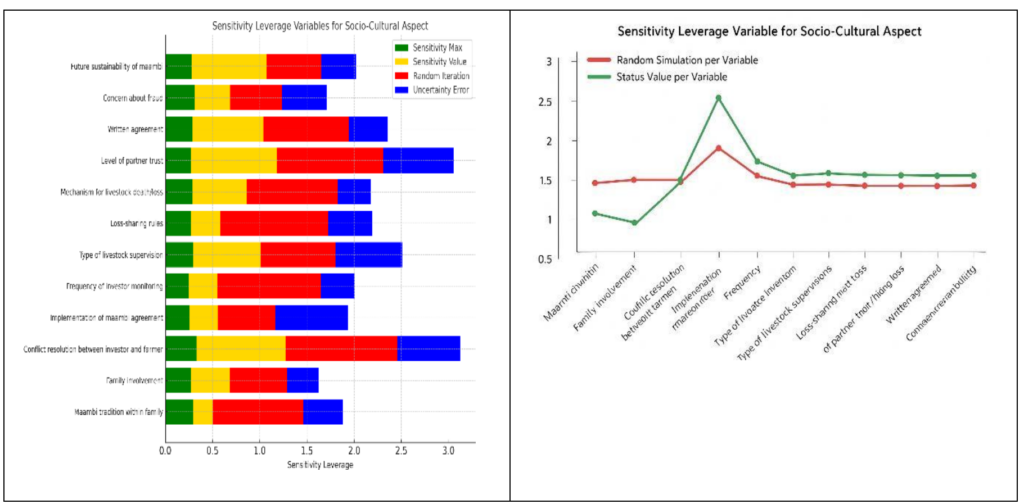
However, the study also reveals serious weaknesses. There are no written agreements. Supervision is often weak. Conflicts can arise when responsibilities are unclear. Some capital owners report financial losses due to negligence in livestock maintenance. Farmers worry about potential fraud. As the researchers note, an overly simplistic agreement system causes problems when unexpected events occur. In other words, the system that has worked for generations is starting to show its age.
This is where the United Nations Sustainable Development Goals become relevant. The Maambi system is a real-world example of SDG 17: Partnerships for the Goals. It shows that effective partnerships even informal ones can create economic opportunities, reduce poverty, and strengthen community bonds. The system supports SDG 1 (No Poverty) by providing income and livestock access to poor farmers. It advances SDG 2 (Zero Hunger) by improving food production through livestock farming. It reflects SDG 4 (Quality Education) by passing down traditional knowledge from generation to generation. And it connects to SDG 15 (Life on Land) through sustainable livestock management.
The researchers recommend strengthening the system through transparency, written agreements, and more effective communication. They emphasize that maintaining sustainability cannot rely solely on traditional heritage. Clear internal regulations are needed to ensure that the relationship between capital owners and farmers remains harmonious and productive. This does not mean abandoning tradition it means adapting it to meet modern challenges.
The Maambi system teaches us a valuable lesson. Trust is a powerful currency, but it needs to be protected by good governance. Local wisdom is precious, but it must evolve to survive. As the study concludes, with appropriate adaptations, the profit-sharing system remains relevant as a local wisdom-based empowerment strategy that supports farmer welfare while maintaining social cohesion.
In a world that often prioritizes profit over people, the Maambi system reminds us that some things are more valuable than money trust, solidarity, and the bonds that hold communities together. And those are worth protecting.
Reference:
https://iopscience.iop.org/article/10.1088/1755-1315/1603/1/012029/meta
Contact:
Prof. Sitti Nurani Sirajuddin
+62 813-8965-4334
sitti.nurani@unhas.ac.id