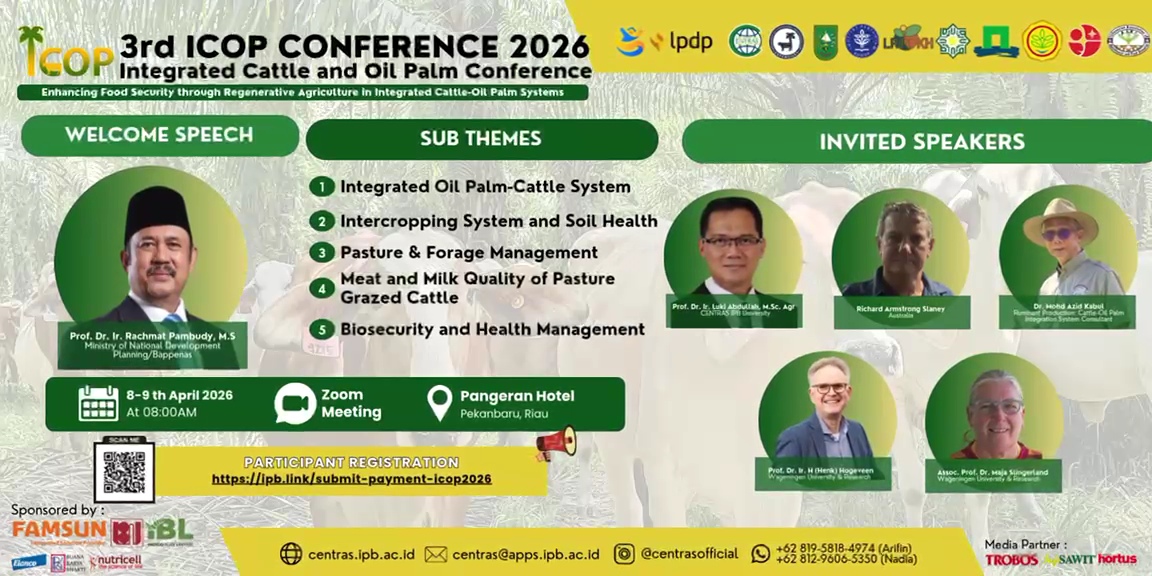

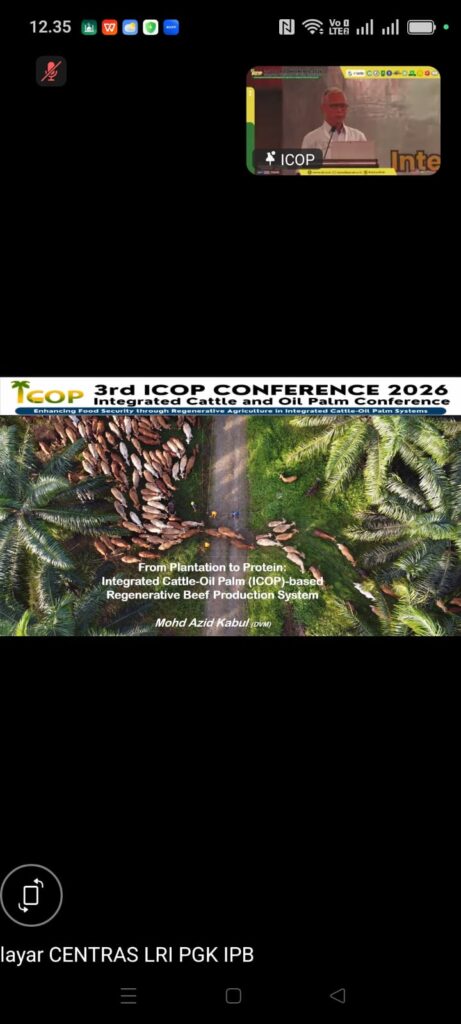
On 08 April 2026, the 3rd Integrated Cattle and Oil Palm Conference 2026 brought together 220 participants and 5 invited speakers from various countries via Zoom. Among the distinguished international experts, Mohd Azid Kabul, Ph.D. , an esteemed External Collaborator, delivered a thought-provoking presentation on the practical and ecological benefits of integrating beef cattle husbandry with oil palm plantations.
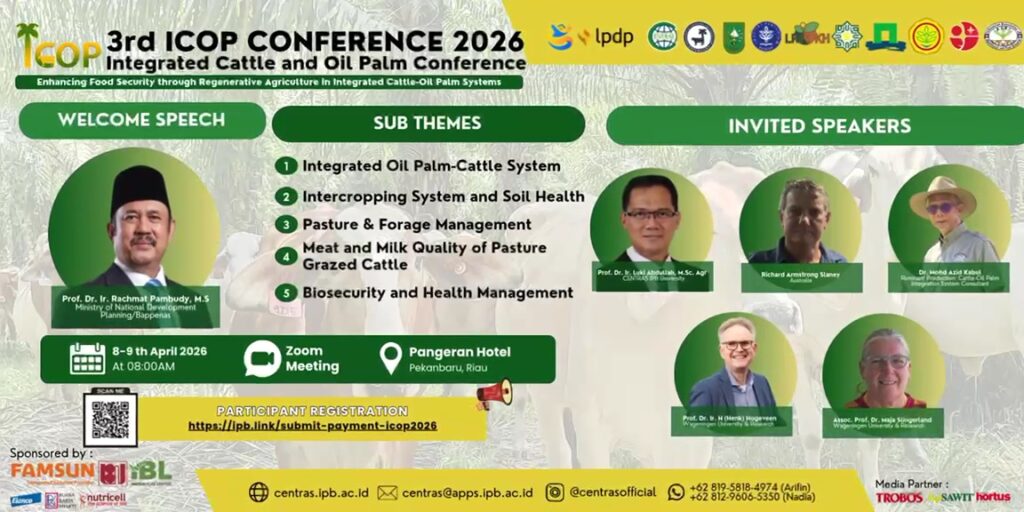
The conference aimed to provide participants with evidence-based insights into how integrated systems can enhance land productivity, reduce chemical fertilizer dependency, and create additional revenue streams for smallholders and plantation companies alike. Dr. Mohd Azid Kabul shared case studies from Southeast Asia, demonstrating that well-managed cattle grazing under mature oil palms suppresses weed growth, recycles nutrients through manure, and improves soil health. He also addressed common challenges such as stocking density, animal welfare, and disease control within plantation environments.
What made his session particularly valuable was the emphasis on scalable models. He explained that integration does not require high-cost technology; rather, it relies on participatory planning, routine monitoring, and knowledge exchange between farmers, extension officers, and researchers. The interactive Zoom format allowed participants from different time zones to ask questions in real time, fostering a dynamic cross-border dialogue.
From a global development perspective, this conference directly supports several Sustainable Development Goals (SDGs). First, it advances SDG 1 (No Poverty) by showcasing an accessible farming system that can increase household income for rural communities, including small-scale cattle owners and oil palm smallholders. Second, it strengthens SDG 4 (Quality Education) by providing a platform for lifelong learning, where international experts transfer actionable knowledge to students, practitioners, and policymakers. Third, it embodies SDG 17 (Partnerships for the Goals) through the very structure of the event: an external collaborator from another country sharing expertise with a diverse audience of 220 participants, facilitated by digital technology and cross-institutional cooperation. Other relevant SDGs implicitly addressed include SDG 15 (Life on Land) through sustainable land management and SDG 3 (Good Health and Well-being) by promoting safer, less chemical-dependent agricultural practices.
The participation of 5 invited speakers from various countries enriched the conference with comparative perspectives from Malaysia, Indonesia, Netherland, and Australia. Meanwhile, Dr. Mohd Azid Kabul’s role as an External Collaborator highlighted the importance of sustained academic and professional networks beyond one-time events.
By the end of the session on 08 April 2026, participants left with practical frameworks, downloadable presentation materials, and a renewed commitment to testing integrated models in their respective regions. The conference proved that even through a virtual platform like Zoom, meaningful knowledge transfer is not only possible but highly effective when driven by clear objectives and expert voices.