



MAKASSAR, Indonesia Aug 30 2026 /HORTICULTURAL BREEDING AND BIOTECHNOLOGY-RG/– Maize is one of the world’s most important crops, supplying food, animal feed, industrial raw materials, vitamins, minerals, and energy. But producing better maize does not begin only in the field. It begins with choosing the right genetic material. For plant breeders, the challenge is simple to state but difficult to solve: among many maize lines, which ones have the traits needed to become the parents of future high-yielding hybrids?
What if the shape of a cob could help reveal tomorrow’s best maize?
A study titled “Characterization of Maize Germplasm and Promising Genotypes Selection Based on Morphological Traits, Heritability, and Multivariate Analysis,” published in the SABRAO Journal of Breeding and Genetics by the Society for the Advancement of Breeding Researches in Asia and Oceania (SABRAO) on October 5, 2025, addressed this question by examining 27 maize genotypes from South Sulawesi, Indonesia.
The researchers measured a wide range of visible and yield-related traits, including plant height, flowering time, cob length, cob diameter, number of rows, grains per row, harvested cob weight, yield percentage, and productivity. They also calculated heritability, which helps breeders understand how strongly a trait is controlled by genetics rather than the environment.
The results showed wide genetic variation among the maize genotypes. Several important traits had very high heritability, including harvested cob weight, yield percentage, and productivity. This matters because highly heritable traits can be more reliable targets for selection. The study also found that cob length and yield percentage had the strongest direct positive effects on productivity.
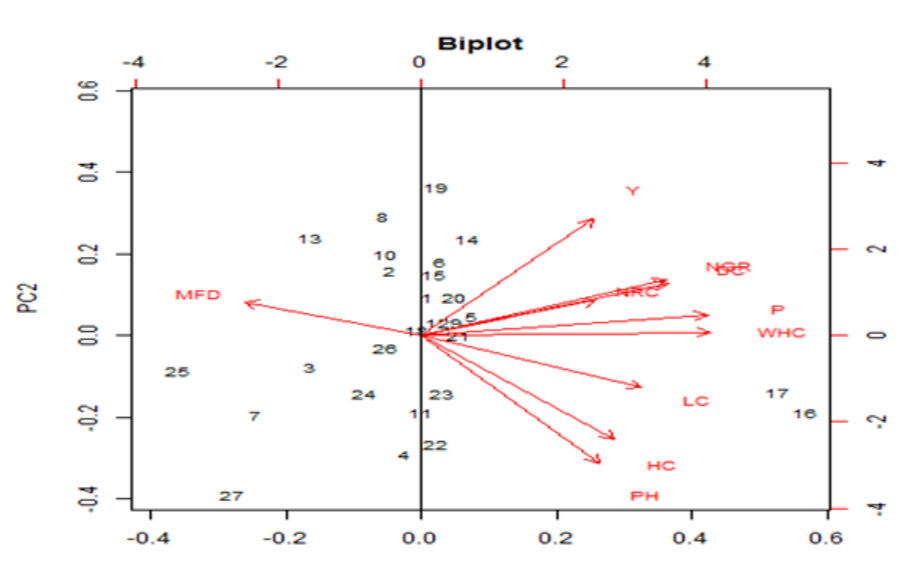
To simplify the many measurements, the researchers used Principal Component Analysis, or PCA. This statistical method groups related information so breeders can see which genotypes stand out without being overwhelmed by dozens of traits. The first two principal components captured 72% of the variation in the dataset, making the selection process clearer and more efficient.
Two maize lines emerged as the strongest candidates: JHD 14 and JHD 15. JHD 14 produced 9.04 tons per hectare, while JHD 15 reached 8.01 tons per hectare. They also recorded long cobs—21.30 cm and 20.14 cm, respectively—supporting the study’s conclusion that cob length is a useful indicator when searching for productive maize.
This research is closely connected to SDG 15: Life on Land. Protecting life on land also means safeguarding and using crop genetic diversity wisely. Diverse maize germplasm gives breeders more options to develop varieties that are productive, adaptable, and better prepared for changing environments. By identifying promising genetic resources instead of relying on a narrow genetic base, breeding programs can strengthen the long-term resilience of agriculture.
For the public, the message is simple: better harvests often begin long before seeds reach farmers. They begin with careful observation, genetic diversity, and scientific selection.
Sometimes, the future of food can be found in something as ordinary as the length of a maize cob.
Reference:
DOI: https://doi.org/10.54910/sabrao2025.57.5.3
Contact:
Prof. Muh Farid Bdr
+62 813-5504-1712
hortibb@trg.unhas.ac.id


