



MAKASSAR, Indonesia Aug 30 2026 /HORTICULTURAL BREEDING AND BIOTECHNOLOGY-RG/– Rice feeds a large part of the world, but climate change is making its future less predictable. In Indonesia, irregular rainfall can turn productive fields into environments that are suddenly too dry or too wet. Conventional rice varieties are often suited to one condition or the other, leaving farmers vulnerable when weather patterns shift within a single growing season.
But what if one rice variety could survive in both worlds?
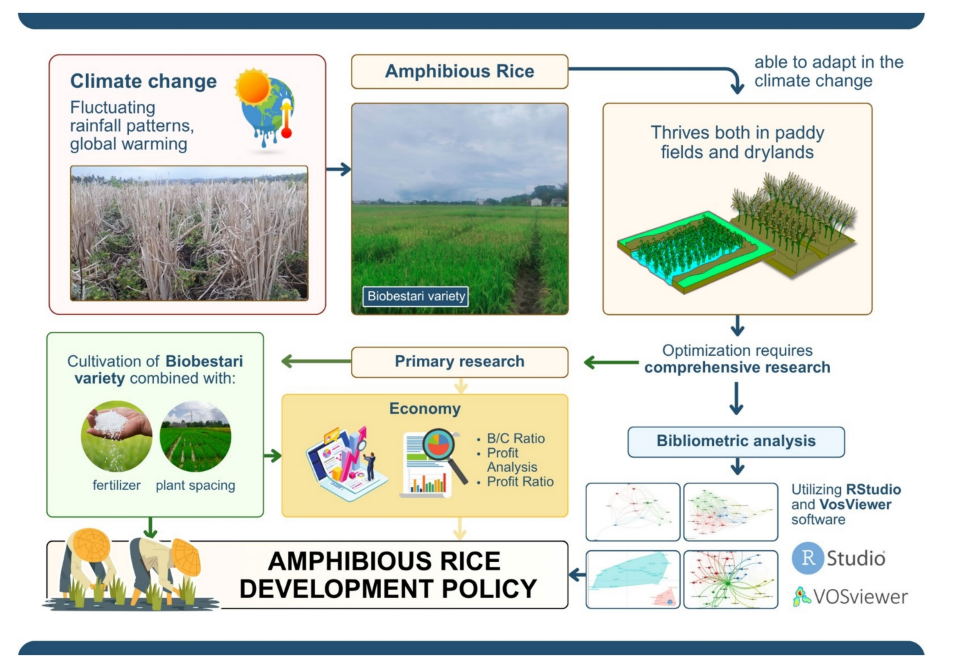
A recent study titled “Amphibious rice policy and development for climate adaptation effort in Indonesia: integrating bibliometric and field insights,” published in Frontiers in Sustainable Food Systems by Frontiers Media SA on September 22, 2025, explores this possibility. The study focuses on “amphibious rice,” a type of rice capable of adapting to both flooded paddy fields and drier upland conditions.
The researchers combined two approaches. First, they analyzed hundreds of scientific publications to map global research trends, collaborations, and key themes in amphibious rice development. Second, they conducted a field experiment on the Biobestari variety in Gowa, South Sulawesi, testing different planting arrangements and fertilizer packages.
The field results were encouraging. The most productive treatment combined double-row planting with a fertilizer package containing non-subsidized urea, trichocompost, and biofertilizer. This combination reached 8.05 tons per hectare. Economically, it also generated the highest net income and a profit ratio of 1.91. A similar fertilizer package without biofertilizer produced slightly lower returns but showed more stable results, which may be important for small farmers who cannot easily absorb production risks.
The idea behind amphibious rice is simple but powerful: instead of forcing farmers to predict whether a season will be wet or dry, develop rice that is better prepared for both. Its root system can adjust to changing water conditions, helping plants access oxygen, nutrients, and water during periods of flooding or water shortage.
This research also speaks directly to SDG 17: Partnerships for the Goals. Climate-resilient agriculture cannot be built by plant breeders alone. The bibliometric analysis showed that amphibious rice research already involves countries across Asia, the Americas, Europe, and Australia, but Indonesia still has relatively limited collaborative publication links. Stronger partnerships among universities, government agencies, research institutes, international organizations, extension services, and farmers could accelerate the development and adoption of climate-resilient rice.
The study therefore recommends more than a new variety. It calls for policy support, farmer-centered training, green technology incentives, and better access to sustainable agricultural inputs. These measures can help translate laboratory and field discoveries into real benefits for farming communities.
As rainfall becomes harder to predict, resilience may become one of agriculture’s most valuable traits. Amphibious rice offers a compelling example of how genetics, farming practices, economics, and collaboration can work together—helping farmers prepare not for one type of season, but for an uncertain climate.
Reference:
DOI: https://doi.org/10.3389/fsufs.2025.1648630
Contact:
Prof. Muh Farid Bdr
+62 813-5504-1712
hortibb@trg.unhas.ac.id


