



MAKASSAR, Indonesia Aug 30 2026 /HORTICULTURAL BREEDING AND BIOTECHNOLOGY-RG/– Maize is one of Indonesia’s most important crops, serving as food, animal feed, and an industrial raw material. Demand continues to increase, especially from the feed and processing sectors, which account for more than 80% of national maize use. Yet productivity remains difficult to improve in areas affected by poor soil fertility, irregular rainfall, and high temperatures. These challenges make the search for productive and resilient maize hybrids increasingly important.
But what if the future of a high-yielding maize hybrid could be predicted from the traits we can see and measure today?
A study titled “Morphophysiological evaluation of hybrid maize lines from peak and test crosses for high-yield development,” published in Biodiversitas by the Biology Department, Sebelas Maret University Surakarta on November 15, 2025, explored this question by combining plant breeding with morphological and physiological evaluation.
The researchers evaluated a broad group of maize materials, including hybrid lines, parental lines, and commercial checks. They measured traits such as plant height, cob size, number of seeds per row, cob weight, seed weight, leaf chlorophyll, and NDVI, a vegetation index used to assess plant vigor. These traits help breeders understand not only how much a plant produces, but also which characteristics contribute most strongly to yield.
The results identified several promising hybrids. G29 produced the highest yield at 8.7 tons per hectare, while G28 and G39 also performed better than their parental lines and commercial controls. These results demonstrate the potential of peak and test crossing strategies to create new genetic combinations with stronger productivity.
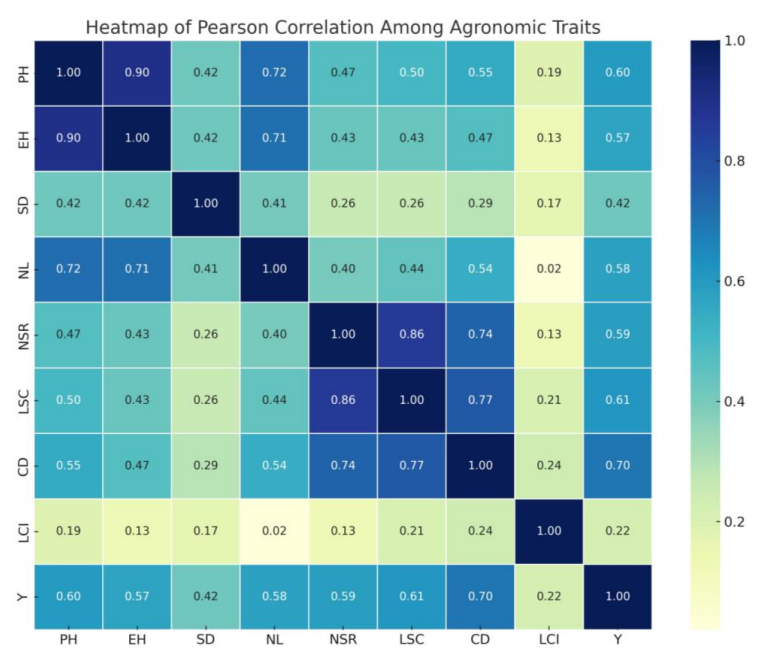
The study also found that cob weight, number of seeds per row, and plant height were particularly valuable for selection. These traits showed strong genetic control and meaningful relationships with yield. Cob-related characteristics were especially important because they directly reflected how effectively the plant converted growth into grain production.
This research is closely connected to SDG 15: Life on Land. Sustainable agriculture depends not only on protecting natural ecosystems, but also on improving how existing agricultural land is used. Developing maize hybrids that produce higher yields and tolerate environmental stress can help farmers obtain more from the same farmland while reducing pressure to expand cultivation into new areas.
The research is also relevant to smallholder farmers. Many farming communities cannot easily access expensive genomic technologies. Field-based selection using reliable morphological and physiological traits offers a practical pathway for developing improved maize varieties under resource-limited conditions.
For the public, the message is simple: better harvests begin long before the crop reaches the farm. They begin with careful selection of genes, traits, and parents.
Sometimes, the future of food can be found in something as simple as a heavier cob, more seeds, or a plant that remains productive when the environment becomes difficult.
Reference:
DOI: https://doi.org/10.13057/biodiv/d261034
Contact:
Prof. Muh Farid Bdr
+62 813-5504-1712
hortibb@trg.unhas.ac.id


