
In many coastal areas of Indonesia, life depends on the sea. Fishing, aquaculture, and small-scale trade shape daily survival. But behind this rich maritime life lies a quieter challenge: how villages are governed—and whether people truly have a voice in it.
A recent academic study sheds light on this issue, revealing that governance in coastal villages often falls short of expectations. While policies promise empowerment and autonomy, reality tells a more complicated story. Community participation remains limited, and accountability mechanisms are often weak. These gaps matter, because they directly affect how resources are distributed, how decisions are made, and ultimately, how people live.
The study found that village governments tend to focus more on administrative accountability—reporting to higher authorities—rather than public accountability, which involves being answerable to citizens. In practice, this means that while reports may look complete on paper, many villagers still feel excluded from decision-making processes.
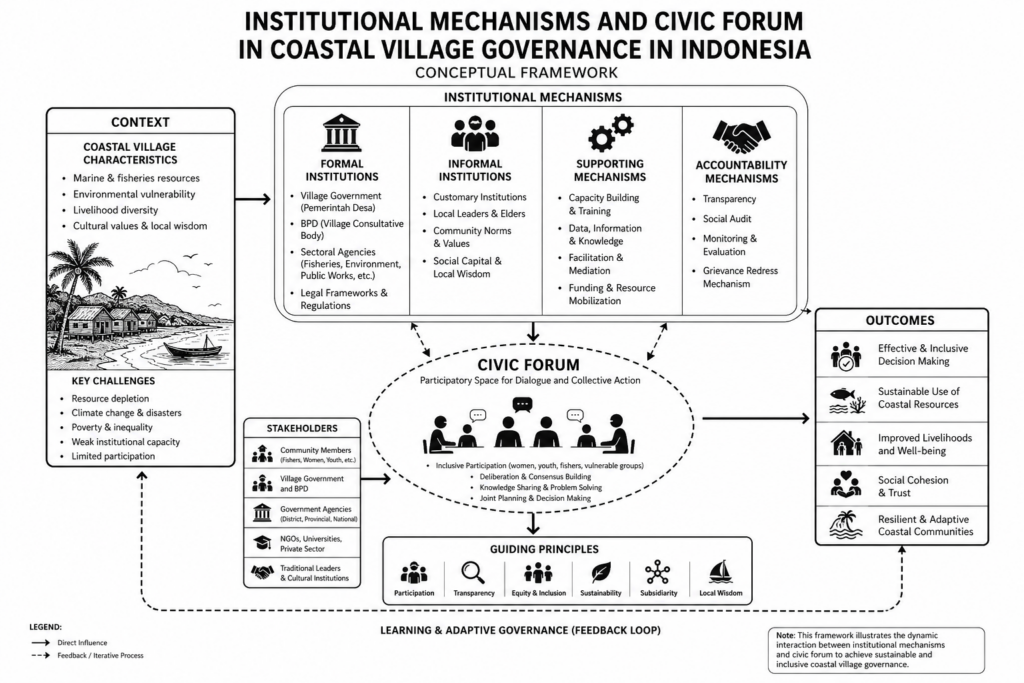
One striking example is the management of village funds. Although these funds are designed to improve welfare—such as supporting fishermen with boats or equipment—the distribution is not always fair or transparent. In some cases, access depends on personal connections rather than actual need. This creates inequality and weakens trust in local governance.
Another key issue is the role of community institutions. Ideally, bodies like village consultative councils should act as checks and balances. However, limited capacity and weak coordination often reduce their effectiveness. As a result, decision-making power becomes concentrated in the hands of village leaders.
This situation is closely linked to SDG 14: Life Below Water, which emphasizes sustainable use of marine resources. Coastal communities are at the frontline of this goal. Without inclusive and accountable governance, efforts to protect marine ecosystems and improve livelihoods may fail. Sustainable fisheries, for instance, require not only environmental awareness but also fair policies and active community participation.
The study also highlights the importance of “civic forums”—spaces where citizens can express their views. While such forums formally exist, participation is often superficial. Meetings may be held, but not all voices are heard, especially those of marginalized groups like small-scale fishers.
So, what can be done?
Improving governance in coastal villages is not just about increasing budgets. It requires strengthening institutions, enhancing transparency, and most importantly, ensuring that communities are genuinely involved. When people participate in planning, monitoring, and evaluating development programs, outcomes are more likely to be fair and effective.
At its core, this issue is about trust. When villagers trust their leaders—and feel heard—they are more willing to collaborate, innovate, and protect their environment. And in coastal areas, where livelihoods are deeply tied to nature, this trust becomes even more crucial.
This popular article is based on the study titled “Institutional Mechanisms and Civic Forum in Coastal Village Governance in Indonesia,” published in the journal Public Policy and Administration by Mykolo Romerio Universitetas on 15 October 2020.
Reference:
DOI: https://doi.org/10.5755/j01.ppaa.19.3.27832
Contact:
Prof. Nurlinah
+62 812-4249-867
nurlinah@unhas.ac.id
or
Muhammad Chaeroel Ansar
+62 852-4221-2842
mchaeroel@unhas.ac.id