

MAKASSAR, Indonesia Mar 11 2026/f-analysis/ – Have you ever wondered how we measure the “shape” of things we cannot see? In school, we learn to measure angles using plastic protractors on flat paper. However, as our modern world shifts into a landscape of massive data—ranging from predicting global stock market fluctuations to training complex artificial intelligence—the simple rulers of the past are no longer enough. To navigate these digital frontiers, we need a new kind of mathematical compass. A recent research paper by Muh Nur and his team provides exactly that: a sophisticated way to define geometry in the abstract world of infinite sequences.
Beyond the Physical World
Most of us are familiar with standard geometry, where we use an “inner product” to find the angle between two lines. This works perfectly for the three-dimensional world we inhabit. However, mathematicians and data scientists often work in more abstract environments known as p-summable sequences, or $l^p$ spaces. These spaces are essentially infinite lists of numbers used to model complex systems like signal processing, quantum physics, and even the behavior of neural networks.
The challenge is that in many of these $l^p$ spaces, the traditional “ruler” (the inner product) simply does not exist for certain values. For decades, this made it incredibly difficult to define what “perpendicular” or “angle” actually meant in these specific mathematical realms. Without these definitions, it is hard to calculate the most efficient path or relationship between different sets of data.
Introducing the Mathematical Compass
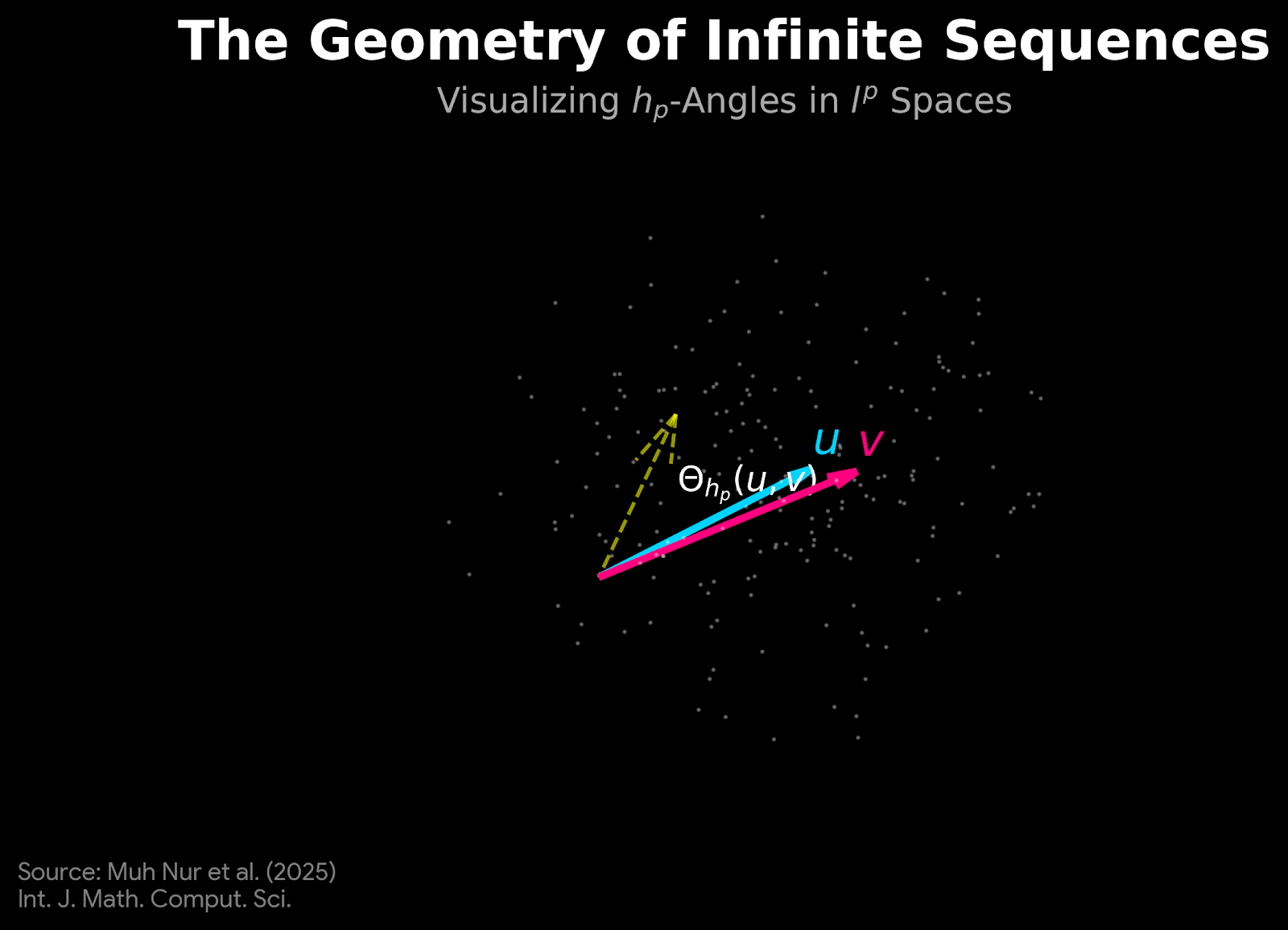
The breakthrough presented in this research involves a specialized tool called a 2-semi-inner product. Think of this as a high-tech navigation system designed for a world where a standard compass fails. By using this functional tool, the researchers successfully defined $h_p$-orthogonality—a way to determine if two complex sequences are perfectly “square” to each other—and the $h_p$-angle between them.
They didn’t stop at simple lines. The team formulated a precise method to measure the angle between two-dimensional surfaces, known as subspaces, that share a common edge. This level of precision allowed the researchers to prove that these sequence spaces are strictly convex. In simpler terms, they proved that these abstract spaces have a regular, “well-behaved” shape, which is essential for ensuring that complex calculations and optimizations are accurate and reliable.
A Foundation for Global Progress
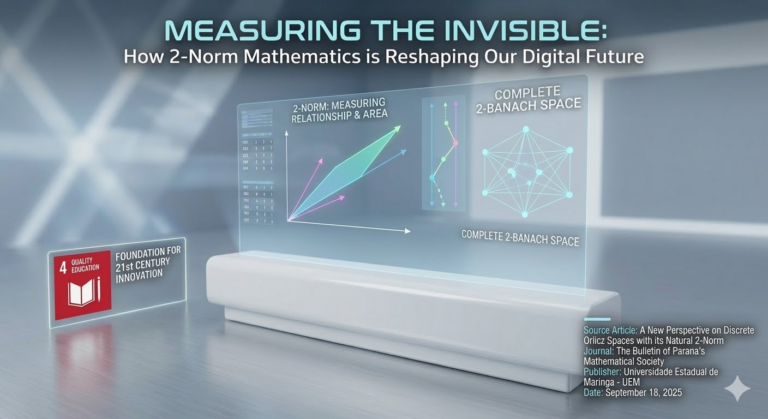
This research is far more than just abstract theory; it is a vital contribution to SDG 4 (Quality Education). By expanding the boundaries of functional analysis and advanced mathematics, this work ensures that the next generation of scientists, researchers, and engineers has access to the most advanced theoretical frameworks. High-quality tertiary education depends on such cutting-edge research to prepare students for the technical challenges of the future. By refining our “mathematical toolbelt,” this study ensures we are better equipped to solve the complexities of a data-driven society, fostering innovation that benefits us a
Reference
DOI:
https://doi.org/10.69793/ijmcs/02.2025/muh
Contact:
Dr. Muh. Nur, S.Si., M.Si
+6282187050898
muhammadnur@unhas.ac.id